All Astronauts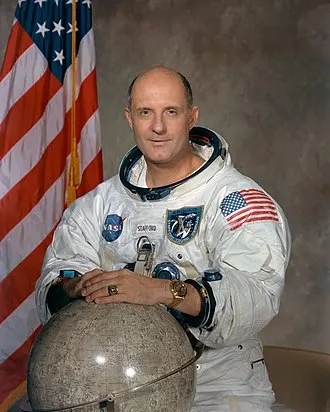 VETERANIn MemoriamNASA
VETERANIn MemoriamNASANASA·🇺🇸 United States·Born 1930
Tom Stafford
Flew the Apollo 10 dress rehearsal to within 15 km of the lunar surface and commanded the American side of the 1975 Apollo-Soyuz handshake in orbit.
507h
Hours in Space
4
Missions
0
EVAs
—
EVA Time
Inspirations
Biography
Flew the Apollo 10 dress rehearsal to within 15 km of the lunar surface and commanded the American side of the 1975 Apollo-Soyuz handshake in orbit. He died in 2024.
Before NASAU.S. Air Force fighter pilot and test pilot who graduated from the Naval Academy in 1952, flew F-86 Sabres on Arctic defense missions, finished first in his class at the Air Force Test Pilot School at Edwards AFB in 1958, and co-wrote the definitive USAF handbooks on performance flight testing.
Life & career
Thomas Patten Stafford was born on September 17, 1930, in Weatherford, Oklahoma, and rose to become one of the most accomplished pilots of the space age. He graduated from the U.S. Naval Academy in 1952 but chose a commission in the newly independent U.S. Air Force, flying F-86 Sabres on Arctic air-defense missions. In 1958 he finished first in his class at the Air Force Experimental Test Pilot School at Edwards Air Force Base and stayed on as an instructor, co-authoring USAF handbooks on performance flight testing that became standard texts. NASA selected him in September 1962 with the second astronaut group. Over a career that spanned the heart of the Space Race, Stafford flew four missions and, on the 1975 Apollo-Soyuz flight, became the first general officer to fly in space.
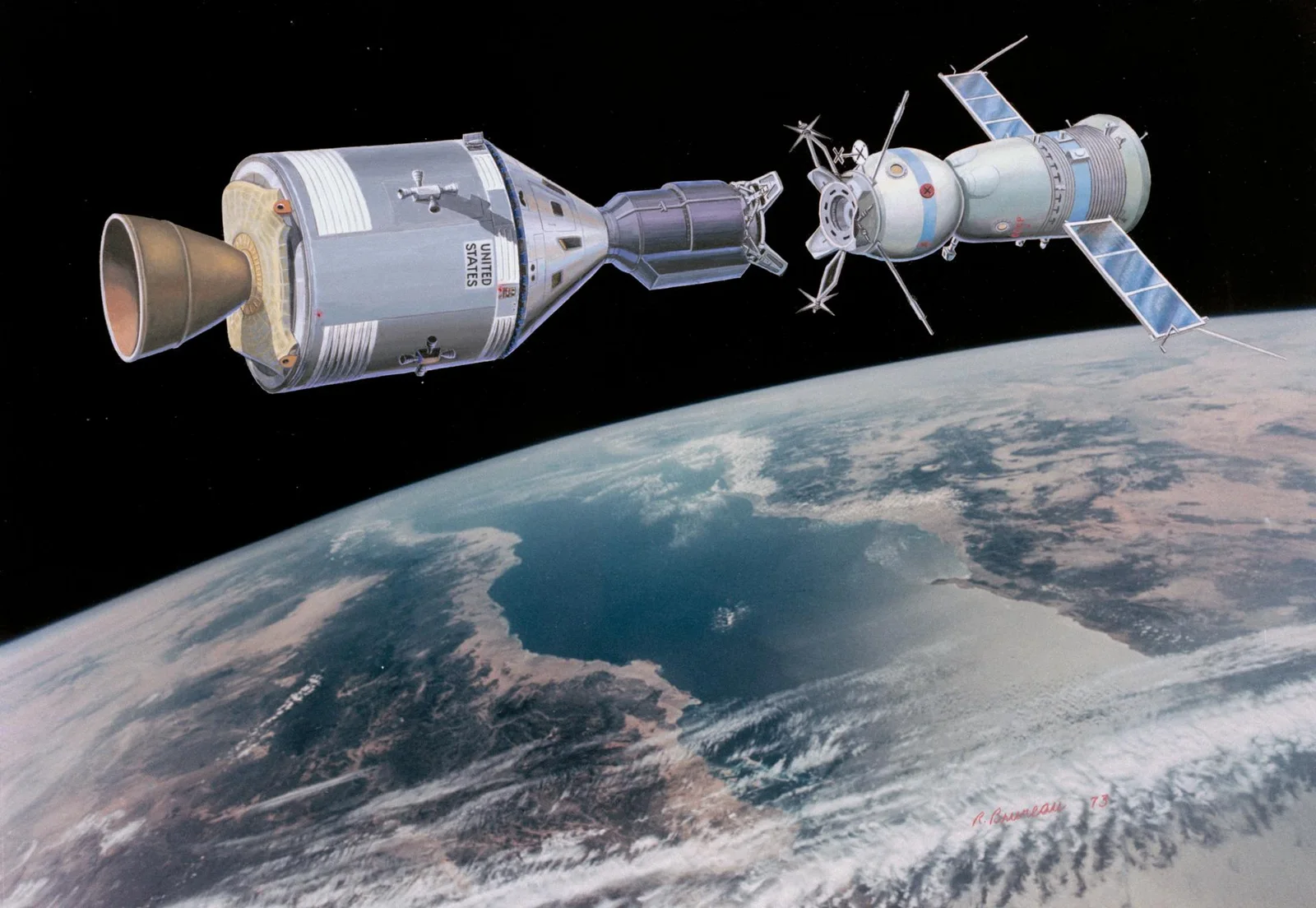
Stafford's four flights traced the arc of the era. On Gemini 6A, launched December 15, 1965, he and Wally Schirra achieved the first rendezvous of two crewed spacecraft, maneuvering within about a foot of Gemini 7—validating techniques Apollo would depend on. On Gemini 9A in June 1966 he commanded a demanding rendezvous test whose docking target was shrouded by a jammed panel he famously dubbed the 'angry alligator.' His third flight, Apollo 10 in May 1969, was the full dress rehearsal for the Moon landing: Stafford and Gene Cernan flew the Lunar Module 'Snoopy' to within about 15 kilometers (roughly eight nautical miles) of the lunar surface—everything but the landing itself. His final mission, the Apollo-Soyuz Test Project of July 1975, was history of a different kind. As commander of the American crew, Stafford docked with a Soviet Soyuz and, in orbit, exchanged a handshake with cosmonaut Alexei Leonov—a symbolic thaw between Cold War rivals. Stafford, who had learned Russian for the flight, formed a lifelong friendship with Leonov, who later became godfather to Stafford's children.
Stafford served as Chief of the Astronaut Office from 1969 to 1971 and continued to rise through the Air Force, retiring as a lieutenant general—a three-star officer. After leaving NASA he remained deeply involved in aerospace as a business leader and government adviser, later co-chairing the task group that oversaw the Space Shuttle's return to flight after the 2003 Columbia accident and chairing earlier panels on the future of human spaceflight. He logged 507 hours in space across his four missions. When Leonov died in 2019, Stafford delivered a eulogy in Russian, honoring the partnership that had turned adversaries into friends. Stafford died of liver cancer on March 18, 2024, at his home in Satellite Beach, Florida, at the age of 93, remembered as both a supremely capable pilot and, through Apollo-Soyuz, one of the Space Race's most enduring peacemakers.
Mission Timeline
- Pilot
Gemini spacecraft
Gemini 6A
Launch: Dec 15, 1965Landing: Dec 16, 1965Duration: 1 day- First space rendezvous, with Gemini 7
- Commander
Gemini spacecraft
Gemini 9A
Launch: Jun 3, 1966Landing: Jun 6, 1966Duration: 3 days- Rendezvous tests with the 'angry alligator' target vehicle
- Commander
Apollo CSM Charlie Brown / LM Snoopy
Apollo 10
Launch: May 18, 1969Landing: May 26, 1969Duration: 8 days- Flew the Lunar Module to within 15 km of the Moon's surface
- Commander
Apollo CSM
Apollo-Soyuz Test Project
Launch: Jul 15, 1975Landing: Jul 24, 1975Duration: 9 days- Historic orbital handshake with Alexei Leonov
Don't just read it — fly it
Relive Tom's missions
Step into the missions Tom Stafford flew — chapter by chapter, from ignition to splashdown.
Beyond the Mission
Hobbies & Interests
huntingfishingscuba divingglidingweight lifting
Languages
EnglishRussian
Fun fact
Stafford was the first general officer to fly in space, and he later delivered a eulogy in Russian at his friend Alexei Leonov's funeral in 2019 — a reflection of the bond forged during the 1975 Apollo-Soyuz mission, when Leonov served as godfather to Stafford's children.
More Astronauts
Other space travelers from NASA