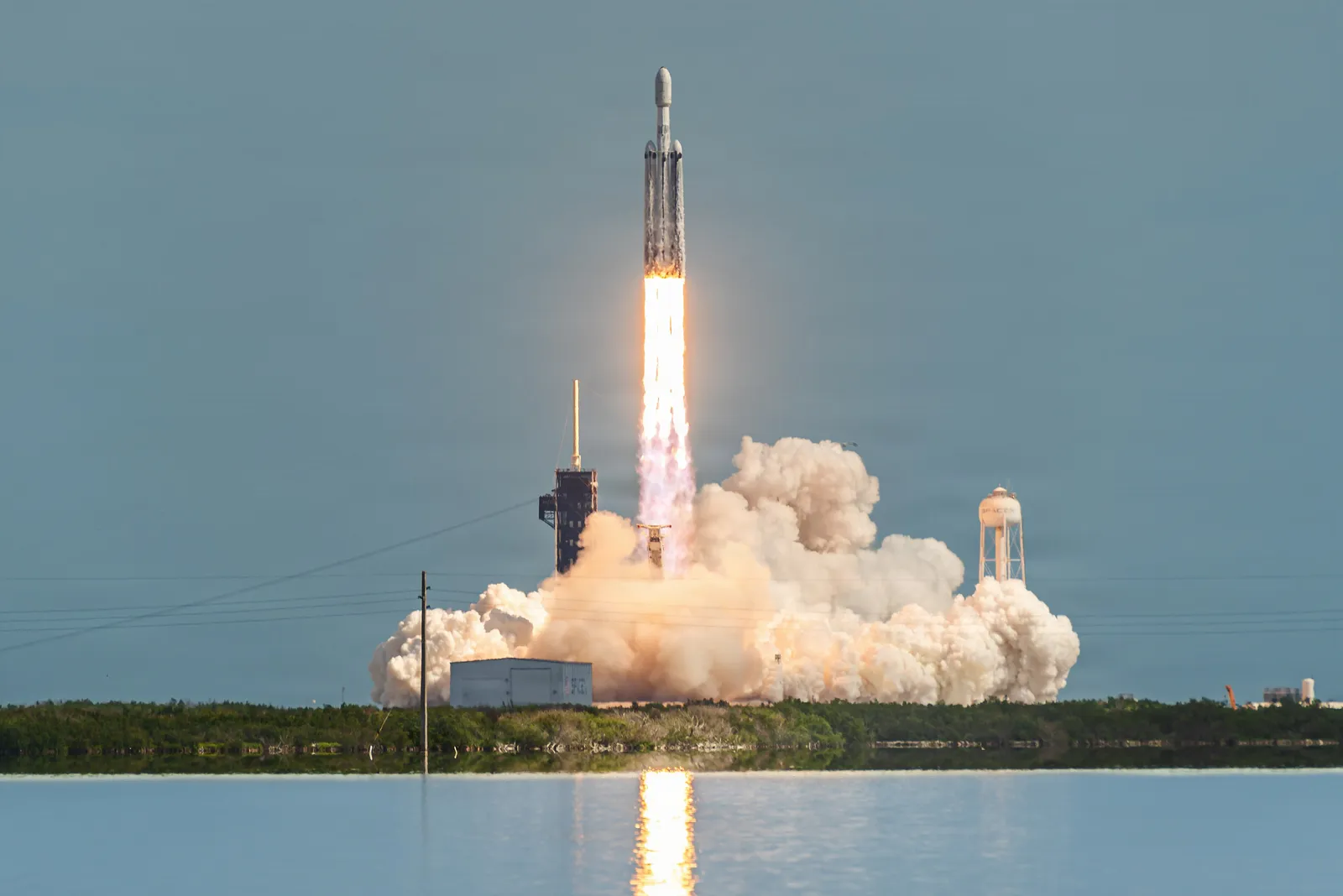
 U.S. Space Force / Gwendolyn Kurzen · public domain
Viasat Inc
Overview
Viasat is a global GEO broadband satellite operator with two reporting segments: Communication Services (~$3.30B FY2025) — in-flight connectivity for ~3,800 aircraft, maritime broadband, government broadband, and Inmarsat L-band safety-of-life services; and Defense & Advanced Technologies (~$1.22B FY2025, +7%) — high-assurance encryption, tactical SATCOM, and antenna systems for U.S. and allied militaries. The May 2023 Inmarsat acquisition ($7.3B) doubled revenue and added the only global L-band safety-of-life ELT/GMDSS franchise. ViaSat-3 F2 launched November 2025 and is entering service in early 2026, doubling capacity. Capital structure carries $7.2B debt — limiting flexibility versus better-capitalized LEO competitors.
Moat: Viasat's moat rests on three pillars: (1) Inmarsat L-band global safety-of-life services — the only commercial provider authorized for GMDSS maritime distress and aviation cockpit ATC; (2) #1 share in commercial in-flight broadband on widebody aircraft via long-term airline contracts; (3) Defense & Advanced Technologies segment provides high-assurance encryption (Type 1) and cyber capabilities that take a decade to certify. The principal moat erosion vector is Starlink LEO latency advantage on consumer airline broadband — Viasat is countering with ViaSat-3 capacity (~10× per satellite vs. ViaSat-2) and multi-orbit (LEO+GEO) hybrid offerings. Heavy debt ($7.2B) and slower share growth in IFC remain the financial overhang.
Business
Primary customers
- Commercial: Commercial airlines (Delta, JetBlue, United, ~3,800 aircraft)
- Defense: U.S. Department of Defense and allied militaries
- Commercial: Maritime fleet operators (Inmarsat heritage)
- Government: Government broadband customers
- Government: Aviation and maritime safety-of-life regulators (Inmarsat L-band)
Sectors
Satellite Broadband · In-Flight Connectivity · Maritime Comms · Defense Comms · L-band Safety-of-Life
Gallery
Key Products
- ViaSat-3 Constellation (F1, F2, F3)operational
Three Ka-band high-throughput GEO satellites; F1 Americas operational with reduced capacity (antenna deployment issue); F2 launched Nov 2025, entering service early 2026; F3 APAC scheduled 2026-27
First flight: 2023-04-30
- Inmarsat I-6 Constellationoperational
Dual-payload (Ka+L-band) satellites providing safety-of-life and broadband; I-6 F1 operational; I-6 F2 had power anomaly post-launch
- Inmarsat ELERA / GXoperational
Legacy Inmarsat L-band (ELERA) and Ka-band (Global Xpress) services; safety-of-life GMDSS / cockpit ATC franchise
- Defense & Advanced Technologies (DAT) productsoperational
High-assurance Type 1 encryption, tactical SATCOM, antenna systems, Link-16 connectivity, cyber defense for DoD/allies
Government Contracts
| Agency | Program | Amount | Year | Source |
|---|---|---|---|---|
| DoD / multiple agencies | Defense and Advanced Technologies — high-assurance encryption, antenna systems, cyber defense | $1.22B FY2025 segment revenue (+7% YoY) | 2025 | |
| U.S. Air Force | Tactical SATCOM, IRIS terminals, Link-16 connectivity | Multi-year IDIQs (cumulative >$1B) | 2024 |
Investor Resources
Primary-source documents — straight from Viasat Inc's investor relations and SEC filings.
Investor Presentations
Earnings Call Transcripts
Near-term Catalysts
- 2026-Q2
ViaSat-3 F2 entry into service after in-orbit testing
Doubles Ka-band capacity; restores broadband supply that was constrained by F1 anomaly; unlocks IFC and government broadband revenue growth
- 2026-2027
Multi-orbit (LEO+GEO) hybrid IFC offering go-live with airline partners
Addresses Starlink latency competition by combining ViaSat GEO capacity with partner LEO; protects ~3,800-aircraft IFC franchise
- 2026-Q4
Inmarsat integration synergies fully captured ($100M+ identified)
Cost synergies improve EBITDA margin and free cash flow — critical for servicing $7.2B debt
Top Risks
- $7.2B debt burden — limits financial flexibility, restricts capex for next-generation satellites, and amplifies any execution miss.
- Starlink LEO competition in commercial in-flight broadband — Starlink's lower latency is winning narrowbody airline RFPs; Viasat must execute multi-orbit hybrid quickly.
- ViaSat-3 F1 partial impairment ($905M FY2024) demonstrates technical risk on satellite reflector deployment; F3 APAC launch is the next binary technical event.
- GEO broadband margin compression — Starlink and Amazon Kuiper drive long-term price competition; safety-of-life L-band remains the most defensible revenue line.
Recent Milestones
- 2023-05-30
Closed $7.3B acquisition of Inmarsat — doubled revenue, added global L-band safety-of-life franchise, brought $7.2B combined debt load
- 2025-05-20
FY2025 results: $4.52B revenue (+6%); Communication Services ~$3.30B; Defense & Advanced Technologies $1.22B (+7%); operating loss reduced 89% to -$97.5M
- 2025-11-14
ViaSat-3 F2 successfully launched on ULA Atlas V from Cape Canaveral; entering service in early 2026 after in-orbit testing — doubles Ka-band capacity
From Management
Recent interviews and talks from Viasat Inc's leadership — hear the strategy in their own words.
What investors should know
Q1What does Viasat do?⌄
Q2How does Viasat generate revenue?⌄
Q3Who are Viasat's primary customers?⌄
Q4What is Viasat's competitive moat?⌄
Q5What are the top risks for Viasat investors?⌄
Q6What near-term catalysts could move Viasat stock?⌄
Q7How does Viasat compare to Iridium Communications?⌄
Peers
Compare side-by-side →Sources & References
Investor Relations
- Viasat — Q4 FY2025 Earnings Results · 2025-05-20
- Viasat — Q2 FY2026 Shareholder Letter · 2025-11-06
- Viasat Investor Relations · 2026-05-08
Press Release
- Viasat — Confirms Successful Launch of ViaSat-3 F2 · 2025-11-14
Trade Press
- San Diego Business Journal — Viasat's FY2025 Rakes in $4.5B · 2025-06-15(archived)