"Wie het kleine niet eert, is het grote niet weerd." (He who does not honor the small is not worthy of the great.)
— Dutch proverb
There is a stretch of North Sea coastline in South Holland, about 35 kilometers southwest of Amsterdam, where the dunes give way to a sprawling technical campus that most Europeans have never heard of. Behind the security gates, inside clean rooms and vibration chambers and the largest thermal vacuum facility in Europe, engineers from across the continent design, build, and test the spacecraft that carry European ambitions into orbit and beyond.
This is ESTEC — the European Space Research and Technology Centre — and it sits in the seaside town of Noordwijk, in the Netherlands. It is the single largest establishment of the European Space Agency. Every major European space mission of the past half-century has passed through its doors. And it is just the beginning of the Dutch story in space. 🇳🇱
When people list the world's space powers, the conversation moves predictably through the United States, Russia, China, India, Japan, and perhaps France or Germany. The Netherlands almost never enters the frame. This is a remarkable oversight. The Dutch host the technical headquarters of European spaceflight. Dutch factories build the solar arrays that power satellites from low Earth orbit to deep space. Dutch scientific institutes have contributed instruments to missions that have reshaped our understanding of the universe, from X-ray astronomy to infrared cosmology. Dutch companies lead the global market in cubesat deployment hardware. And a Dutch astronaut became one of Europe's most beloved ambassadors for human spaceflight.
The Netherlands is not a country that shouts about its achievements. It never has been. But in the quiet, methodical, pragmatic manner that defines the Dutch national character — the same character that reclaimed a third of the country from the sea and built a global trading empire from a river delta — it has made itself indispensable to European space.
This is the story of how a small, flat country became Europe's hidden space powerhouse.
Why the Netherlands Matters: The Numbers Behind the Quiet Giant
Before we explore the institutions and companies individually, it is worth understanding the scale of the Dutch space enterprise.
The Netherlands' space sector generates approximately €1.9 billion in production value and €1 billion in added value annually. More than 10,500 highly skilled professionals work across a growing ecosystem of over 150 companies, research institutes, and startups. The Dutch government has committed €453 million to ESA programs for the 2026-2028 period, with total national space spending reaching approximately €550 million over the same three years — a significant increase that reflects growing recognition of space as a strategic priority.
For a country of just 17.9 million people, these figures are extraordinary. On a per-capita basis, the Netherlands is one of the most space-invested nations in Europe. And unlike many countries where space spending is distributed across a vast territory, Dutch space activity is remarkably concentrated: the corridor from Noordwijk through Leiden and Delft to The Hague contains one of the densest clusters of space expertise anywhere in the world.
In 2024, the Netherlands published its first comprehensive national space strategy, outlining six priority missions spanning security, climate, economic growth, and responsible space governance. And in March 2026, the Netherlands Space Office (NSO) was officially transformed into the Netherlands Space Agency (NLSA) — a name change that reflects the country's growing ambition and the expanding scope of its space activities.
The foundation of all of this, however, begins in Noordwijk.
ESTEC: The Engine Room of European Space
Origins on the Dunes
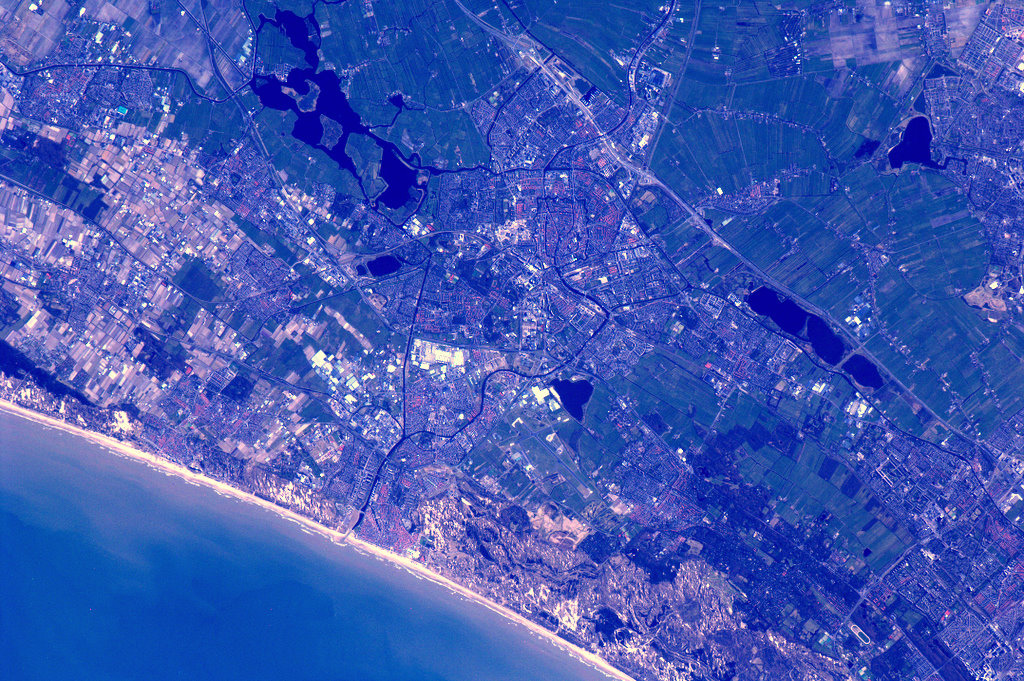
In the early 1960s, when the nations of Western Europe began pooling their space research efforts under the European Space Research Organisation (ESRO, the predecessor to ESA), they needed a central technical facility — a place where spacecraft could be designed, built, and tested under one roof. The initial plan was to locate this facility in Delft, near the Technical University that was already hosting early ESRO personnel. But Delft presented problems: land was scarce, labor was in short supply, and the site was waterlogged, offering less than ideal stability for the precision testing equipment that would be installed.
In the spring of 1964, the Dutch government proposed an alternative: Noordwijk, a coastal town roughly 40 kilometers from Amsterdam. The sandy soil of the dune landscape was ideal for the sensitive testing operations the center would require. Land was available. And the Dutch government was prepared to make a generous offer to secure the facility.
Construction began, and on April 3, 1968, ESTEC was officially inaugurated. It has been the technical heart of European space ever since.
What Happens at ESTEC
ESTEC is not an administrative headquarters — that role belongs to ESA's Paris office. ESTEC is where the engineering happens. Approximately 2,500 ESA staff — engineers, scientists, and technicians — work at ESTEC, making it by far the largest of ESA's establishments worldwide. This figure does not include the hundreds of additional contractors and industry personnel who are on-site at any given time supporting specific programs.
The center's activities span the entire lifecycle of a space mission:
Mission design and systems engineering. ESTEC houses the Concurrent Design Facility (CDF), where multidisciplinary teams can assess the feasibility of new mission concepts in a matter of weeks. Early-phase studies for missions ranging from Earth observation satellites to deep-space probes begin here.
Technology development. Before a new material, component, or subsystem can fly in space, it must be validated. ESTEC operates laboratories covering everything from electrical power systems to thermal control, from propulsion to materials science. The center also manages ESA's Technology Development Element, which funds the maturation of new space technologies across European industry.
Spacecraft testing. This is where ESTEC truly distinguishes itself. The center hosts the largest spacecraft test facility in Europe and one of the largest in the world. Prior to launch, virtually every European spacecraft undergoes some form of testing at ESTEC.
The Test Centre: Where Missions Are Proven
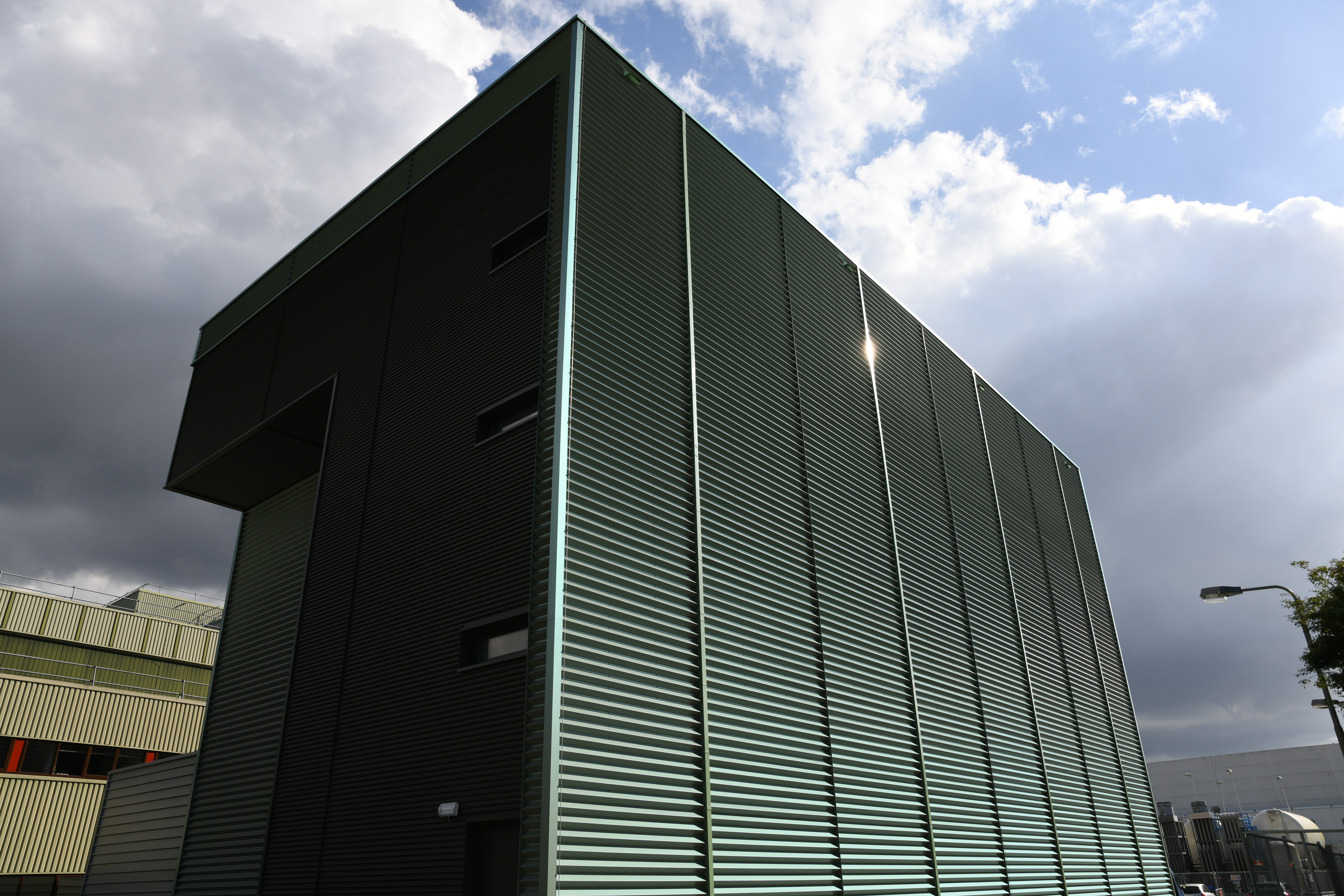
The ESTEC Test Centre is an extraordinary facility. It houses a suite of equipment designed to subject spacecraft to every condition they will face in orbit and beyond:
The Large Space Simulator (LSS) is the centerpiece — the largest thermal vacuum chamber in Europe. Standing over 15 meters tall, the LSS can reproduce the vacuum and temperature extremes of space while simultaneously illuminating the test article with a powerful Sun simulator using up to 19 IMAX cinema-class xenon light bulbs. Liquid and gaseous nitrogen shrouds line the chamber walls, replicating the deep chill of the space environment. Satellites for missions including Rosetta, JUICE (Jupiter Icy Moons Explorer), and PLATO have been tested in the LSS.
Acoustic test facilities blast spacecraft with sound pressures exceeding 154 decibels — louder than a jet engine at close range — to simulate the punishing noise environment of launch. The LEAF (Large European Acoustic Facility) uses a wall of acoustic horns powered by nitrogen to achieve these levels.
Multi-axis vibration tables (including the QUAD shaker) subject spacecraft to the mechanical vibrations of launch, ensuring structural integrity under dynamic loads.
Electromagnetic compatibility (EMC) test chambers verify that a satellite's electronic systems will not interfere with each other or with external signals once in orbit.
The ESA Propulsion Laboratory (EPL) tests thrusters and propulsion systems in vacuum conditions, validating the engines that will maneuver spacecraft in orbit.
The philosophy is straightforward but uncompromising: no European spacecraft should face conditions in orbit that it has not already survived on the ground. ESTEC's test center is the crucible through which that guarantee is forged.
The Erasmus Centre and Human Spaceflight Operations
ESTEC is also home to the Erasmus Centre, which plays a critical role in European human spaceflight and International Space Station operations. The Erasmus Payload Operations Centre (EPOC) is responsible for coordinating European experiments on the ISS, particularly those conducted in the Columbus laboratory module. The Dutch User Support and Operations Centre (USOC), staffed by specialists from the National Aerospace Laboratory (NLR), operates from within the Erasmus Centre, serving as a direct link between scientists on the ground and experiments running in orbit 400 kilometers above.
The Erasmus Space Exhibition Centre, also located at ESTEC, opens its doors to the public and has become the Netherlands' premier destination for space education and outreach — a visible reminder that the work happening behind ESTEC's gates ultimately belongs to all of Europe.
NL Space Campus: The Innovation Ecosystem Next Door
Adjacent to ESTEC, the NL Space Campus has emerged as a thriving innovation hub. In October 2025, the campus celebrated a major milestone with the opening of CometLab — a new facility designed to bring together companies, researchers, engineers, and students to accelerate space technology innovation. The ESA Business Incubation Centre (BIC) Noordwijk, co-funded by ESA and Dutch regional authorities, has helped over 100 startups transform space technology into commercial products over the past 20 years. Companies including Stellar Space Industries, Dunedain Space, and Soilspect now call the campus home.
The proximity of NL Space Campus to ESTEC is not accidental. It creates a feedback loop: the technical knowledge generated inside ESA's largest facility flows outward to startups and SMEs, while the commercial innovation happening next door feeds new ideas and technologies back into ESA programs. It is a model that other European space hubs aspire to replicate.
The Netherlands Space Agency: From NSO to NLSA

A Quiet Coordinator Finds Its Voice
The Dutch government's role in space has historically been coordinated through the Netherlands Space Office (NSO), which served as the national body responsible for developing and executing Dutch space policy, managing the country's ESA subscriptions, and supporting the national space industry.
The NSO's approach reflected the Dutch temperament: pragmatic, efficient, focused on maximizing the return on every euro invested. Rather than pursuing flagship national missions or building indigenous launch vehicles — as France has done with Ariane — the Netherlands concentrated its space spending on areas where it could achieve disproportionate impact: Earth observation, satellite communications, scientific instruments, and technology development.
This strategy has been remarkably effective. Dutch instruments fly on missions from virtually every major space agency. Dutch companies have carved out globally dominant positions in specific niches. And Dutch scientists punch far above their weight in space research publications and citations.
The Transformation to NLSA
On March 3, 2026, at the Amsterdam Space Symposium, the Netherlands Space Office was officially transformed into the Netherlands Space Agency (NLSA). The change was more than cosmetic. It reflected the government's recognition that space had grown from a niche scientific endeavor into a strategic domain affecting national security, economic competitiveness, climate monitoring, and digital infrastructure.
The NLSA carries forward the NSO's mandate while operating with a stronger international profile and expanded scope. Its priorities for the 2026-2028 period include:
- €40-50 million for ESA Earth Observation programs, reflecting the Netherlands' acute interest in sea-level monitoring, land-use mapping, and climate science — natural priorities for a country where roughly a third of the land lies below sea level
- €40-45 million for ESA launcher programs, ensuring Dutch industry retains a role in European launch vehicle development
- €25-30 million for ESA technology programs, feeding the Dutch innovation pipeline
- Continued investment in scientific instruments through the Space Instruments Programme
The NLSA also plays a growing role in space security and defense, an area that has gained urgency across Europe in recent years. In December 2024, the Dutch Ministry of Defence signed a framework agreement with ISISpace to develop and launch a series of military small satellites — a clear signal that the Netherlands views space as a domain with both civilian and defense implications.
André Kuipers: A Nation's Astronaut
From Amsterdam to the International Space Station
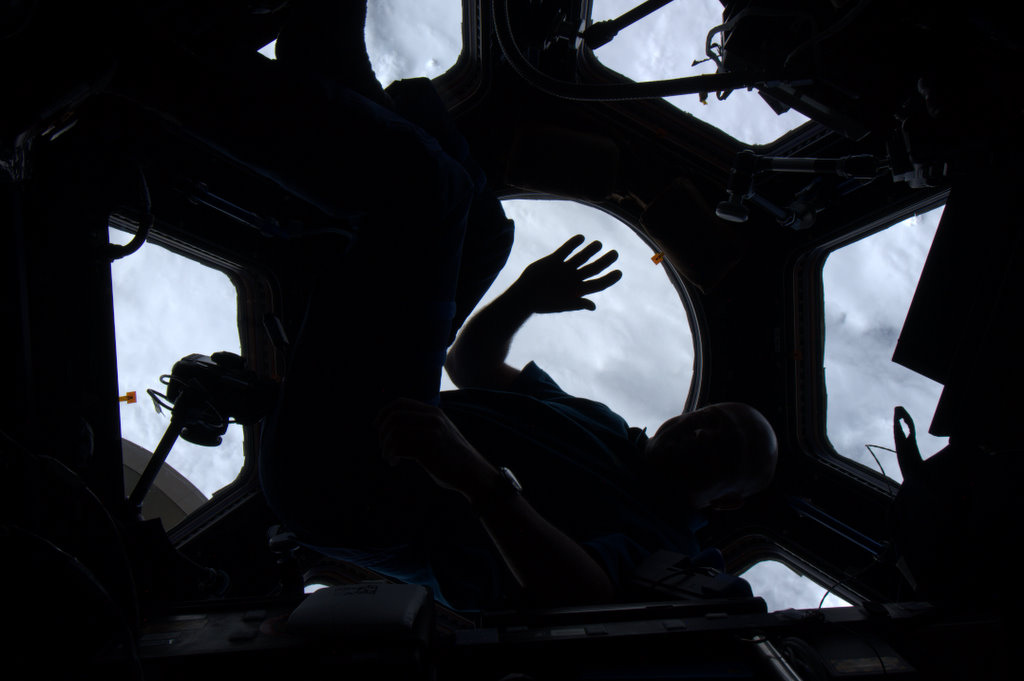
Every space-faring nation needs heroes — individuals who embody the ambition and possibility of spaceflight in a way that statistics and policy documents cannot. For the Netherlands, that hero is André Kuipers.
Born on October 5, 1958, in Amsterdam, Kuipers trained as a physician and vestibular researcher before being selected by ESA as an astronaut candidate. He was not the first Dutch person in space — that distinction belongs to Wubbo Ockels, who flew aboard the Space Shuttle Challenger in October 1985 on the Spacelab D-1 mission, becoming the first Dutch citizen to travel to space. But Kuipers would become the first Dutchman to fly twice, and his long-duration stay aboard the ISS made him a household name across the Netherlands and beyond.
The DELTA Mission (2004)
Kuipers' first spaceflight was the DELTA mission (Dutch Expedition for Life Science, Technology and Atmospheric Research), launched on April 19, 2004, from Baikonur Cosmodrome aboard a Soyuz TMA-4. The 11-day mission was sponsored by the Dutch government through an agreement between ESA and the Russian Federal Space Agency.
DELTA had three objectives: exchange the Soyuz spacecraft that serves as the ISS's emergency lifeboat, rotate a portion of the station crew, and conduct a program of scientific experiments. Kuipers performed 21 experiments during his time aboard, spanning human physiology, biology, physical sciences, and technology demonstration. He also conducted educational activities, connecting with Dutch schools from orbit.
The mission was a success, and Kuipers returned to Earth on April 30, 2004 — landing in the Kazakh steppe after 11 days in space.
The PromISSe Mission (2011-2012)
Seven years later, Kuipers returned to space for an assignment of far greater scale. In August 2009, he was assigned to Expeditions 30 and 31 aboard the ISS, in a long-duration mission named PromISSe — an acronym for Programme for Research in Orbit Maximising the Inspiration from the Space Station for Europe.
On December 21, 2011, Kuipers launched from Baikonur aboard Soyuz TMA-03M alongside Russian cosmonaut Oleg Kononenko and NASA astronaut Don Pettit. He would not return to Earth until July 1, 2012 — a stay of 193 days that gave him extensive time to conduct a comprehensive research program.
During PromISSe, Kuipers was trained on approximately 35 ESA experiments and participated in more than 20 additional experiments for NASA and JAXA, utilizing nearly 30 different research facilities across the ISS laboratories. The breadth of his research was remarkable:
- The SOLO experiment — Kuipers followed a strictly controlled low-sodium diet to investigate why astronauts lose bone density in microgravity. The findings had direct implications for understanding osteoporosis on Earth.
- Neurospat — Using a network of 64 electrodes placed on his head, Kuipers participated in experiments measuring how the brain processes spatial information in weightlessness, with applications for understanding vestibular disorders.
- ROALD-2 — A biology experiment studying the behavior of human immune cells in microgravity, addressing the known phenomenon of astronauts' immune systems functioning less effectively in space. Immune cells from Earth-based volunteers were chemically frozen at specific intervals for comparison.
- DSC (Diffusion and Soret Coefficient) — Conducted in the European-built Microgravity Science Glovebox, this experiment examined temperature-driven changes in fluid mixtures, with practical applications for improving computer models used in oil extraction.
In total, André Kuipers spent 204 days in space across his two missions — 11 days on DELTA and 193 days on PromISSe.
Legacy Beyond Orbit
Kuipers' impact on Dutch space culture extends far beyond his mission data. He became one of Europe's most effective science communicators, sharing stunning photographs of Earth from the ISS, engaging with millions of students, and advocating tirelessly for European investment in space. In a country where space had traditionally been viewed as something that happened elsewhere — in Florida, or Baikonur, or Kourou — Kuipers demonstrated that space could belong to the Netherlands too.
His predecessor Wubbo Ockels, who passed away in 2014, had planted the first seed. Kuipers nurtured it into a full-grown tree. The increased Dutch investment in ESA, the growth of the national space ecosystem, and the transformation of the NSO into the NLSA all owe something to the public enthusiasm that Kuipers helped cultivate.
Airbus Defence & Space Netherlands: Powering Europe's Satellites
From Fokker to the Stars
The story of the Netherlands' largest space company begins not with satellites but with aircraft. In the 1960s, the legendary Dutch aviation manufacturer Fokker — founded by Anthony Fokker in 1912 and once the largest aircraft company in the world — began diversifying into space. The reasoning was sound: the lightweight-yet-robust engineering principles that Fokker had developed for aircraft could be adapted for the extreme demands of spaceflight.
Fokker's space division cut its teeth on the ANS (Astronomical Netherlands Satellite), launched in 1974, and the IRAS (Infrared Astronomical Satellite), launched in 1983. Both were pioneering scientific missions, and both required Fokker's engineers to develop new capabilities in attitude and orbit control, thermal control systems, electrical systems, and systems engineering. In parallel, during the 1970s, Fokker's space department initiated the development of solar arrays — a technology that would define the company's future.
The space division evolved through several name changes: it became Fokker Space in the 1990s, then Dutch Space in 2002, before being acquired by EADS Astrium in 2006. In 2014, the company was renamed Airbus Defence and Space Netherlands B.V., and in 2023, it became simply Airbus Netherlands B.V. Throughout these transitions, the technical expertise and product lines remained rooted in the same Leiden facility where Fokker engineers had first turned their attention skyward.
Sparkwing and Solar Array Dominance
Today, Airbus Netherlands operates from its facility at Mendelweg 30, Leiden, and its primary claim to fame is the Sparkwing solar array. Sparkwing is the world's first commercially available, off-the-shelf solar array for small satellites, developed by Airbus Netherlands with support from the Netherlands Space Office and ESA.
Optimized for Low Earth Orbit missions requiring power levels between 100W and 2,000W, Sparkwing arrays are built on a dedicated production line at Airbus' high-capacity manufacturing facility in Leiden. The product line has achieved significant commercial success:
- In September 2024, MDA Space of Canada selected Airbus Netherlands to supply over 200 Sparkwing solar array wings for MDA's AURORA satellite product line — a major international commercial win for Dutch space industry.
- Sparkwing has also been adopted by Aerospacelab of Belgium for its serial satellite production lines.
But Airbus Netherlands' heritage extends far beyond small-satellite solar arrays. The Leiden facility has built solar arrays and structures for some of Europe's most important space missions:
- Rosetta — The comet-chasing spacecraft that made history by landing the Philae probe on Comet 67P/Churyumov-Gerasimenko in 2014
- MetOp — Europe's polar-orbiting meteorological satellite series
- Galileo — Europe's global navigation satellite constellation
- Orion — The European Service Module for NASA's Artemis program, carrying astronauts back to the Moon
The company also has deep expertise in launcher structures, having contributed to the Ariane 5 and Vega launch vehicles, and in thermal and mechanical products for a wide range of satellite platforms.
With over 30 years of solar array development behind it, Airbus Netherlands has established itself as Europe's largest supplier of satellite solar arrays — a position that traces directly back to Fokker's decision, more than 50 years ago, to look beyond aircraft toward the stars.
Dutch Scientific Instruments: SRON and the Leiden Observatory
SRON: The Netherlands Institute for Space Research

If ESTEC is the engine room of European space and Airbus Netherlands is the factory floor, then SRON (Space Research Organisation Netherlands, officially the Netherlands Institute for Space Research) is the country's scientific soul.
SRON is the Dutch national institute for space research, focusing on three core domains: astrophysics, Earth observation, and exoplanetary research. Based in Leiden and Utrecht, SRON designs and builds the instruments that allow telescopes and satellites to see what the human eye cannot — X-rays from colliding galaxies, infrared whispers from the births of stars, the spectral signatures of alien atmospheres.
The institute's contributions to major space missions read like a highlight reel of European and international space science:
IRAS (1983) — The Infrared Astronomical Satellite, a joint project of the Netherlands, the United States, and the United Kingdom. IRAS was the first space telescope to perform a survey of the entire sky at infrared wavelengths, detecting approximately 350,000 infrared sources and transforming our understanding of the dusty universe. Dutch involvement in IRAS was foundational — the satellite was built in the Netherlands, and SRON's predecessor organizations played central roles in its instrument development.
ISO (1995-1998) — The Infrared Space Observatory, an ESA mission, carried Dutch-built instruments that continued the legacy of IRAS with far greater sensitivity and spectral resolution.
Herschel (2009-2013) — ESA's Herschel Space Observatory was the largest infrared telescope ever launched. SRON led the construction of the HIFI instrument (Heterodyne Instrument for the Far Infrared), one of Herschel's three science instruments. HIFI provided the highest spectral resolution available on the observatory, enabling groundbreaking studies of the chemistry of star-forming regions and the interstellar medium.
XMM-Newton (1999-present) — ESA's premier X-ray space observatory. SRON served as the Principal Investigator institute for the Reflection Grating Spectrometers (RGS), overseeing the development and construction of these instruments in collaboration with institutions across Europe and the United States. SRON built the two X-ray detector cameras for the RGS. Now celebrating over 25 years in orbit, XMM-Newton continues to make discoveries, and SRON continues to support its operations.
BeppoSAX (1996-2002) and Chandra — SRON contributed components and scientific expertise to these X-ray observatories, further establishing the Netherlands' position in high-energy astrophysics.
Future missions — SRON is the co-PI for the X-IFU instrument (X-ray Integral Field Unit) on ESA's Athena X-ray observatory, one of the most ambitious future European space science missions. SRON's hardware contributions include the focal plane assembly and its cold electronics, built around revolutionary Transition Edge Sensors (TES) — ultra-sensitive detectors that can measure the energy of individual X-ray photons with extraordinary precision.
SRON is also contributing to PLATO (exoplanet detection), ARIEL (exoplanet atmosphere characterization), and LISA (gravitational wave detection) — ensuring that Dutch scientific instruments will be at the frontier of space science for decades to come.
Leiden Observatory: 393 Years and Counting
The Netherlands' astronomical heritage predates the space age by centuries. Leiden Observatory, established in 1633 at Leiden University, is the oldest operating university observatory in the world. It was founded to house the quadrant of Willebrord Snellius, and over the nearly four centuries since, it has been home to some of the most influential astronomers in history.
Willem de Sitter worked at Leiden with Albert Einstein on the implications of general relativity for cosmology. Ejnar Hertzsprung developed the Hertzsprung-Russell diagram while at Leiden, a fundamental tool for understanding stellar evolution. Jan Oort — perhaps Leiden's most famous director — proposed the existence of the Oort Cloud, the vast reservoir of comets at the outer reaches of the solar system, and made pioneering observations of the structure of the Milky Way using radio astronomy.
Today, Leiden Observatory is one of the world's leading centers for research in exoplanets, galaxy formation, and computational astrophysics. Its proximity to SRON and ESTEC creates a natural pipeline from fundamental astronomical research to the design of space instruments and missions — a pipeline that has been producing world-class science for generations.
The old observatory building in central Leiden, constructed in 1860 in the university's botanical garden, was restored between 2008 and 2012. It now serves as a visitor center and public engagement facility — a bridge between the Netherlands' deep astronomical past and its spacefaring present.
The Dutch Space Ecosystem: Small Country, Outsized Impact
ISISpace: The World's CubeSat Deployer

One of the most remarkable stories in the Dutch space ecosystem begins not in a corporate boardroom but in a university laboratory. In 2004, students at Delft University of Technology (TU Delft) began developing Delfi-C3, a triple-unit CubeSat that would become the first nanosatellite from the Netherlands. The project's success inspired several students to consider whether the technologies and skills they were developing could form the basis of a commercial venture.
In 2006, a group of these students founded Innovative Solutions In Space (ISISpace) as a spin-off from TU Delft. Their initial focus was on CubeSat deployers — the mechanical systems that hold small satellites during launch and release them into orbit at the correct moment.
Two decades later, ISISpace has become the world leader in CubeSat deployment hardware. The company's product line includes:
- QuadPack — The world's most flown CubeSat launch adapter, with over 250 units delivered and a 100% success rate. QuadPack deploys CubeSats with release velocities under 1.8 m/s, providing a gentle and precise insertion into orbit.
- DuoPack — A lightweight, compact deployer designed for CubeSats up to 6UXL.
- ISIPOD — A versatile deployer line accommodating CubeSats and nanosatellites from 1U to 16U.
These deployers have flight heritage on an extraordinary range of launch vehicles, including India's PSLV, Northrop Grumman's Antares, ESA's Vega and Vega-C, United Launch Alliance's Atlas V, Orbital ATK's Minotaur, and SpaceX's Falcon 9. When a CubeSat reaches orbit — regardless of which rocket carried it — there is a significant probability that Dutch hardware opened the door.
ISISpace has expanded well beyond deployers. The company now offers complete CubeSat platforms and end-to-end mission services, from design through launch to operations. In December 2024, the Dutch Ministry of Defence signed a framework agreement with ISISpace to develop and launch a series of military small satellites — a watershed moment that demonstrated how a university spin-off could evolve into a company trusted with national security applications.
Hyperion Technologies (AAC Hyperion)
Another Delft success story, Hyperion Technologies was founded in 2013 and quickly established itself as a specialist in miniaturized, high-performance components for nanosatellites. The company developed one of the world's smallest star trackers — the sensors that spacecraft use to determine their orientation by comparing observed star patterns against a catalog.
Hyperion's product range expanded to include attitude determination and control systems (ADCS), navigation components, payload processing units, chemical propulsion modules, and laser communications solutions. A notable achievement came in 2020, when Hyperion and Dawn Aerospace launched the first ECSS-compliant 3D-printed bi-propellant propulsion system ever to reach space — a 1U CubeSat propulsion module that demonstrated cutting-edge manufacturing techniques in the harshest environment imaginable.
Hyperion was acquired by AAC Clyde Space of Sweden and now operates as AAC Hyperion, retaining its Delft base and continuing to supply components to customers ranging from the Canadian Space Agency and ESA to D-Orbit and universities worldwide.
TU Delft: The University That Seeds an Industry
The role of Delft University of Technology in the Dutch space ecosystem cannot be overstated. Its Faculty of Aerospace Engineering is one of Europe's premier aerospace programs, and it has directly or indirectly spawned a constellation of space companies, research programs, and technical capabilities.
The Delfi satellite program, which began in 2004, has given successive generations of master's students the opportunity to design, build, and operate real spacecraft. Delfi-C3, launched in 2009, demonstrated thin-film solar cells, autonomous wireless sun sensors, and amateur radio transponders — and remained operational for years beyond its design life. Subsequent Delfi missions have continued to push the boundaries of nanosatellite capability.
The Delft Aerospace Rocket Engineering (DARE) group, one of Europe's largest student rocketry programs, provides hands-on experience in propulsion and launch vehicle design. Multiple Dutch space startups trace their founding teams back to DARE and the broader TU Delft aerospace ecosystem.
In 2016, TU Delft expanded its horizons further, entering the field of PocketQubes — satellites with body dimensions of approximately 5 cm per unit — pushing satellite miniaturization even further. The university's willingness to explore the frontier of what is technically possible, combined with its tradition of translating academic research into commercial ventures, makes it one of the most productive university-to-industry pipelines in global space.
The Broader Ecosystem
Beyond these headline names, the Dutch space directory lists over 150 companies and organizations active in the sector. Key players include:
- NLR (Royal Netherlands Aerospace Centre) — The national aerospace laboratory, which provides testing, simulation, and research services for both aviation and space applications
- TNO (Netherlands Organisation for Applied Scientific Research) — Contributes optical, sensor, and materials technology to space programs
- Dawn Aerospace — A New Zealand/Netherlands company developing reusable suborbital vehicles and green propulsion systems from its Delft base
- Stellar Space Industries and Dunedain Space — NL Space Campus-based startups developing next-generation space technologies
The ESA Business Incubation Centre in Noordwijk has graduated over 100 startups in 20 years, many of which continue to operate and grow within the Dutch space ecosystem. Combined with initiatives like OneSpaceHub (launched in 2024 to connect space entrepreneurs with investors) and the newly opened CometLab, the Netherlands has built a support infrastructure for space innovation that rivals countries with far larger space budgets.
The Wubbo Ockels Legacy: Before Kuipers, There Was the Pioneer
No account of the Netherlands in space is complete without acknowledging the man who went first. Wubbo Ockels (1946-2014) studied physics and mathematics at the University of Groningen, earning his doctorate in 1978. That same year, ESA selected him as one of three candidates for Space Shuttle missions involving Spacelab, ESA's crewed research module.
On October 30, 1985, Ockels flew aboard the Space Shuttle Challenger on the STS-61A Spacelab D-1 mission — a German-led research flight. Over the course of the mission, Ockels traveled 2.5 million miles in 110 Earth orbits, logging over 168 hours in space. He became the first Dutch citizen to fly in space (though he was preceded by Dutch-born, naturalized American Lodewijk van den Berg, who had flown on STS-51-B earlier that year).
After his spaceflight, Ockels dedicated himself to sustainability and education. In 1992, he began teaching at TU Delft, and in 2003, he became a full professor of aerospace for sustainable engineering and technology. He championed the idea that the perspective gained from viewing Earth from space — the so-called "overview effect" — should inform how humanity approaches environmental challenges. His passion for sustainability and his infectious enthusiasm for exploration made him a beloved figure in the Netherlands until his passing in May 2014.
Ockels laid the groundwork. Kuipers built upon it. Together, they gave the Netherlands two generations of astronaut heroes who inspired a nation to look upward.
Future Outlook: Europe's Silent Space Anchor
The Netherlands faces the future from a position of quiet strength. Its space sector is growing, its government commitment is increasing, and its institutional advantages — ESTEC, SRON, Airbus Netherlands, TU Delft, ISISpace — show no signs of eroding. If anything, global trends are amplifying Dutch relevance.
The rise of small satellites plays directly to Dutch strengths. ISISpace's deployers and platforms, Airbus Netherlands' Sparkwing solar arrays, AAC Hyperion's miniaturized components — all are products of an ecosystem optimized for the new space economy, where constellations of smaller, cheaper, faster-built satellites are replacing the monolithic spacecraft of previous decades.
Earth observation and climate monitoring are existential priorities for a country that has spent centuries managing its relationship with the sea. The Netherlands' heavy investment in ESA Earth Observation programs is not abstract policy — it is survival strategy. Dutch expertise in processing and interpreting satellite data for water management, agriculture, and urban planning is among the most advanced in the world.
European strategic autonomy in space — a concept that has gained urgency in the wake of geopolitical disruptions — enhances the value of every node in the European space infrastructure. As long as ESTEC remains the technical heart of ESA, the Netherlands will hold a structural advantage that no amount of budget shifting can replicate. The testing, design, and engineering capabilities concentrated in Noordwijk are irreplaceable.
Defense and security space is an emerging domain where the Netherlands is positioning itself carefully. The December 2024 agreement with ISISpace for military small satellites signals a new chapter in Dutch space activity — one where national security considerations drive investment alongside scientific and commercial goals.
And the transformation of the NSO into the NLSA reflects a maturation of Dutch space ambition. The Netherlands is no longer content to be a quiet participant in European space. It is asserting itself — carefully, methodically, in the Dutch way — as a space nation in its own right.
Conclusion: The Seafarers' Descendants
There is a deep continuity in Dutch history that connects the Golden Age merchants who sent ships to every corner of the globe with the engineers who test spacecraft in Noordwijk today. Both traditions share a common DNA: the pragmatic conviction that a small nation, properly organized and strategically positioned, can project its capabilities far beyond what its size would suggest.
The Dutch did not build the world's largest navy. They built the most efficient trading network. They did not conquer the most territory. They mastered the art of commerce, finance, and logistics. They did not try to do everything. They chose what to do and did it exceptionally well.
The same philosophy animates the Netherlands' approach to space. The Dutch do not build rockets. They do not operate a national space station. They do not pursue prestige missions for their own sake. Instead, they host the facility where all of Europe's spacecraft are proven. They build the solar arrays that power those spacecraft. They construct the instruments that give those spacecraft the ability to see. They manufacture the deployers that release the world's small satellites. And they do all of this from a country roughly the size of Maryland.
Wie het kleine niet eert, is het grote niet weerd. He who does not honor the small is not worthy of the great.
The Netherlands has honored the small — the precision instrument, the reliable component, the niche technology done to perfection — and in doing so, it has earned something far greater: an indispensable role at the heart of European space.
The seafarers' descendants are still exploring. They have simply exchanged the horizon of the ocean for the horizon of the cosmos. And from Noordwijk, Leiden, and Delft, they continue to look outward — as they always have. 🇳🇱
This article is part of SpaceOdysseyHub's series of national space program deep dives, exploring the institutions, companies, and people that drive spaceflight around the world.