Extreme-class world
51 Pegasi
First exoplanet ever found around a sun-like star (1995, Nobel Prize 2019).
- Planets
- 1
- Distance
- 50.4 ly
- Host
- G-type
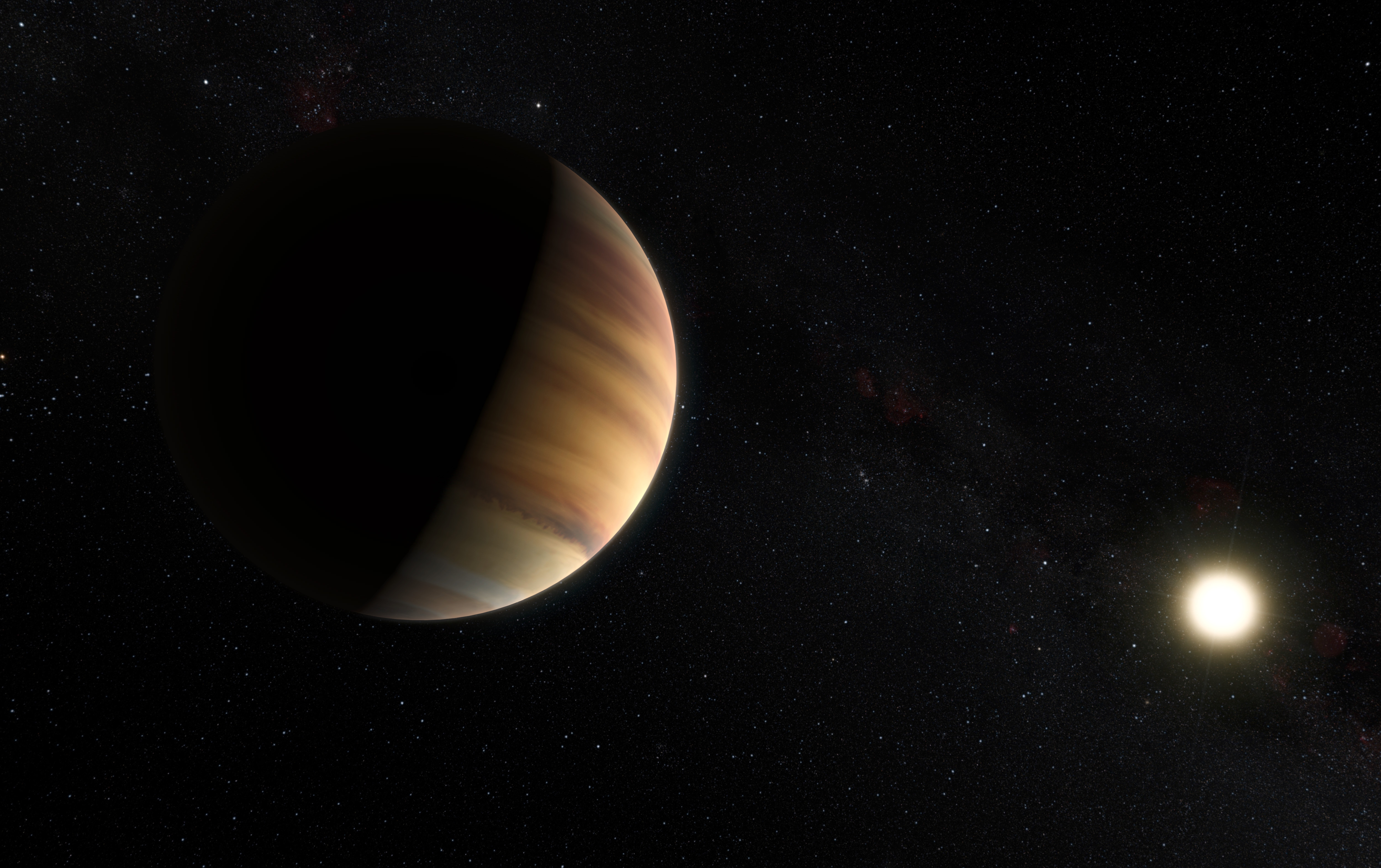
About 51 Pegasi
Discovery
Announced in October 1995 by Michel Mayor and Didier Queloz of the Geneva Observatory using radial-velocity measurements at Haute-Provence, 51 Pegasi b was the first confirmed planet around a Sun-like star — a discovery that earned the 2019 Nobel Prize in Physics.
Why it matters
51 Peg b shattered the assumption that planetary systems would look like ours: a Jupiter-mass world on a 4-day orbit, vastly closer to its star than any planet in the Solar System. It launched the entire field of exoplanet science.
Current research
More than a quarter-century on, 51 Peg b is still used as a benchmark for spectroscopy techniques and as a test case for understanding hot-Jupiter migration histories.
Comparable to
A Jupiter twin — roughly half Jupiter's mass — but orbiting where Mercury would melt, in 4.2 days instead of 88.
System geometry
At a glance
- Hostname
- 51 Peg
- Spectral type
- G5V
- Distance
- 50.4 ly · 15.46 pc
- Stellar mass
- 1.03 M☉
- Stellar radius
- 1.18 R☉
- Luminosity
- 1.369 L☉
- Effective temp
- 5758 K
- Confirmed planets
- 1
- Habitable zone
- 1.111 – 1.603 AU
Top-down orbital diagram
Orbits to scale within this system. Dashed green = habitable-zone edges.
Planet positions are illustrative (evenly spaced in phase). For live motion see the 3D scene.
The planets
1 confirmed.
Gas giant
51 Peg b
- Orbit
- 0.053 AU
- Period
- 4.23 days
- Radius
- 14.30 R⊕
- Mass
- 146.20 M⊕
- Eq. temperature
- —
- Eccentricity
- 0.013
- Discovered
- 1995 · Radial Velocity
Compared to our Solar System
Each row shows the closest Solar-System analog by radius (log-space). Earth is pinned at the bottom as the constant frame of reference.
| Planet | Radius (R⊕) | Mass (M⊕) | Orbit (AU) | Period (days) | Eq temp (K) | Solar analog |
|---|---|---|---|---|---|---|
| 51 Peg b | 14.30 | 146.20 | 0.053 | 4.23 | — | Jupiter |
| Earth (reference) | 1.00 | 1.00 | 1.000 | 365.25 | 255 | — |
Research status
◇ JWST observation status
No JWST programs are currently targeting planets in this system. The system may be observed in future cycles or by upcoming missions (Ariel, HWO, Roman).
Discovery timeline
- 1995
51 Peg b
via Radial Velocity
If you liked this
Other systems in the same theme:
HD 209458
1 planets · 157.5 ly · G0 V
First exoplanet seen transiting its star (1999) — atmospheric studies pioneer.
WASP-12
1 planets · 1393.5 ly · G2V
A hot Jupiter being literally devoured by its star — losing 6×10⁹ tonnes/sec.
KELT-9
1 planets · 666.8 ly · B9.5-A0
The hottest known exoplanet — daytime hotter than most stars (4,600 K).
Experience it
See 51 Pegasi in interactive 3D
Fly through the system, click any planet, watch orbits play out at 100× speed.
▶ Launch 3D scene