Multi-planet system
HR 8799
Four giant planets directly imaged at infrared — orbiting a young A-type star.
- Planets
- 4
- Distance
- 134.5 ly
- Host
- A-type
About HR 8799
Discovery
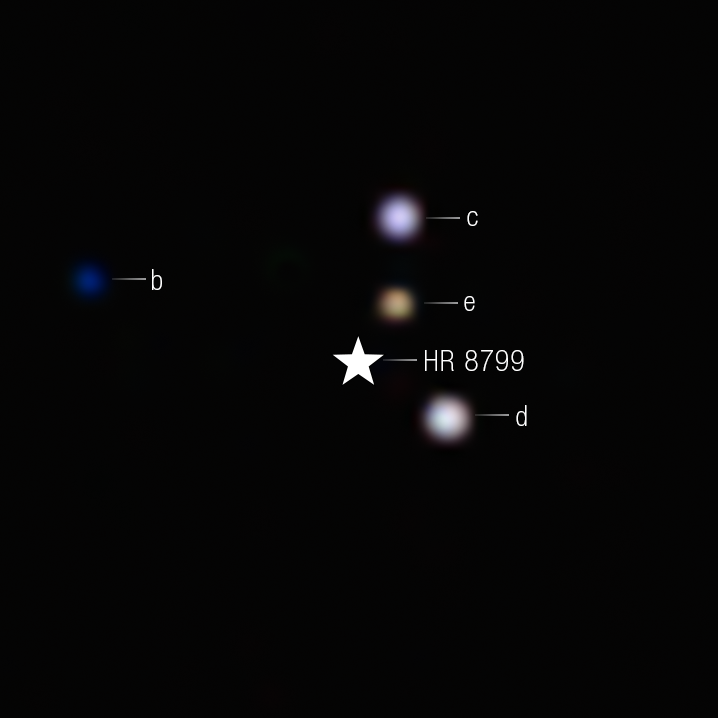
Three planets around HR 8799 were directly imaged in 2008 by Christian Marois and colleagues using Keck and Gemini adaptive optics; a fourth innermost planet was added in 2010 — the first multi-planet system ever directly photographed.
Why it matters
HR 8799 is the showcase system for direct imaging: four young, hot Jupiters orbit at wide separations around an A5V star, and as juvenile worlds they are still glowing in the infrared from formation heat.
Current research
JWST's MIRI coronagraph imaged the inner dust belt and all four planets in 2024, refining their masses and atmospheric chemistry; high-contrast spectroscopy on 30-m-class telescopes is the next frontier.
Comparable to
Like seeing our own Solar System's outer planets from 130 light-years away — four giant worlds caught in family portrait.
System geometry
At a glance
- Hostname
- HR 8799
- Spectral type
- A5
- Distance
- 134.5 ly · 41.24 pc
- Stellar mass
- 1.51 M☉
- Stellar radius
- 1.49 R☉
- Luminosity
- 5.413 L☉
- Effective temp
- 7400 K
- Confirmed planets
- 4
- Habitable zone
- 2.210 – 3.188 AU
Top-down orbital diagram
Orbits to scale within this system. Dashed green = habitable-zone edges.
Planet positions are illustrative (evenly spaced in phase). For live motion see the 3D scene.
The planets
4 confirmed.
Gas giant
HR 8799 e
- Orbit
- 16.400 AU
- Period
- 57.0 years
- Radius
- 13.11 R⊕
- Mass
- 3178.30 M⊕
- Eq. temperature
- 1150 K
- Eccentricity
- 0.150
- Discovered
- 2010 · Imaging
Gas giant
HR 8799 d
- Orbit
- 24.000 AU
- Period
- 101.3 years
- Radius
- 13.00 R⊕
- Mass
- 3000.00 M⊕
- Eq. temperature
- 1300 K
- Eccentricity
- 0.600
- Discovered
- 2008 · Imaging
Gas giant
HR 8799 c
- Orbit
- 38.000 AU
- Period
- 188.9 years
- Radius
- 13.00 R⊕
- Mass
- 3000.00 M⊕
- Eq. temperature
- 1200 K
- Eccentricity
- 0.500
- Discovered
- 2008 · Imaging
Gas giant
HR 8799 b
- Orbit
- 68.000 AU
- Period
- 465.4 years
- Radius
- 13.00 R⊕
- Mass
- 2000.00 M⊕
- Eq. temperature
- 1200 K
- Eccentricity
- 0.000
- Discovered
- 2008 · Imaging
Compared to our Solar System
Each row shows the closest Solar-System analog by radius (log-space). Earth is pinned at the bottom as the constant frame of reference.
| Planet | Radius (R⊕) | Mass (M⊕) | Orbit (AU) | Period (days) | Eq temp (K) | Solar analog |
|---|---|---|---|---|---|---|
| HR 8799 e | 13.11 | 3178.30 | 16.400 | 20815.60 | 1150 | Jupiter |
| HR 8799 d | 13.00 | 3000.00 | 24.000 | 37000.00 | 1300 | Jupiter |
| HR 8799 c | 13.00 | 3000.00 | 38.000 | 69000.00 | 1200 | Jupiter |
| HR 8799 b | 13.00 | 2000.00 | 68.000 | 170000.00 | 1200 | Jupiter |
| Earth (reference) | 1.00 | 1.00 | 1.000 | 365.25 | 255 | — |
Research status
◇ JWST observation status
4 planets have confirmed JWST observation time across Cycles 1–3.
- HR 8799 e
- HR 8799 d
- HR 8799 c
- HR 8799 b
JWST programs include transit spectroscopy, thermal phase curves, and direct imaging coronagraph observations depending on planet class.
Discovery timeline
- 2008
3 planets: d, c, b
via Imaging
- 2010
HR 8799 e
via Imaging
If you liked this
Other systems in the same theme:
Kepler-90
8 planets · 2766.6 ly · G2V
Eight known planets — first system to tie our solar system's count.
TOI-178
6 planets · 204.5 ly · K
Six planets in a precise resonance chain — orbital ratios like a cosmic clock.
Kepler-11
6 planets · 2108.1 ly · G2V
Six tightly packed planets — all closer to their star than Mercury is to ours.
Experience it
See HR 8799 in interactive 3D
Fly through the system, click any planet, watch orbits play out at 100× speed.
▶ Launch 3D scene