🇩🇪 "Wer nicht wagt, der nicht gewinnt." "He who does not dare, does not win." — German proverb, invoked by Alexander Gerst before his second ISS mission
In November 2025, ministers from twenty-three European nations gathered in Bremen — a Hanseatic port city where ships once carried wool and grain across the North Sea — to decide the future of the European Space Agency. When the pledges were tallied, Germany had committed €5.4 billion, the single largest contribution by any nation, accounting for roughly 23 percent of ESA's record €22.3 billion budget for 2026-2028. It was not close. France pledged €3.6 billion. Italy followed at €3.46 billion. Germany, for the second consecutive ministerial cycle, was the indispensable nation of European space.
That headline figure tells only part of the story. Germany also operates one of the world's most capable aerospace research organizations, the DLR, with more than 10,000 employees spread across 55 institutes. It runs the Columbus Control Center that manages Europe's laboratory on the International Space Station. It has produced astronauts who commanded the ISS and cosmonauts who flew aboard Soviet capsules before the Berlin Wall fell. And in the last five years, it has incubated two serious orbital launch vehicle startups — Isar Aerospace and Rocket Factory Augsburg — that are attempting to give Europe something it has desperately lacked: responsive, commercially priced, privately built access to space.
This is Part 1 of a two-part deep dive into Germany's space program. It traces the arc from the V-2 rockets of Peenemünde through the founding of DLR, Germany's role as ESA's anchor investor, its astronaut legacy from Sigmund Jähn to Alexander Gerst, and the NewSpace companies now racing toward orbit. Part 2 will examine Germany's satellite manufacturing industry — OHB, Airbus Defence and Space's German operations, Mynaric's laser communications terminals — and Germany's role in Galileo, Copernicus, LISA, and the defense space buildup that is reshaping European priorities.
The Shadow of Peenemünde: Germany's Complicated Rocket Heritage
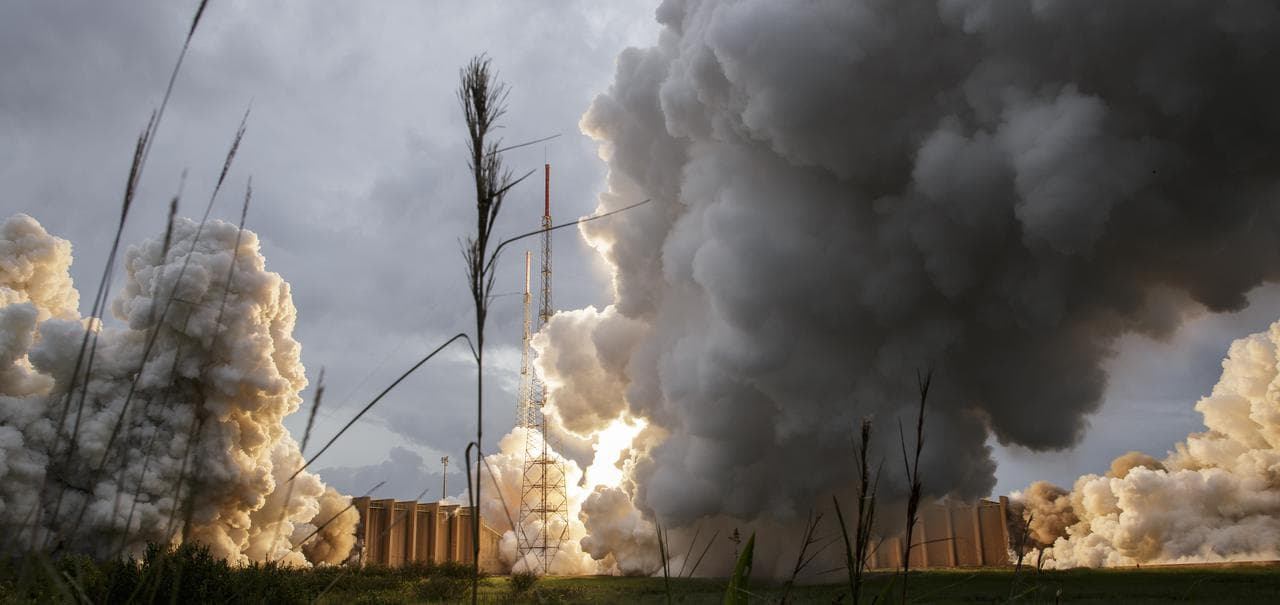
Every history of the German space program must begin in a place that most Germans would rather not discuss. Peenemünde, on the Baltic island of Usedom, was where the modern liquid-fueled rocket was transformed from a laboratory curiosity into a weapon of mass destruction — and, eventually, into the technology that carried human beings to the Moon.
The Army Research Center Peenemünde was established in 1937 under the direction of Walter Dornberger and his young technical chief, Wernher von Braun, then twenty-five years old. The site was chosen for its remoteness, its proximity to the sea for overwater testing, and its distance from prying eyes. Over the next seven years, a team of several thousand engineers — supplemented, critically, by forced laborers — developed the Aggregat 4, known to history as the V-2: a 14-meter, 12,500-kilogram liquid-oxygen and ethanol-fueled ballistic missile capable of carrying a 1,000-kilogram warhead to a range of roughly 320 kilometers. On October 3, 1942, a V-2 became the first human-made object to reach the boundary of space, climbing to an altitude of approximately 84 kilometers during a test flight.
The V-2 was a genuine engineering marvel. It was also built on human suffering. After Allied bombing raids damaged Peenemünde in August 1943, production was moved underground to the Mittelwerk factory complex in the Harz Mountains, where the rockets were assembled by prisoners from the Mittelbau-Dora concentration camp. An estimated 20,000 forced laborers died in the tunnels — more people than were killed by the approximately 3,000 V-2s that struck London, Antwerp, and other Allied targets beginning in September 1944. Wernher von Braun, who held the rank of SS-Sturmbannführer, was personally aware of the conditions. He visited Mittelwerk. He knew.
This is the foundational tension of the German space story: the technology that would eventually carry Apollo astronauts to the Moon was forged in a slave labor camp. Von Braun and roughly 1,600 German scientists and engineers surrendered to American forces in May 1945 and were brought to the United States under Operation Paperclip, where they formed the nucleus of the U.S. Army's rocket program at Fort Bliss, then at Huntsville, Alabama, and eventually at NASA's Marshall Space Flight Center. Von Braun became the chief architect of the Saturn V — the most powerful rocket ever successfully flown — and arguably the most important single individual in the American space program.
Germany itself was left with nothing. The Allied occupation powers stripped the country of rocket technology, expertise, and the legal right to conduct aerospace research. For a decade after the war, Germany had no space program, no rocket program, and no ambitions in that direction. The scientists were in America and the Soviet Union. The test stands were dismantled. The knowledge was classified.

Rebuilding: From DFVLR to DLR
Germany's return to aerospace research was slow, cautious, and deliberately civilian. The Federal Republic began reconstituting aeronautics research institutions in the early 1950s, initially focused on basic atmospheric science and aviation — domains considered non-threatening by the occupying powers and, after 1955, by Germany's NATO allies. The Gesellschaft für Weltraumforschung (Society for Space Research), established in 1948, was an early coordinating body, but it had no rockets and no launch facilities. It was, for its first two decades, essentially a research discussion group.
The institutional breakthrough came in 1969, when several disparate organizations — the Aerodynamische Versuchsanstalt (AVA) in Göttingen, the Deutsche Versuchsanstalt für Luftfahrt (DVL), and the Deutsche Forschungsanstalt für Luftfahrt (DFL) — were merged into the Deutsche Forschungs- und Versuchsanstalt für Luft- und Raumfahrt, or DFVLR. The Gesellschaft für Weltraumforschung was folded in three years later, in 1972. For the first time, West Germany had a single national organization responsible for aerospace research.
The timing was not coincidental. Europe's space ambitions were crystallizing in the late 1960s. The European Space Research Organisation (ESRO) and the European Launcher Development Organisation (ELDO) had been operating since 1964, and discussions were underway about merging them into a more capable agency — which would become ESA in 1975. West Germany, as Europe's largest economy, was expected to be a major contributor. Having a credible national aerospace research organization was a prerequisite for meaningful participation.
The DFVLR went through two more reorganizations before reaching its current form. In 1989, it was renamed the Deutsche Forschungsanstalt für Luft- und Raumfahrt — still abbreviated DLR but with a slightly different German expansion. That same year, in the wake of reunification politics, the German government created a separate entity called DARA — the Deutsche Agentur für Raumfahrtangelegenheiten, or German Agency for Space Affairs — to serve as a space-specific policy and funding body, analogous to CNES in France. DARA managed Germany's contributions to ESA and funded German-led space missions.
The separation proved inefficient. In 1997, DARA was merged back into DLR, creating the organization that exists today: the Deutsches Zentrum für Luft- und Raumfahrt, or German Aerospace Center. The merger gave DLR a dual mandate that it has held ever since — it is simultaneously Germany's premier aerospace research organization (comparable to NASA's research centers) and Germany's space agency (managing the country's ESA contributions, national space programs, and astronaut activities).
DLR Today: The Engine Room of German Space

The DLR of 2026 is one of the most capable aerospace research organizations in the world, and arguably the least well-known outside of specialist circles. While NASA has a global brand and JAXA benefits from Japan's cultural soft power, DLR operates with a quiet intensity that reflects the German engineering tradition it embodies — the concept of Ingenieurkunst, the art of engineering, where the work speaks louder than the marketing.
The numbers are formidable. DLR employs approximately 10,000 people across 55 research institutes and facilities, distributed among 13 primary sites throughout Germany plus liaison offices in Brussels, Paris, and Washington, D.C. The federal budget for DLR in 2025 allocated roughly €736.5 million for the center's own research activities, but this is only a fraction of the total German aerospace spend. When ESA contributions, national space programs managed through DLR, and defense-related space allocations are included, the total approaches €2.3 billion annually.
The geographic distribution of DLR's sites reflects both historical accident and strategic design:
Cologne (Köln) is DLR's headquarters and home to the European Astronaut Centre (EAC), where ESA astronauts train. The medical and life sciences institutes are based here, along with core administrative functions.
Oberpfaffenhofen, roughly 25 kilometers southwest of Munich, houses the German Space Operations Center (GSOC) and the Columbus Control Center (Col-CC). From this Bavarian campus, a team of approximately 75 scientists and engineers oversees European activities on the International Space Station around the clock. The Col-CC was inaugurated in 2004 and became operational in 2005, maintaining constant coordination with NASA's Payload Operations Center in Huntsville, Roscosmos mission control in Moscow, and JAXA's Tsukuba Space Center near Tokyo. Oberpfaffenhofen also hosts DLR's Earth observation and remote sensing institutes.
Göttingen has been a center of aerodynamics research since Ludwig Prandtl's pioneering work in the early twentieth century. DLR's site here operates some of Europe's most advanced wind tunnels and conducts fundamental research in fluid mechanics, aerothermodynamics, and turbulence — work that feeds both aviation and spacecraft design.
Bremen is the commercial aerospace capital of Germany. Airbus Defence and Space's major satellite manufacturing facility is located here, and OHB SE is headquartered in the city. DLR's Bremen site focuses on space systems engineering and serves as a bridge between the research organization and the local industrial base. It was also the host city for the landmark 2025 ESA Ministerial Council.
Lampoldshausen, in the hills of Baden-Württemberg, is where DLR tests rocket engines. For more than sixty years, this site has operated large-scale test stands used to qualify the engines of the Ariane launch vehicle family. Roughly 250 DLR employees work here on next-generation propulsion systems, including research into more environmentally sustainable rocket fuels.
Braunschweig is DLR's third-largest site, with more than 1,200 employees working in aeronautics, transport, space, and energy research. The site has roots going back to 1936, when the Deutsche Forschungsanstalt für Luftfahrt was founded here, and it operates wind tunnels, flight simulators, rotor test rigs, and railway research laboratories.
In May 2025, DLR established a new Institute of Space Research in Berlin-Adlershof, consolidating expertise in space instrumentation and fundamental space science. The institute represents DLR's continued expansion into areas that complement its traditional engineering strengths with deeper scientific capability.

ESA's Anchor Investor: The Politics of €5.4 Billion
Understanding Germany's space program requires understanding ESA's funding model, because the two are inseparable. Unlike NASA, which is a national agency funded by a single government, ESA is an intergovernmental organization whose budget is assembled every three years at Ministerial Council meetings where each member state pledges contributions to specific programs. Nations can pick and choose: a country might invest heavily in Earth observation but skip launcher development, or pour money into science missions while declining to fund human spaceflight.
This à la carte model creates intense political dynamics. The largest contributors shape program priorities. And because ESA operates under the principle of juste retour — geographic return — every euro a nation contributes must flow back to that nation's industrial base in the form of contracts, roughly proportional to its subscription. If Germany contributes 23 percent of ESA's budget, then approximately 23 percent of ESA's industrial contracts should go to German companies. In practice, the accounting is imprecise and the subject of perpetual diplomatic negotiation, but the principle means that ESA contributions are as much industrial policy as they are space policy.
At the November 2025 Ministerial Council in Bremen — the meeting that coincided with ESA's 50th anniversary — the dynamics played out on a grand scale. The total pledged was €22.3 billion for 2026-2028, the largest commitment in ESA history. Germany's €5.4 billion represented a dramatic increase from the €3.5 billion it had pledged at the previous ministerial in 2022. Of that total, approximately €1.3 billion went to ESA's mandatory programs — the General Budget and the Space Science program that funds missions like LISA, Juice, and the Cosmic Vision portfolio. The remainder was distributed across optional programs in Earth observation, telecommunications, navigation, launcher development, human and robotic exploration, and space safety.
The size of Germany's commitment reflected several converging factors. First, the German economy — despite its well-documented industrial challenges — remains Europe's largest, and the political class in Berlin recognizes that space technology is a strategic capability, not a discretionary luxury. Second, the defense dimension has become impossible to ignore. The German Federal Ministry of Defence contributed approximately €292 million to ESA programs at the 2025 ministerial, specifically targeting launcher development for guaranteed launch access and activities in space safety and security. This was a new emphasis, reflecting Germany's broader €35 billion space-defense commitment announced by Defence Minister Boris Pistorius in September 2025 — a figure that encompasses satellite constellations, space situational awareness, and what Pistorius described as "offensive capabilities in space to maintain credible deterrence."
Third, Germany's space industry is larger and more capable than many outside observers realize. OHB SE, Airbus Defence and Space's German operations, TESAT-Spacecom (now part of Mynaric's ecosystem), ArianeGroup's German division, and dozens of smaller Mittelstand firms depend on ESA contracts flowing through the juste retour system. Every billion euros Germany contributes to ESA is a billion euros that comes back to German factories, laboratories, and engineering firms. The space budget is, in this sense, a disguised industrial subsidy — but one that produces real technology, real jobs, and real strategic capability.
France, historically ESA's co-leader alongside Germany, has seen its relative influence diminish. At the 2022 ministerial, France and Germany contributed roughly equal amounts. By 2025, Germany was ahead by nearly €2 billion. The shift has consequences. Germany now has greater influence over ESA's program direction, its technology roadmaps, and the distribution of prime contractor roles for flagship missions. When ESA selected OHB System AG as the prime contractor for the €839 million LISA gravitational-wave observatory in June 2025 — the most ambitious and expensive science mission in ESA's portfolio — it was not coincidental that the contract went to a German company.
German Astronauts: From Sigmund Jähn to Alexander Gerst
Germany has produced more astronauts than any other European nation, and their stories track the arc of the country's postwar history — from Cold War division through reunification to the collaborative European present.
Sigmund Jähn: The First German in Space (1978)
The first German to reach space was not a West German. On August 26, 1978, Sigmund Jähn — a fighter pilot from the Deutsche Demokratische Republik, East Germany — launched aboard Soyuz 31 alongside Soviet cosmonaut Valery Bykovsky as part of the Intercosmos program, the Soviet Union's initiative to fly allied cosmonauts on routine missions. Jähn spent seven days and twenty hours aboard the Salyut 6 space station, conducting 25 experiments in remote sensing, medicine, biology, materials science, and geophysics before returning to Earth on Soyuz 29 on September 3, 1978.
The East German state seized on Jähn's flight with everything its propaganda apparatus could muster. He was named a Hero of the Soviet Union and awarded the Order of Lenin. Streets were renamed. Schools were dedicated. The message was unmistakable: the first German in space was a socialist, a citizen of the DDR, a product of the Soviet system. It was a genuine point of pride in a country that had few opportunities for international prestige.
After reunification in 1990, Jähn's legacy became more complicated — as did his career. He joined the newly unified German space establishment and served as a consultant to ESA at the Yuri Gagarin Cosmonaut Training Centre in Star City, Russia. He was respected by colleagues across the former East-West divide, and he remained a beloved figure in eastern Germany until his death on September 21, 2019, at the age of 82. His story is a reminder that the history of spaceflight cannot be separated from the history of politics.
Ulf Merbold: ESA's First Astronaut in Space (1983)
If Jähn opened the door from the East, Ulf Merbold walked through it from the West — though through a very different door. Born in 1941 in Greiz, Thuringia, in what would become East Germany, Merbold fled to the West in 1960, just a year before the Berlin Wall went up. He became a physicist, and in 1978 he was selected as one of ESA's first four astronaut candidates alongside Franco Malerba of Italy, Claude Nicollier of Switzerland, and Wubbo Ockels of the Netherlands.
On November 28, 1983, Merbold launched aboard the Space Shuttle Columbia on STS-9, serving as a payload specialist for the Spacelab-1 mission. He became the first ESA astronaut to fly in space, and the first West German. He went on to fly two more missions: STS-42 (the International Microgravity Laboratory) in January 1992 aboard Discovery, and the EuroMir '94 mission to the Russian Mir space station in October 1994 — making him the first ESA astronaut to fly with Russia. Three spaceflights across three different program partnerships: an embodiment of ESA's collaborative philosophy.
Thomas Reiter: Europe's Endurance Pioneer (1995-2006)
Thomas Reiter holds a unique place in European spaceflight history. His 179-day EuroMir '95 mission to the Mir space station, from September 1995 to February 1996, made him the first German astronaut to perform a spacewalk and set a European duration record at the time. A decade later, in 2006, he flew again — this time to the International Space Station on the Space Shuttle Discovery for the Astrolab mission, ESA's first long-duration ISS mission. He served as Flight Engineer for Expeditions 13 and 14, spending 166 days aboard the station, conducting 19 European experiments, and performing another spacewalk on August 3, 2006.
By the time Reiter retired from active flight status, he had accumulated more than 350 days in space across two missions — making him, at that time, the most experienced European astronaut in history. He went on to serve as ESA's Director of Human Spaceflight and Operations, shaping the institutional framework within which the next generation of European astronauts would fly.
Alexander Gerst: Germany's Space Communicator (2014-2018)
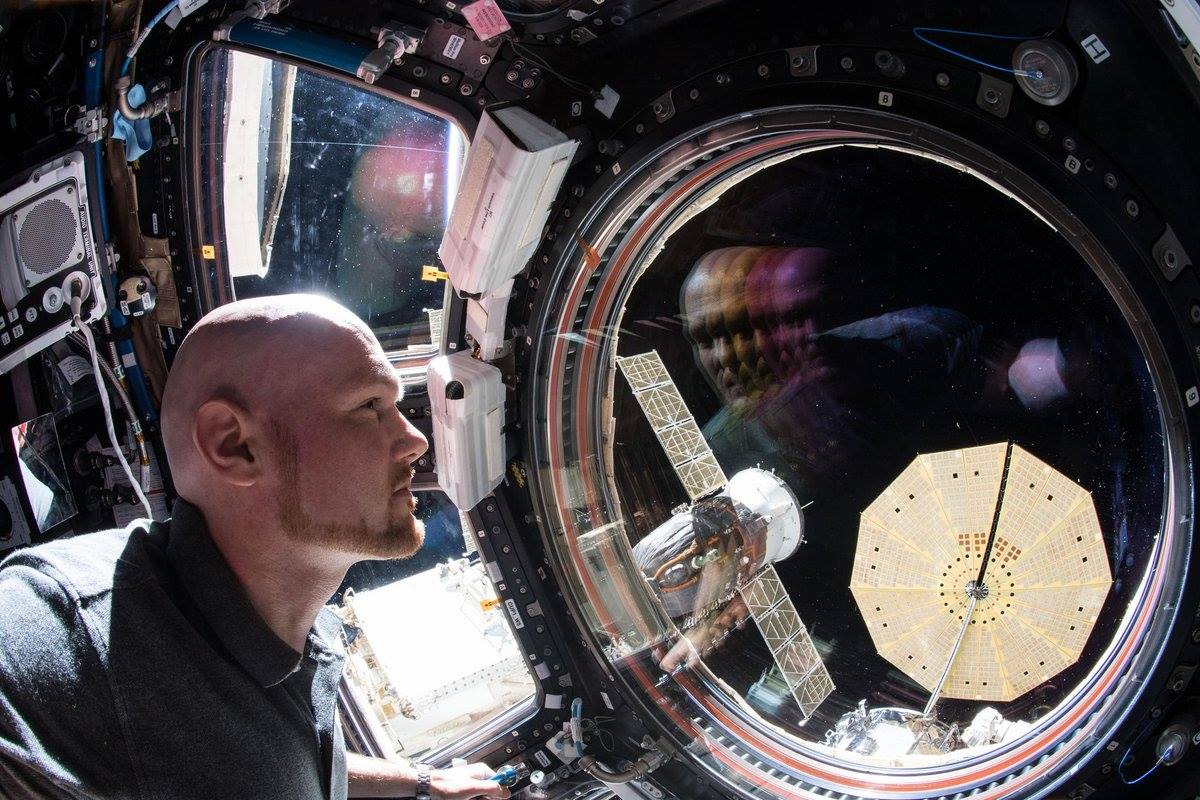
Alexander Gerst is, by several measures, the most prominent European astronaut of the current generation. A geophysicist and volcanologist by training — his doctoral research involved studying the eruption dynamics of volcanoes in Antarctica and Ethiopia — Gerst was selected as an ESA astronaut in 2009 and flew his first mission, Blue Dot, to the ISS in 2014, spending 165 days in space.
His second mission, Horizons, launched on June 6, 2018, aboard a Soyuz MS-09 spacecraft from Baikonur. On October 3, 2018 — the anniversary of German reunification — Gerst assumed command of the ISS as part of Expedition 57, becoming only the second European astronaut to serve as ISS commander (after Belgium's Frank De Winne in 2009). He returned to Earth on December 20, 2018, having spent 197 days in orbit.
What sets Gerst apart from his predecessors is not just his technical competence but his gift for communication. With millions of followers across social media platforms, Gerst has done more to bring spaceflight into German public consciousness than any figure since the Apollo era. His photographs from orbit — of hurricanes, auroras, city lights, and the paper-thin blue line of Earth's atmosphere — became cultural touchstones. His video messages to German schoolchildren were broadcast in classrooms nationwide. In a country where public enthusiasm for space has historically lagged behind that of the United States, France, or Japan, Gerst created a genuine popular connection to human spaceflight.
Gerst remains an active member of the ESA astronaut corps in 2026 and has publicly stated his openness to a lunar mission. "Of course," he replied when asked if he could imagine flying to the Moon. Whether a German astronaut will actually set foot on the lunar surface depends on the depth of European involvement in NASA's Artemis program — and on the continued willingness of German taxpayers to fund the ambition.
Matthias Maurer: The Cosmic Kiss (2021-2022)
Germany's most recent astronaut mission was Matthias Maurer's Cosmic Kiss, which ran from November 11, 2021, to May 6, 2022. Maurer, a materials scientist from the Saarland region near the French border, launched aboard a SpaceX Crew Dragon as part of the Crew-3 mission alongside NASA astronauts Raja Chari, Thomas Marshburn, and Kayla Barron.
During his approximately six months aboard the ISS, Maurer supervised 36 German experiments and more than 100 international experiments, most conducted in the European Columbus laboratory. The mission's name — a "declaration of love for space," as Maurer described it — reflected an increasingly deliberate effort by ESA and DLR to use astronaut missions as public engagement tools. The mission patch featured Earth, the Moon, the Pleiades star cluster, and Mars, with the ISS rendered in the shape of a heart.
Maurer's flight continued a cadence that Germany has maintained for over four decades: at least one German astronaut in space per generation. From Jähn in 1978 through Merbold in the 1980s and 1990s, Reiter in the mid-1990s and 2000s, Gerst in the 2010s, and Maurer in the 2020s, Germany has kept its astronaut pipeline active. This continuity is not accidental. It requires sustained political commitment, training infrastructure, and — above all — money. Germany's willingness to fund human spaceflight through ESA is directly connected to the public visibility that astronaut missions provide. The investment in Gerst and Maurer is, in part, an investment in the political constituency that supports the next €5.4 billion pledge.
The NewSpace Boom: Germany's Private Launch Revolution
The most dramatic change in Germany's space landscape over the past five years has been the emergence of a serious private launch vehicle industry. For decades, European access to space meant one thing: Ariane, built by ArianeGroup (a joint venture of Airbus and Safran), launched from Kourou in French Guiana, and managed through ESA's launcher program with heavy French influence. Germany contributed money and engineering to Ariane, but the program's center of gravity was always in France.
That model is no longer sufficient. The rise of SpaceX demonstrated that commercial launch services could be faster, cheaper, and more responsive than government-managed programs. The gap between Ariane 5's retirement in July 2023 and Ariane 6's first flight in July 2024 — a year in which Europe had no independent heavy-lift capability — concentrated minds across the continent. And the emerging demand for responsive, small-to-medium-lift launch services — driven by satellite constellations, defense requirements, and the sheer volume of commercial payloads seeking orbit — created a market opportunity that Europe's traditional launcher architecture was too slow and expensive to address.
Germany's response has been to grow its own launch companies, and two stand out.
Isar Aerospace: Europe's Best-Funded Rocket Startup
Isar Aerospace Technologies, founded in 2018 by three graduates of the Technical University of Munich — Daniel Metzler, Josef Fleischmann, and Markus Brandl — is the most heavily capitalized private launch company in European history. The company has raised more than €590 million across multiple funding rounds, including a €150 million convertible-bond agreement with Eldridge Industries in mid-2025. Its investors include Porsche SE, Lombard Odier, Earlybird Venture Capital, Bayern Kapital, and Lakestar. No European NewSpace company, in any sector, has attracted comparable private investment.
Isar's vehicle is Spectrum: a two-stage, 28-meter-tall rocket with a 2-meter diameter, powered by the company's proprietary Aquila engines. Nine Aquila engines power the first stage; a single vacuum-optimized Aquila powers the second. The propellant combination is liquid oxygen and propane — an unusual choice that Isar selected for its relatively clean combustion characteristics and its suitability for a simplified, cost-effective engine cycle. Spectrum's target payload capacity is 1,000 kilograms to low Earth orbit and 700 kilograms to sun-synchronous orbit, placing it squarely in the small-lift market segment currently dominated by Rocket Lab's Electron and, potentially, by a range of emerging competitors.
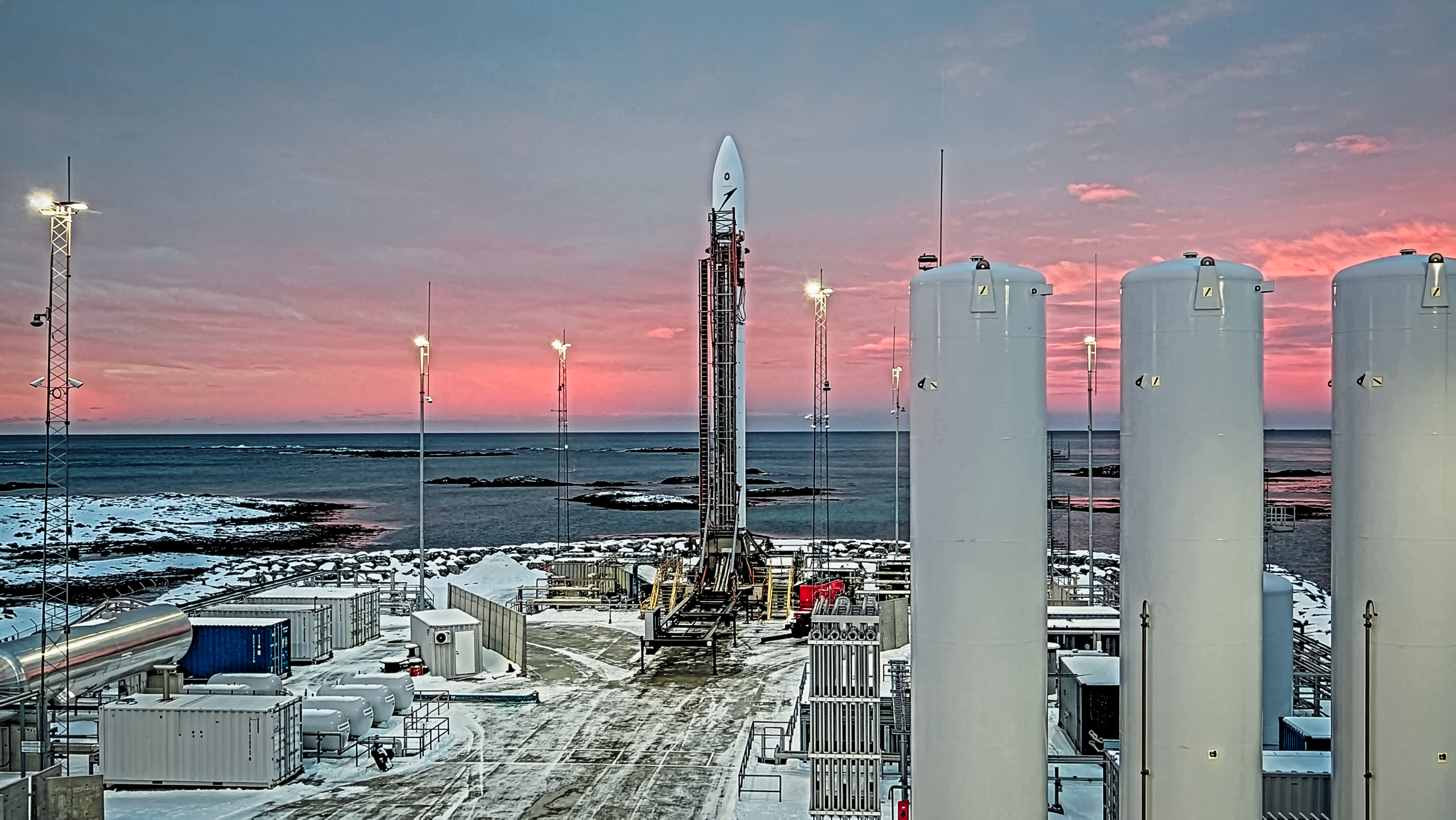
The company's launch site is at Andøya Space, on a narrow island above the Arctic Circle in northern Norway. The location offers high-inclination launch azimuths ideal for sun-synchronous and polar orbits — the orbits most in demand for Earth observation, signals intelligence, and communications relay satellites.
Spectrum's first flight, "Going Full Spectrum," launched on March 30, 2025. It did not go well. The rocket lifted off at 10:30 UTC and flew for approximately 30 seconds before losing attitude control during the initial roll maneuver. An unintended opening of a vent valve initiated the sequence of events that led to loss of control, and a termination order brought the vehicle down into the sea near the launch pad. The company characterized the flight as a success — pointing to the clean liftoff, the 30 seconds of powered flight data, and the validation of its flight termination system — but the reality was an in-flight failure on the first attempt, a common outcome for maiden launches but a setback nonetheless.
The recovery has been rapid. Less than nine months after the first flight, Isar completed stage testing and began preparations for a second launch, "Onward and Upward," carrying six payloads — five commercial and educational cubesats plus a technology demonstration experiment. But the second flight has been bedeviled by delays. A pressurization valve fault scrubbed the January 21, 2026, attempt. Weather pushed the rescheduled March attempt through several dates. And in early April 2026, the mission was postponed indefinitely after engineers discovered a suspected leak in a composite overwrapped pressure vessel (COPV) tank — a serious issue that requires careful diagnosis before the vehicle can be cleared for flight.
As of mid-April 2026, Isar Aerospace has not yet reached orbit. But the company's financial position remains strong, its engineering team has demonstrated the ability to identify and correct problems quickly, and the European institutional customer base — ESA, national agencies, and defense ministries — is actively seeking launch alternatives. The question is not whether a market exists for Spectrum, but whether Isar can close the gap between development and reliable operations before its capital runway shortens.
Rocket Factory Augsburg: The Staged-Combustion Challenger
Rocket Factory Augsburg (RFA), founded in 2018 and headquartered in the Bavarian city whose aerospace heritage dates to the Messerschmitt works of the 1930s, has taken a different technical path than Isar Aerospace — and, arguably, a more ambitious one.
RFA's vehicle is RFA ONE: a 30-meter, three-stage rocket designed to deliver 1,300 kilograms to low Earth orbit and 450 kilograms to geostationary transfer orbit. The first stage is powered by a cluster of nine Helix engines, each producing 100 kilonewtons of thrust. What makes Helix unusual — and technically impressive — is its engine cycle: oxygen-rich staged combustion (ORSC). In this architecture, the turbopump is driven by oxygen-rich gas, which is then injected into the main combustion chamber and mixed with the remaining RP-1 kerosene fuel. Staged combustion engines are significantly more efficient than the gas-generator or pressure-fed cycles used by most small-launch-vehicle engines, delivering up to 7 percent more specific impulse — which translates to roughly 30 percent more payload capacity for a given vehicle size.
The ORSC cycle is notoriously difficult to master. The Soviet Union perfected it with the RD-170 family. SpaceX uses a full-flow staged combustion cycle on Raptor. But for a startup company with a few hundred employees to develop a staged-combustion engine from scratch is an act of considerable engineering ambition — and considerable risk.
That risk materialized in 2024, when a hot-fire test of the first stage at a test facility resulted in an anomaly. The company spent 18 months conducting a comprehensive technical overhaul, identifying and resolving the root causes of the failure, and implementing upgrades to the Helix engine, tank pressurization systems, and ground operating procedures. It was a serious setback, but RFA's response — methodical, transparent, and technically thorough — earned respect from observers who had watched less disciplined startups try to paper over failures.

The second stage uses a vacuum-optimized variant called HelixVAC, with a larger nozzle for efficiency in the vacuum of space. The third stage — a distinctive feature of RFA ONE's architecture — is an orbital transfer vehicle called Redshift, powered by an RFA-developed Fenix engine burning nitromethane and nitrous oxide. Redshift can be restarted multiple times in orbit, enabling precise payload delivery to different orbital planes and altitudes. This last-mile delivery capability is increasingly valued by satellite constellation operators who need to distribute spacecraft across specific orbital slots.
RFA's launch site is SaxaVord Spaceport on Unst, the northernmost inhabited island of Scotland's Shetland archipelago. In a milestone for both the company and the European launch industry, RFA received the first spaceflight operator license ever issued by the UK Civil Aviation Authority for vertical launches of a privately developed orbital rocket.
As of early 2026, RFA has shipped the first and second stages of RFA ONE to SaxaVord. The first stage was newly built and tested in Augsburg before delivery in February 2026. The nine Helix engines are undergoing final acceptance testing at a facility in Kiruna, Sweden, and will be delivered on a rolling basis for mating with the first stage at the launch site. The full vehicle stack will undergo an integrated hot-fire test on the Shetland launch pad — firing all nine engines while the rocket remains bolted to the ground — before proceeding to the maiden orbital flight, currently targeted for summer 2026. The first flight will carry seven satellites for various organizations, coordinated through DLR.
The RFA ONE first-stage design uses common-bulkhead stainless steel tanks — a manufacturing choice shared with SpaceX's Starship that optimizes for durability and reusability potential. Whether RFA pursues first-stage recovery in subsequent vehicle iterations remains to be seen, but the design does not foreclose the option.
A German Launch Duopoly?
Isar Aerospace and RFA represent two different philosophies — Isar optimizing for simplicity and speed-to-market with its propane/LOX gas-generator Aquila engine, RFA optimizing for performance and efficiency with its kerosene/LOX staged-combustion Helix — but they share a common strategic thesis. Europe needs multiple independent launch providers. The continent cannot depend solely on Ariane 6 for institutional missions, and it cannot continue relying on SpaceX for commercial missions without strategic vulnerability. The European Commission, ESA, and national agencies have all signaled willingness to support European launch startups through anchor contracts, co-funding, and institutional demand guarantees.
Both companies are also products of a specifically German ecosystem. Munich and Bavaria are home to a dense network of aerospace suppliers, university research groups (TU Munich, the University of the Bundeswehr Munich, the Ludwig Maximilian University), and venture capital investors who understand deep-tech hardware companies. The Mittelstand tradition — Germany's characteristic landscape of mid-sized, technically specialized, often family-influenced companies — provides a supply chain of precision component manufacturers, materials specialists, and test equipment providers that a rocket startup can draw on without building everything in-house.
Whether both companies survive to become operational launch providers is uncertain. The history of launch vehicle development is littered with well-funded companies that never reached orbit. But the fact that Germany has produced two credible orbital launch startups within five years of each other — after decades of ceding launcher development to France-led European consortia — represents a genuine structural shift in the European space industry.
What Comes Next: A Bridge to Part 2
Germany's space program in 2026 is defined by a paradox. It is simultaneously one of the world's largest space investors and one of the least recognized as a space power. It spends more on ESA than France. It operates more aerospace research institutes than most countries have aerospace companies. Its astronauts have commanded the ISS. Its NewSpace startups have raised hundreds of millions of euros. And yet, in the global conversation about spacefaring nations, Germany is rarely mentioned in the same breath as the United States, China, India, or even Japan.
Part 2 of this deep dive will examine the dimensions of Germany's space program that explain this paradox — and that may resolve it. We will look at OHB SE, the publicly traded satellite manufacturer with record revenue of €1.25 billion in 2025 and a backlog of €3.2 billion, including the €839 million LISA prime contract. We will examine Airbus Defence and Space's German operations in Bremen, Friedrichshafen, and Ottobrunn. We will trace Germany's role in building Europe's Galileo navigation constellation and the Copernicus Earth observation program. We will explore Mynaric's laser communication terminals and the emerging German capability in optical inter-satellite links. And we will assess the defense space transformation — the €35 billion commitment, the planned LEO military satellite constellation, and what it means for Germany's traditional identity as a space power oriented toward peaceful scientific exploration.
Germany's space story is, in many ways, the story of modern Germany itself: a nation defined by engineering excellence, haunted by a complicated past, embedded in European institutions, and now being forced by geopolitical reality to think bigger about its own strategic ambitions. The rockets are on the launch pads. The money has been committed. The question is whether the ambition will match the investment.
Part 2 coming soon.