Callisto
The most heavily cratered world in the solar system — a quiet, ancient archive at the edge of Jupiter's radiation belt.
Vital statistics
01
Overview
Callisto is the outermost Galilean moon and a striking contrast to its restless siblings. Far enough from Jupiter to escape the orbital resonance that drives Io, Europa, and Ganymede, it has been geologically quiet for billions of years — its crust preserves an essentially unaltered record of impacts dating back to the heavy bombardment era. Sitting outside the worst of Jupiter's radiation belts, it has long been studied as a relatively benign staging post for future crewed exploration.
02
Composition
Callisto is poorly differentiated — about 60% rock and 40% ice by mass, with no fully separated metallic core. Galileo magnetic-field measurements detected an induced response consistent with a salty liquid layer somewhere between 100 and 300 km below the surface, sandwiched within the icy mantle. The interior structure is closer to a uniform mixture than the layered onion of Ganymede or Europa.
04
Surface
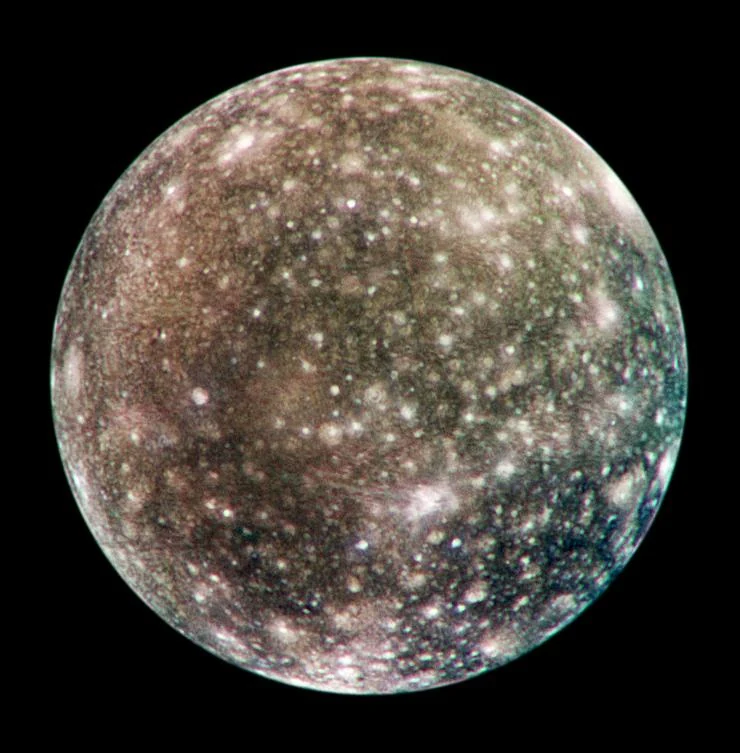
The most densely cratered surface in the solar system — saturation cratering means new impacts now mostly erase older ones. The Valhalla multi-ring basin spans roughly 3,800 km in concentric rings around its bright central plain, the result of a giant impact frozen into the icy crust. Bright icy peaks sit beside dark, dust-covered plains where ice sublimation has left a residue of non-ice material. The surface lacks the tectonic grooves seen on Ganymede.
05
Exploration
Pioneers 10 and 11 returned the first close imagery in 1973-74, followed by both Voyagers in 1979. The Galileo orbiter executed eight targeted flybys between 1996 and 2001, providing the magnetic-field data that pointed to a possible ocean. ESA's JUICE will perform 21 Callisto flybys during its tour of the Jovian system before settling into orbit around Ganymede.
Did you know?
Callisto has so many craters that its surface has reached "saturation" — new impacts erase older ones one-for-one.
It sits outside Jupiter's most intense radiation belts, making it the safest Galilean moon for a future crewed outpost.
The Valhalla basin's concentric rings extend roughly 1,900 km from its centre.
Callisto is the third-largest moon in the solar system — just slightly smaller than Mercury.
Galileo magnetometer data pointed to a possible salty subsurface ocean over a decade after the data was first collected.
Callisto is not in orbital resonance with the other Galileans, which is why its interior never heated up enough to fully differentiate.
Its surface ice sublimates so slowly that crater rims trace impacts dating back almost the full age of the solar system.
Timeline
- 16101610
Galileo Galilei discovers Callisto.
- 19731973
Pioneer 10 returns the first close images of the moon.
- 19791979
Voyager 1 and 2 reveal the Valhalla multi-ring basin in detail.
- 19961996
Galileo begins targeted Callisto flybys; magnetic data later suggests a subsurface ocean.
- 20232023
ESA JUICE launches; will conduct 21 Callisto flybys during its tour.