Charon
Pluto's binary partner — half Pluto's diameter, gravitationally locked, orbiting a shared centre between them.
Vital statistics
01
Overview
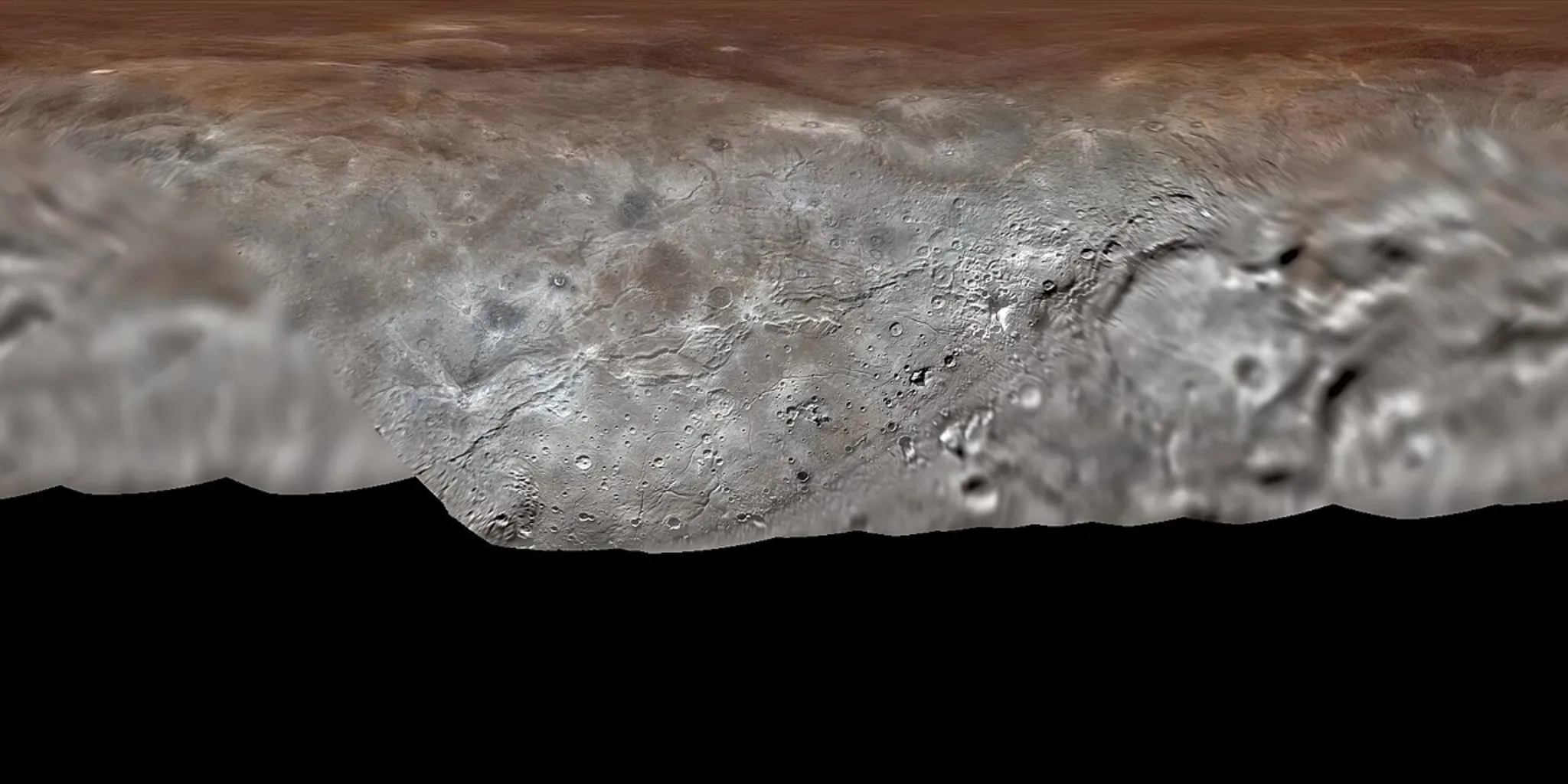
Charon is so large relative to Pluto — about half its diameter and one-eighth its mass — that the two are often described as a binary dwarf-planet system rather than a planet-and-moon. Their common centre of gravity (the barycentre) lies outside Pluto's surface, meaning Pluto and Charon literally orbit each other. The two are mutually tidally locked: each shows the same face to the other, perpetually. Charon's surface is mostly water ice, with a striking dark reddish polar cap — Mordor Macula — composed of tholins synthesised from methane that escaped Pluto's atmosphere and froze onto Charon's coldest regions.
02
Composition
Charon is approximately 55% rock and 45% water ice — slightly rockier than Pluto. The surface has fewer volatile ices than Pluto, since Charon's lower gravity couldn't retain methane or nitrogen long-term. A massive equatorial canyon system, longer than the Grand Canyon, suggests an ancient subsurface ocean that has since frozen, expanding the crust and cracking it open.
05
Exploration
Charon was discovered in 1978 from a slight elongation in photographic plates of Pluto. New Horizons returned the first close-up images during its July 14, 2015 flyby — revealing the canyon system, the "smooth plains" thought to be cryovolcanic in origin, and Mordor Macula.
Did you know?
Pluto and Charon's barycentre is roughly 1,000 km above Pluto's surface — making the system uniquely binary among solar-system planet-moon pairs.
Mordor Macula is reddish because methane escaping Pluto's atmosphere blows over to Charon and gets blasted by UV into reddish tholins.
Charon's discoverer, James Christy, suggested the name partly to include "Char" — his wife Charlene's nickname.
New Horizons revealed canyons on Charon up to 9 km deep — among the largest in the solar system.
Because Pluto and Charon are tidally locked, Charon stays fixed in Pluto's sky — it never rises or sets.
Charon is named after the ferryman of Hades who carried souls across the river Styx — Pluto being the lord of the underworld.
Pluto has four other small moons (Nix, Hydra, Kerberos, Styx) — all chaotically rotating because of Charon's gravitational influence.
Timeline
- 19781978
James Christy discovers Charon from elongated photographic images of Pluto.
- 19901990
Hubble Space Telescope resolves Pluto and Charon as separate objects.
- 20152015
New Horizons returns the first close-up images during its Pluto-Charon flyby.
- 20182018
IAU formally approves Charon feature names drawn from mythology, fiction, and exploration — Mordor Macula, Pulfrich crater, and others.