Third planet from the Sun
Earth
The only world we know with liquid surface water, plate tectonics, and life — across every scale we can measure.
Vital statistics
01
Overview
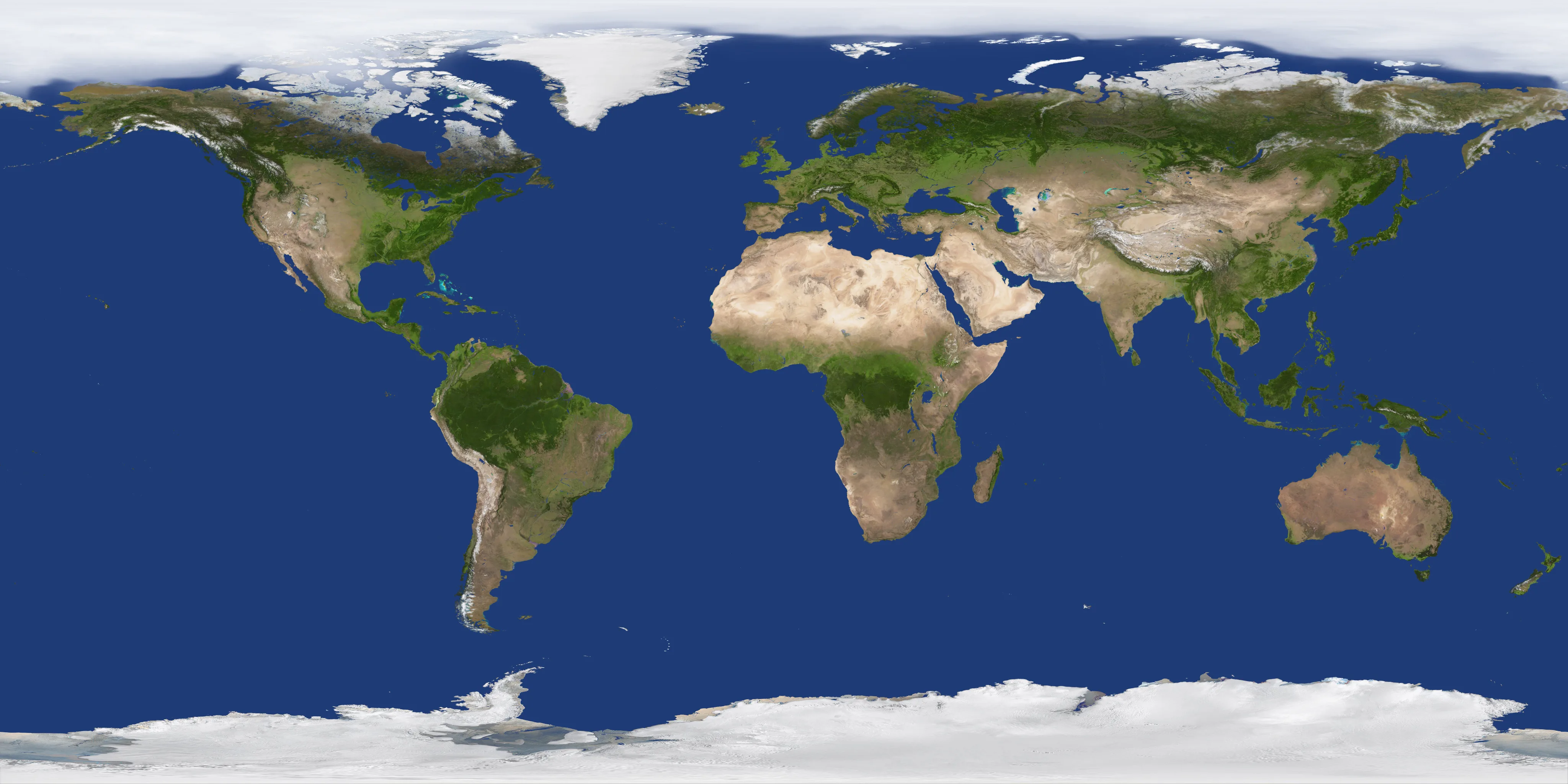
Earth is the third planet from the Sun and — so far — the only place in the universe known to host life. Its defining feature is liquid water, stable for at least 4 billion years thanks to a near-circular orbit in the habitable zone, an active carbon cycle, and a magnetic field generated by a churning iron core. Roughly 71% of the surface is ocean. Plate tectonics, a phenomenon not confirmed on any other planet, recycles crust and regulates atmospheric CO₂ on geological timescales.
02
Composition
A layered structure of solid inner core (iron-nickel, ~5,200 °C), liquid outer core (the dynamo behind the magnetic field), a silicate mantle making up about 84% of the volume, and a thin crust 5-70 km thick. Earth is the densest planet in the solar system at 5.51 g/cm³.
03
Atmosphere
A nitrogen-oxygen atmosphere unique among known worlds — the oxygen is biological in origin, accumulated by photosynthesis since the Great Oxidation Event 2.4 billion years ago. Surface pressure is the reference 1 bar. The atmosphere shields the surface from most cosmic radiation and burns up the vast majority of incoming meteoroids.
05
Exploration
Earth is the most thoroughly observed body in the universe. Sputnik 1 began the Space Age in 1957; humans have lived continuously off the planet aboard the ISS since November 2000. A constellation of Earth-observation satellites — Landsat (since 1972), Sentinel, GOES, Terra, Aqua — track climate, weather, vegetation, ice, and oceans. The Apollo programme delivered the first humans to the Moon in 1969, and provided the photograph "Earthrise" that helped catalyse the modern environmental movement.
Did you know?
Earth is the densest planet in the solar system, at 5.51 g/cm³.
The Moon is unusually large relative to its host — about 1/4 of Earth's diameter — and stabilises Earth's axial tilt.
Earth's day is lengthening by roughly 1.7 milliseconds per century due to lunar tidal friction.
The deepest ocean point — the Mariana Trench Challenger Deep — is 10,935 metres below sea level.
Earth's magnetic poles wander, and have flipped completely roughly every 200,000-300,000 years on average.
About 100 tonnes of meteoritic material falls to Earth every day, mostly as dust.
Earth is the only planet not named after a Greek or Roman deity — the name traces to Old English and Germanic roots meaning "ground".
Timeline
- 4.54 Bya4.54 Bya
Earth forms by accretion in the protoplanetary disk.
- 4.5 Bya4.5 Bya
A Mars-sized impactor strikes Earth; debris coalesces into the Moon.
- 3.8 Bya3.8 Bya
Earliest widely accepted evidence of microbial life appears in the rock record.
- 2.4 Bya2.4 Bya
The Great Oxidation Event transforms the atmosphere.
- 19571957
Sputnik 1 launches; the Space Age begins.
- 19681968
Apollo 8 returns the "Earthrise" photograph from lunar orbit.
- 19721972
Landsat 1 launches, beginning continuous satellite Earth observation.
- 20002000
Continuous human habitation in space begins aboard the ISS.