Enceladus
Saturn's ocean moon — venting the contents of a salty subsurface sea into space through tiger-stripe fractures.
Vital statistics
01
Overview
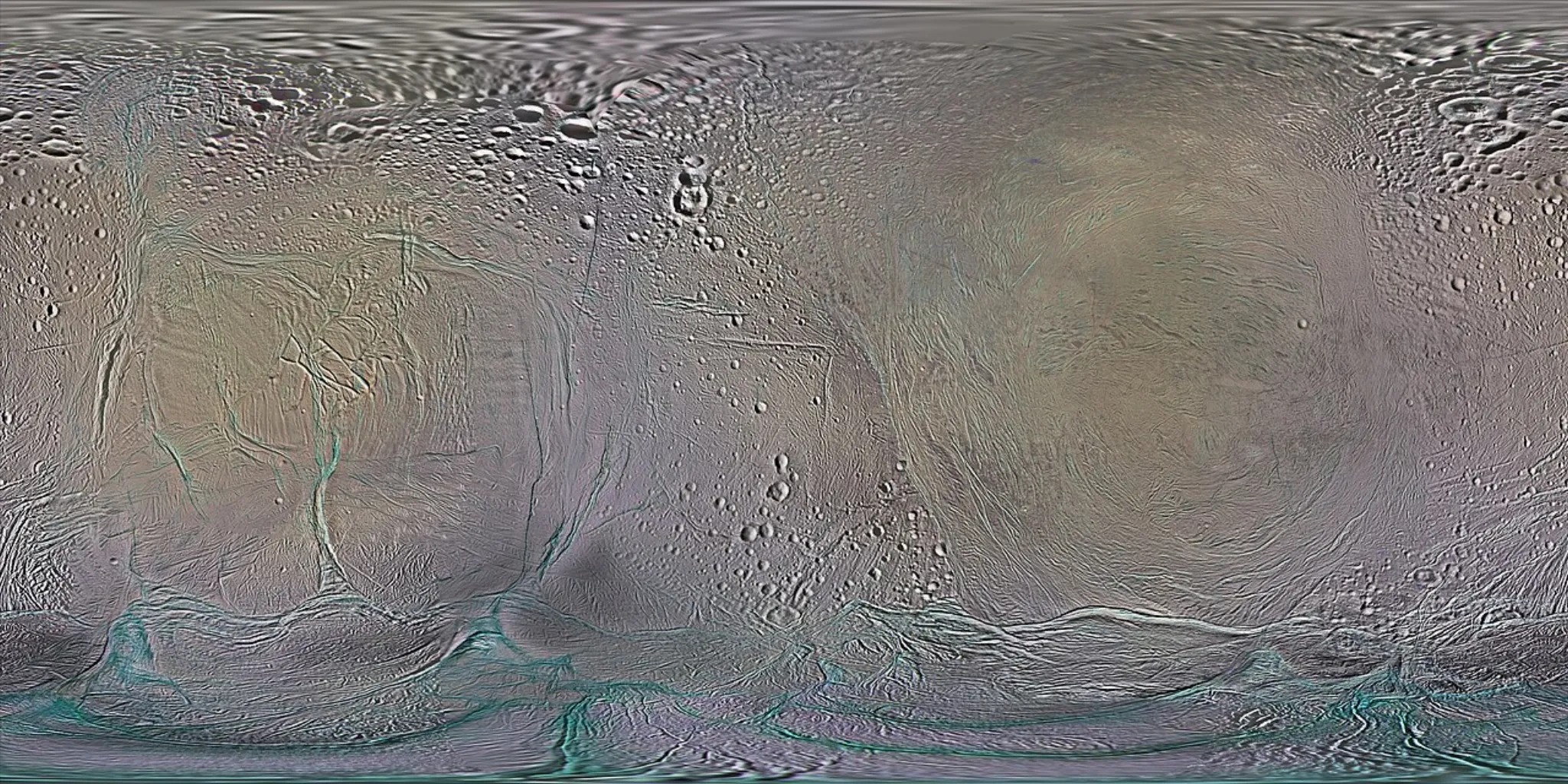
Enceladus is one of the most astrobiologically promising worlds in the solar system. Beneath a 30-km-thick icy shell lies a global subsurface ocean of liquid salt water, kept warm by tidal flexing from Saturn's gravity. At the south pole, four parallel "tiger stripe" fractures vent jets of water vapour and ice particles hundreds of kilometres into space — Cassini flew through these plumes and detected molecular hydrogen, complex organic molecules, and salts. All four ingredients for habitability — liquid water, energy, organics, and chemical disequilibrium — exist beneath Enceladus's ice.
02
Composition
Enceladus is roughly 60% water ice and 40% rock by mass. The subsurface ocean is in direct contact with the rocky core, allowing serpentinisation reactions that produce hydrogen — a potential energy source for chemosynthetic microbes. The plumes seed Saturn's diffuse E ring with fresh ice particles, making Enceladus the source of one of Saturn's rings.
05
Exploration
Voyager 1 and 2 imaged Enceladus from a distance in 1980-1981. Cassini transformed our understanding from 2005 onward — discovering the plumes, flying through them at 8 km/s, and characterising their chemistry. Multiple proposed follow-up missions (Enceladus Orbilander, Enceladus Life Finder) aim to return to fly through the plumes again with more sensitive instruments capable of detecting biosignatures directly.
Did you know?
Enceladus is so reflective that surface temperatures would actually be higher if it were covered in dirt.
Cassini detected silica nanoparticles in the plumes — evidence of hydrothermal vents on the ocean floor.
The plumes erupt continuously; Cassini measured them for 13 years without a pause.
Most of Enceladus's ocean is in contact with rock — far better for chemistry than Europa, where the ocean sits between two ice layers.
A plume flythrough at 6 km/s sounds violent but Cassini was specifically designed to survive it without damage.
Enceladus is small enough that its escape velocity is only 240 m/s — particles in the plumes routinely reach orbit and beyond.
The "tiger stripes" are warmer than the surrounding surface by ~80 °C — heat from the ocean below.
Timeline
- 17891789
William Herschel discovers Enceladus.
- 19801980
Voyager 1 returns first close-up images.
- 20052005
Cassini discovers the south-polar plumes during its first close flyby.
- 20082008
Cassini flies through the plumes for the first time.
- 20172017
Cassini's grand finale ends the mission; final plume sampling complete.
- 2030s (proposed)2030s (proposed)
Enceladus Orbilander concept mission targeted to fly through plumes with biosignature instruments.