Ganymede
The largest moon in the solar system — bigger than Mercury and the only moon with its own magnetic field.
Vital statistics
01
Overview
Ganymede is the giant of the moon family — larger than the planet Mercury, though only about half its mass — and the only natural satellite known to generate its own magnetic field through a dynamo in a liquid-iron core. A thick mantle of ice and at least one buried saltwater ocean make it a primary target of ESA's JUICE mission, which will become the first spacecraft ever to enter orbit around a moon other than our own.
02
Composition
Ganymede is a layered world: an iron-rich core that drives its dynamo, a rocky silicate mantle, and a deep envelope of ice and water several hundred kilometres thick. Models suggest a stratified interior in which a salty liquid ocean is sandwiched between high-pressure ice phases above and below — possibly multiple ocean layers separated by exotic ice. The intrinsic magnetic field is embedded within Jupiter's own and produces auroras at Ganymede's poles that Hubble has used to probe ocean depth.
04
Surface
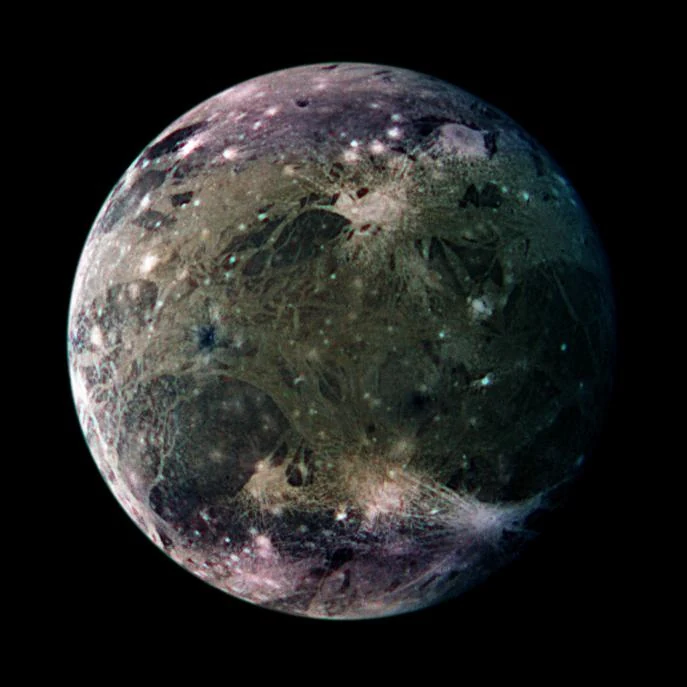
The surface is split between ancient, dark, heavily cratered terrain and brighter, younger grooved terrain criss-crossed by parallel ridges and troughs from past tectonic activity. Ganymede's polar caps are ringed by plasma-darkened ice — a direct fingerprint of charged particles channelled along the moon's magnetic field lines. Impact craters are unusually flat, consistent with a thick, slowly relaxing icy crust.
05
Exploration
Pioneer 10 made the first close approach in 1973, followed by Voyager 1 and 2 in 1979. The Galileo orbiter completed six targeted Ganymede flybys between 1996 and 2000 and discovered its intrinsic magnetic field. Juno passed within 1,038 km in June 2021 — the closest visit in over two decades. ESA's JUICE, launched April 2023, arrives at Jupiter in 2031 and is scheduled to enter Ganymede orbit in late 2034 for a year-long detailed survey.
Did you know?
Ganymede is the only moon in the solar system with a self-generated magnetic field.
It is 8% larger than Mercury but only 45% as massive — half its volume is ice and water.
Hubble's UV observations of Ganymede's auroras provided independent evidence for a buried ocean.
JUICE will be the first spacecraft to orbit a moon other than Earth's.
Ganymede's grooved terrain shows tectonic fracturing on a scale unique among icy moons.
A 2021 Juno flyby returned imagery sharp enough to resolve features just 1 km across.
The moon's ocean may hold more water than all of Earth's surface oceans, locked between ice layers.
Timeline
- 16101610
Galileo Galilei discovers Ganymede.
- 19731973
Pioneer 10 captures the first close-up images during its Jupiter flyby.
- 19961996
Galileo orbiter begins close flybys; detects intrinsic magnetic field.
- 20152015
Hubble auroral observations confirm the subsurface ocean.
- 20212021
Juno performs the closest Ganymede flyby since Galileo.
- 20232023
ESA JUICE launches toward the Jupiter system.
- 2034 (planned)2034 (planned)
JUICE enters Ganymede orbit — a first for any moon other than ours.