Iapetus
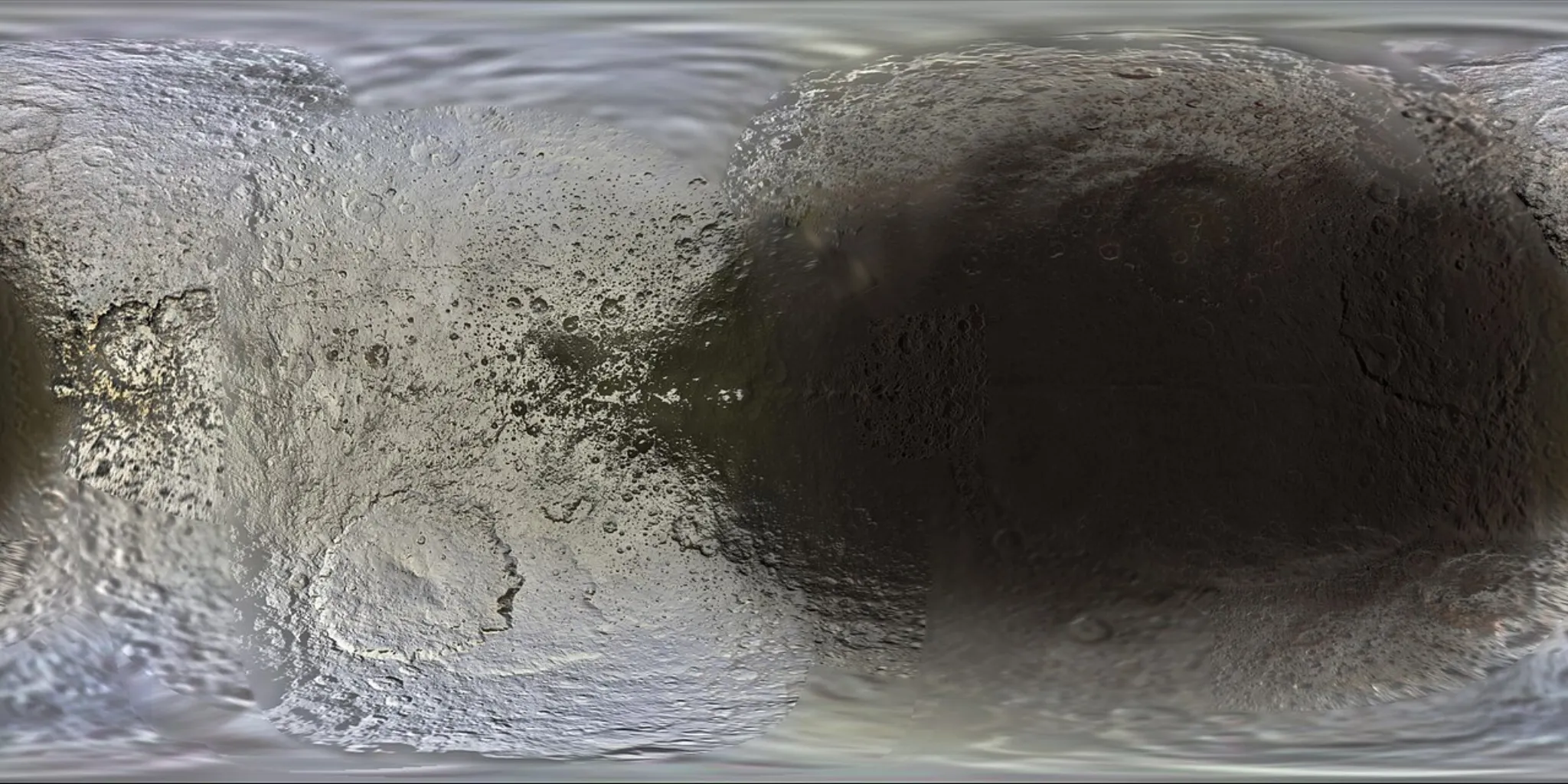
Saturn's yin-yang moon — one hemisphere coal-black, the other bright white, with an inexplicable equatorial ridge.
Vital statistics
01
Overview
Iapetus is the strangest moon in the saturnian system. One hemisphere is as dark as coal (albedo 0.04); the other is as bright as fresh snow (albedo 0.6). The contrast was noticed by Giovanni Cassini in 1671 — he could only see Iapetus on one side of Saturn, leading him to correctly deduce that one hemisphere was dramatically darker. The dark material is now thought to be reddish dust swept up from outer moon Phoebe, accumulating preferentially on Iapetus's leading hemisphere as it orbits. Even more bizarrely, a 1,300 km-long, 13 km-tall ridge runs almost exactly along Iapetus's equator, giving the moon a walnut-like silhouette.
02
Composition
Iapetus is mostly water ice with a smaller rocky fraction. The dark material covering the leading hemisphere is only a millimetre or so thick but completely changes the surface's thermal balance — the dark side absorbs more sunlight, sublimating any underlying ice and exposing more dark dust beneath. The equatorial ridge is the topographic enigma; theories include a collapsed sub-satellite, an ancient rapid-rotation period, or tectonic uplift. None fully explains it.
05
Exploration
Voyager 1 and 2 returned the first close-up images in the 1980s. Cassini performed two close flybys (2004 and 2007) and mapped the ridge in detail.
Did you know?
Cassini correctly inferred Iapetus's two-tone nature in 1671 from the moon's changing brightness in his telescope — long before anyone could resolve a moon's surface.
The equatorial ridge is so straight and well-defined that it's sometimes called "the walnut" by planetary scientists.
Iapetus orbits 60 Saturn-radii out — three times farther than Titan — explaining its high inclination and exotic environment.
The dark hemisphere is named Cassini Regio after the moon's discoverer; the bright hemisphere is Roncevaux Terra.
Some of Iapetus's craters straddle the bright/dark boundary, with one wall in shadow black and the opposite wall in icy white.
Arthur C. Clarke set the climax of "2001: A Space Odyssey" on Iapetus — the alien monolith's lure.
Timeline
- 16711671
Giovanni Cassini discovers Iapetus and notes its asymmetric brightness.
- 1980-19811980-1981
Voyager 1 and 2 return the first close-up images.
- 20042004
Cassini performs its first targeted Iapetus flyby and discovers the equatorial ridge.
- 20072007
Cassini's second close flyby maps the ridge and dark-material distribution.