Io
The most volcanically active world in the solar system — a sulphurous moon kneaded by Jupiter's gravity.
Vital statistics
01
Overview
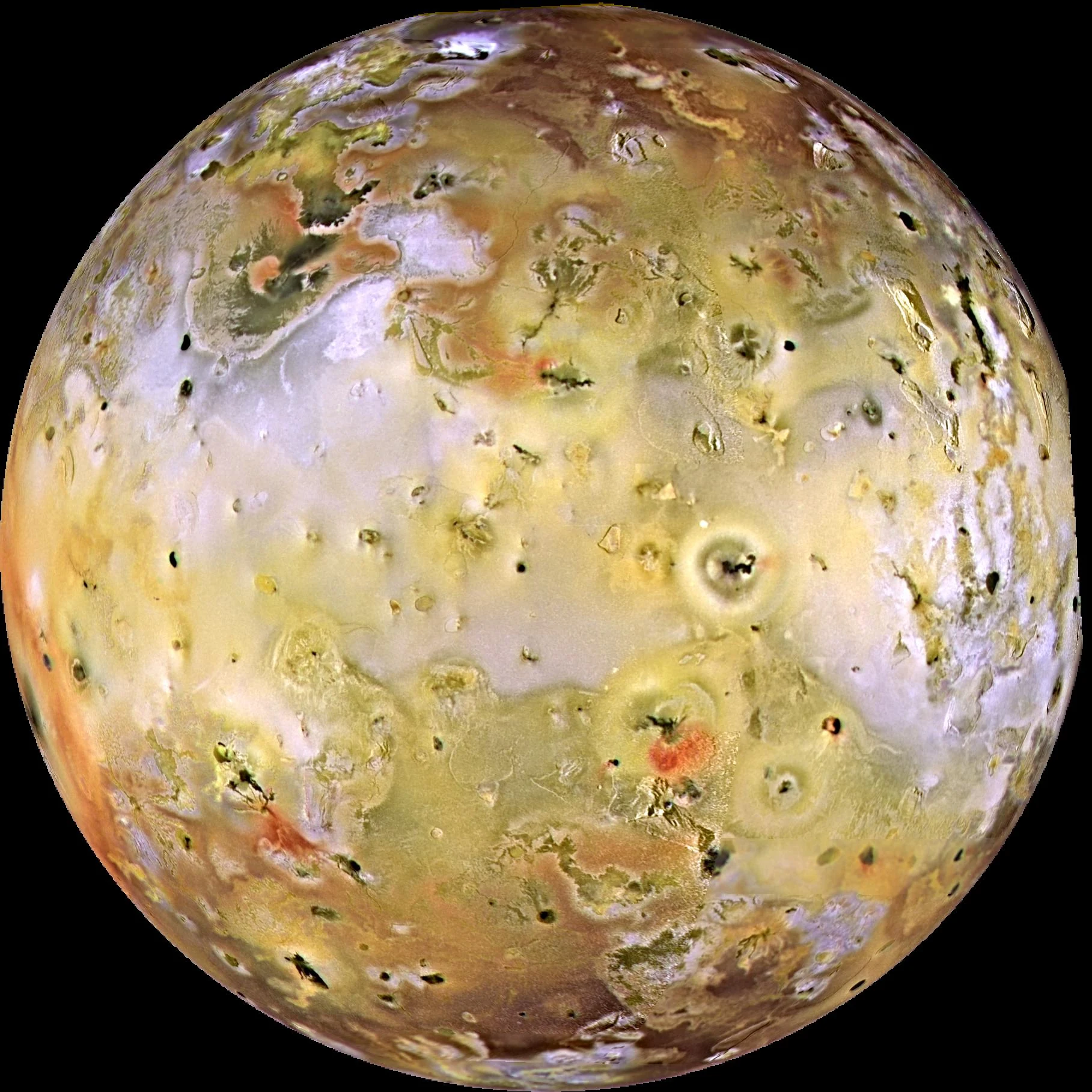
Io is the innermost of Jupiter's four Galilean moons and the most geologically violent body known. Trapped in an orbital resonance with Europa and Ganymede, it is squeezed and stretched by tidal forces that pump enough heat into its interior to keep silicate rock molten just below the crust. The result is a sulphur-stained world repaved continuously by lava — its surface so young that almost no impact craters survive long enough to be catalogued.
02
Composition
Unlike its icy Galilean siblings, Io is a rocky world with a probable iron or iron-sulphide core, a silicate mantle that is partly molten, and a thin crust of sulphur-rich basalts. Volatile water was largely cooked off early in its history, leaving sulphur compounds as the dominant volatile species cycling between surface, atmosphere, and plumes.
04
Surface
Io's landscape is dominated by lakes of molten silicate lava, plumes that rise hundreds of kilometres above the surface, and mountains taller than Everest that are not volcanic but tectonic — pushed up by compression as fresh material buries older crust. Sulphur and sulphur dioxide frosts paint the ground in yellows, oranges, reds, and whites, giving Io the look of a pizza. The volcano Loki Patera alone radiates more heat than all of Earth's volcanoes combined.
05
Exploration
Voyager 1 captured the first images of an erupting plume in March 1979 — the discovery that Io was volcanically active. The Galileo orbiter (1995-2003) made repeated close passes, mapping hotspots and confirming a partially molten interior. NASA's Juno spacecraft, in extended mission since 2021, has executed the closest Io flybys ever flown — within 1,500 km in late 2023 — returning unprecedented imagery of plumes and lava lakes.
Did you know?
Io's volcanoes resurface the entire moon every few million years — there are essentially no impact craters anywhere.
Loki Patera, a single lava lake roughly 200 km across, is the most powerful volcano in the solar system.
A 400,000-amp electric current flows between Io and Jupiter through a flux tube of charged particles.
Io's tallest mountain, Boösaule Montes, rises 17.5 km — about twice the height of Everest above sea level.
Plumes from Pele can shoot ejecta 500 km high — visible from Earth-based telescopes when conditions align.
The moon loses roughly a tonne of material to space every second, feeding a torus of plasma around Jupiter.
Io's thin sulphur dioxide atmosphere collapses to frost on the night side and re-sublimates each Jovian dawn.
Timeline
- 16101610
Galileo Galilei discovers Io as one of Jupiter's four largest moons.
- 19791979
Voyager 1 spots an erupting plume — the first active volcanism known beyond Earth.
- 19951995
Galileo orbiter begins eight years of close Io observations.
- 20072007
New Horizons captures dramatic plume imagery during its Jupiter gravity assist.
- 20232023
Juno performs its closest Io flyby at 1,500 km altitude.