Fifth planet from the Sun
Jupiter
The largest planet — a gas giant whose Great Red Spot has raged for at least 350 years.
Vital statistics
01
Overview
Jupiter is the fifth and largest planet — more massive than every other planet combined, 2.5 times over. It is a gas giant with no solid surface; pressure and temperature climb together until hydrogen behaves like a liquid metal that powers Jupiter's vast magnetic field. The planet rules over 101 IAU-recognised moons; Galileo first spotted four of them in 1610, the moment that broke the geocentric model.
02
Composition
Mostly hydrogen and helium, transitioning from gas to liquid to a metallic-hydrogen mantle several thousand kilometres deep. A possibly-rocky core sits at the centre under pressures around 100 million atmospheres. Jupiter radiates more heat than it receives — gravitational contraction still releases primordial energy.
03
Atmosphere
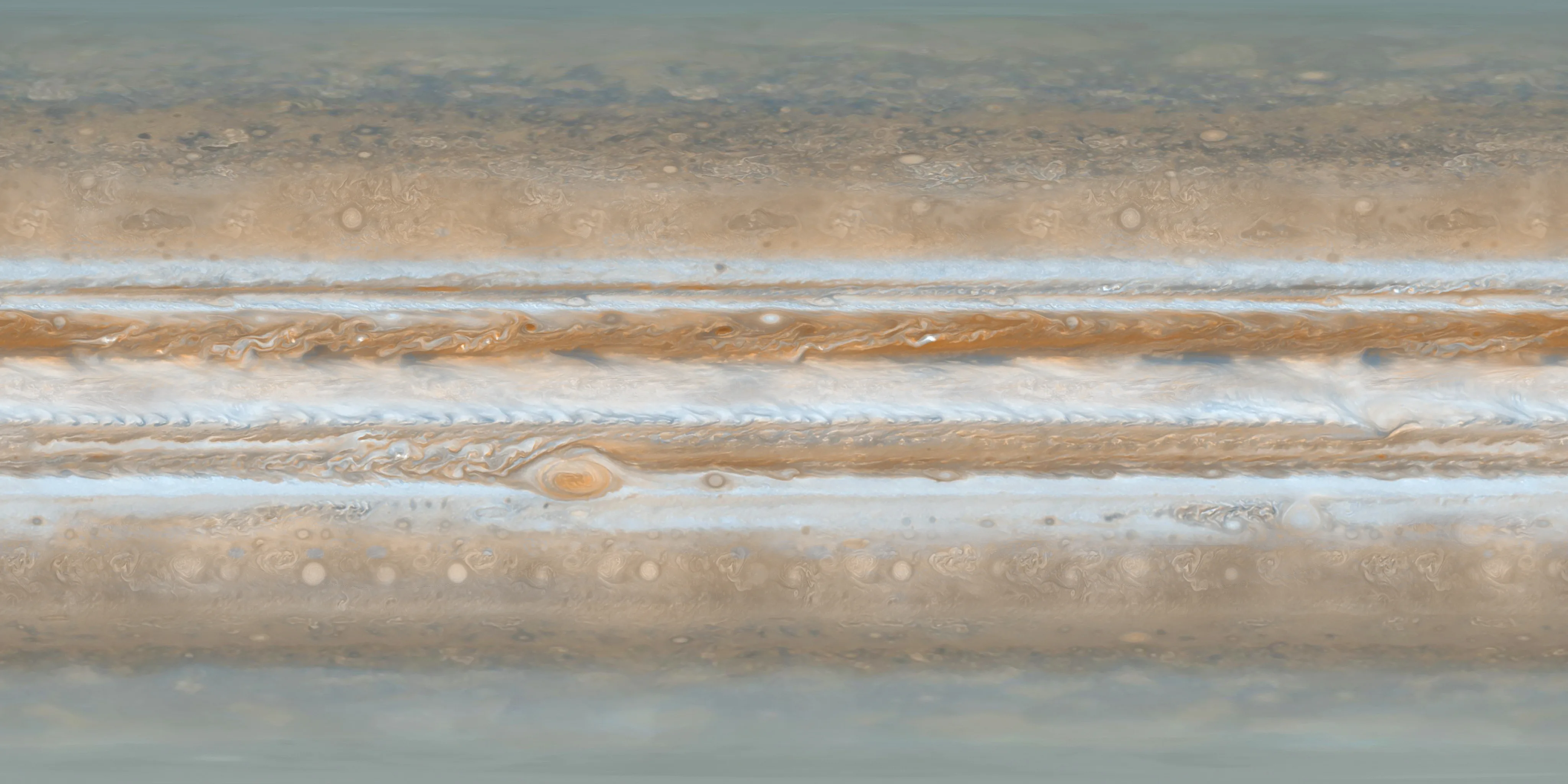
Banded cloud tops of ammonia ice over deeper layers of ammonium hydrosulphide and water. The Great Red Spot is an anticyclonic storm large enough to swallow Earth, observed continuously since at least 1830. Wind speeds in the bands reach 540 km/h.
05
Exploration
Pioneer 10/11 (1973-74) made the first flybys; Voyager 1/2 (1979) returned detailed imagery. Galileo (1995-2003) dropped a probe into the atmosphere. Juno has been in polar orbit since 2016. NASA's Europa Clipper and ESA's JUICE arrive in 2030-31 to study the moons.
Did you know?
Jupiter's magnetosphere is the largest structure in the solar system — it extends past Saturn's orbit.
Comet Shoemaker-Levy 9 fragments crashed into Jupiter in July 1994 — the first observed planetary impact.
Jupiter has a faint, dusty ring system, discovered by Voyager 1 in 1979.
Its gravity sweeps incoming comets and asteroids — partly shielding the inner planets.
Jupiter rotates fastest of any planet — under 10 hours, despite being 11 times Earth's diameter.
You could fit roughly 1,300 Earths inside Jupiter.
Timeline
- 16101610
Galileo Galilei observes the four largest moons.
- 18301830
Continuous documentation of the Great Red Spot begins.
- 19791979
Voyager 1/2 flybys reveal rings and active volcanism on Io.
- 19941994
Comet Shoemaker-Levy 9 fragments impact Jupiter.
- 19951995
Galileo orbiter arrives; releases atmospheric probe.
- 20162016
Juno enters polar orbit.
- 2031 (planned)2031 (planned)
Europa Clipper begins flybys of Europa.