Fourth planet from the Sun
Mars
A cold desert planet with the solar system's tallest volcano, deepest canyon, and a geological record of ancient water.
Vital statistics
01
Overview
Mars is a cold, dry, dust-coloured world about half Earth's diameter, but with the same total land area thanks to its absent oceans. Its red tint comes from iron-oxide dust covering most of the surface. The thin CO₂ atmosphere — under 1% of Earth's surface pressure — cannot retain heat or shield the surface from radiation. Yet ancient riverbeds, deltas, and clay minerals show liquid water flowed here for hundreds of millions of years, making Mars the most accessible candidate for past life beyond Earth.
03
Atmosphere
A thin envelope averaging 6 millibars at the surface — about 0.6% of Earth's pressure. CO₂ dominates, but enough water vapour exists to form thin morning clouds and seasonal frosts. Global dust storms occasionally engulf the entire planet, as in the 2018 storm that ended the Opportunity rover. Surface winds reach 100 km/h but, in the thin air, push with little force.
04
Surface
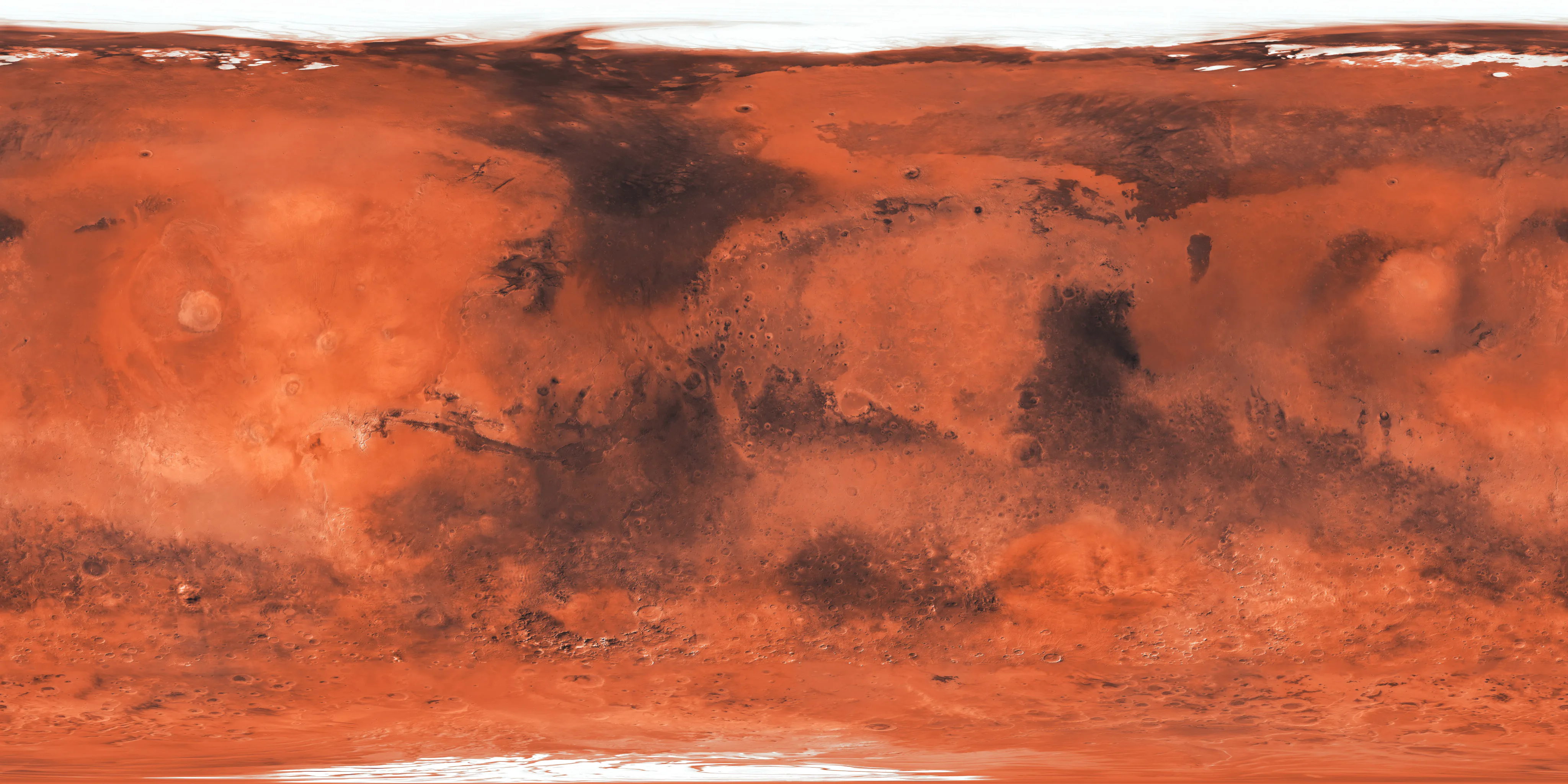
Mars holds the solar system's most extreme topography. Olympus Mons rises 21.9 km — about 2.5 times the height of Everest above sea level — and spans roughly 600 km across. Valles Marineris is a canyon system over 4,000 km long and up to 7 km deep. The northern hemisphere is dominated by smooth lowlands; the southern by ancient cratered highlands. The polar caps are layered water and CO₂ ice that grow and retreat with the seasons.
05
Exploration
Mars is the most-explored planet beyond Earth. Mariner 4 made the first flyby in 1965; Vikings 1 and 2 landed in 1976 and ran the first life-detection experiments. NASA's rovers — Sojourner (1997), Spirit and Opportunity (2004), Curiosity (2012), and Perseverance (2021) — have driven a combined ~80 km across the surface. Perseverance is caching samples for a future Mars Sample Return; the Ingenuity helicopter flew 72 times before its January 2024 retirement. China's Zhurong rover landed in 2021. Crewed missions remain a NASA, SpaceX, and CNSA goal for the 2030s-2040s.
Did you know?
Olympus Mons is the tallest volcano in the solar system — about 21.9 km from base to summit.
A Martian day is only 39 minutes longer than an Earth day, the closest match in the solar system.
Phobos orbits Mars three times a day and is spiralling inward — it will crash into Mars or shatter into a ring within ~50 million years.
Mars hosts the largest dust storms in the solar system, occasionally engulfing the entire planet.
Curiosity has detected seasonal swings in atmospheric methane that remain unexplained.
Surface gravity is just 38% of Earth's — a 70 kg human would weigh 26 kg.
Perseverance recorded the first audio ever captured on another planet in 2021.
Timeline
- 16591659
Christiaan Huygens sketches Syrtis Major, the first identified surface feature on another planet.
- 18771877
Asaph Hall discovers Phobos and Deimos.
- 19651965
Mariner 4 returns the first close-up images, ending the canal era.
- 19761976
Vikings 1 and 2 land — first successful surface missions.
- 19971997
Sojourner becomes the first rover to operate on Mars.
- 20122012
Curiosity lands in Gale Crater and confirms ancient habitable conditions.
- 20212021
Perseverance lands; Ingenuity flies — the first powered flight on another planet.
- 20242024
Ingenuity helicopter retires after 72 flights and three years of operation.