First planet from the Sun
Mercury
The smallest planet and the Sun's closest neighbour — a cratered iron-cored world of brutal extremes.
Vital statistics
01
Overview
Mercury is a small, dense, scorched world that orbits the Sun every 88 days. With virtually no atmosphere to redistribute heat, its surface swings by more than 600 °C between day and night — the steepest temperature range on any planet. It is the second densest body in the solar system after Earth, suggesting an oversized iron core that fills nearly 60% of its volume. Mercury rotates three times for every two orbits, locked into a 3:2 spin-orbit resonance unique among planets.
03
Atmosphere
Effectively none. Mercury holds only a thin exosphere of atoms — sodium, oxygen, hydrogen, helium, potassium — sputtered off the surface by the solar wind and micrometeoroid impacts. Sodium atoms form a faint comet-like tail trailing the planet, photographed by ground-based telescopes.
04
Surface
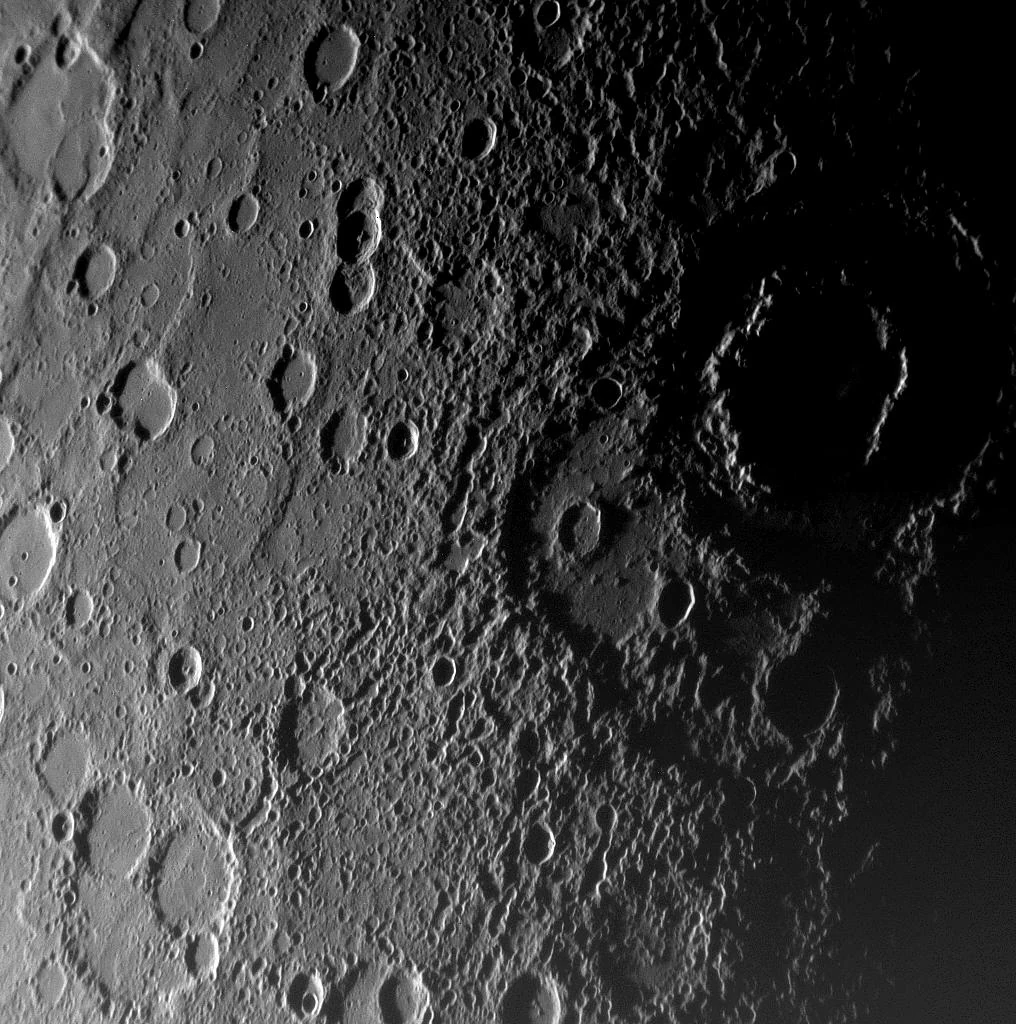
Heavily cratered and geologically ancient, the surface resembles the Moon's but is etched with long lobate scarps — cliffs hundreds of kilometres long that formed as the planet's interior cooled and contracted. The Caloris Basin, 1,550 km wide, is one of the largest impact craters in the solar system. Permanently shadowed crater floors near the poles host confirmed deposits of water ice.
05
Exploration
Only two spacecraft have visited. Mariner 10 made three flybys in 1974-75, mapping under half the surface. NASA's MESSENGER orbited from 2011 to 2015, finally completing global mapping and confirming polar water ice before being deliberately crashed into the surface. The joint ESA-JAXA BepiColombo, launched 2018, is using a long looping trajectory and is scheduled to enter Mercury orbit in November 2026.
Did you know?
Mercury's core takes up roughly 60% of its volume — proportionally the largest core of any planet.
A solar day on Mercury (sunrise to sunrise) lasts two Mercury years.
Despite being closest to the Sun, the polar craters at Mercury's poles hold permanent water ice.
The planet is shrinking — lobate scarps show its radius has contracted by up to 7 km as the core cools.
Mercury has a global magnetic field — surprising for such a small, slowly rotating world.
On Mercury, the Sun can appear to rise, briefly reverse direction, then continue across the sky during perihelion.
The 1,550 km Caloris Basin is so large its impact reshaped terrain on the opposite side of the planet.
Timeline
- 16311631
Pierre Gassendi observes the first recorded transit of Mercury across the Sun.
- 19651965
Radar observations reveal Mercury's 3:2 spin-orbit resonance, overturning a century-old assumption.
- 19741974
Mariner 10 makes the first flyby, returning the first close-up images.
- 20112011
MESSENGER enters orbit — the first spacecraft to do so.
- 20122012
MESSENGER confirms water ice in permanently shadowed polar craters.
- 20182018
BepiColombo launches on a seven-year cruise to Mercury.
- 2026 (planned)2026 (planned)
BepiColombo enters Mercury orbit.