Mimas
Saturn's "Death Star" moon — dominated by a single 130 km crater that nearly broke it apart.
Vital statistics
01
Overview
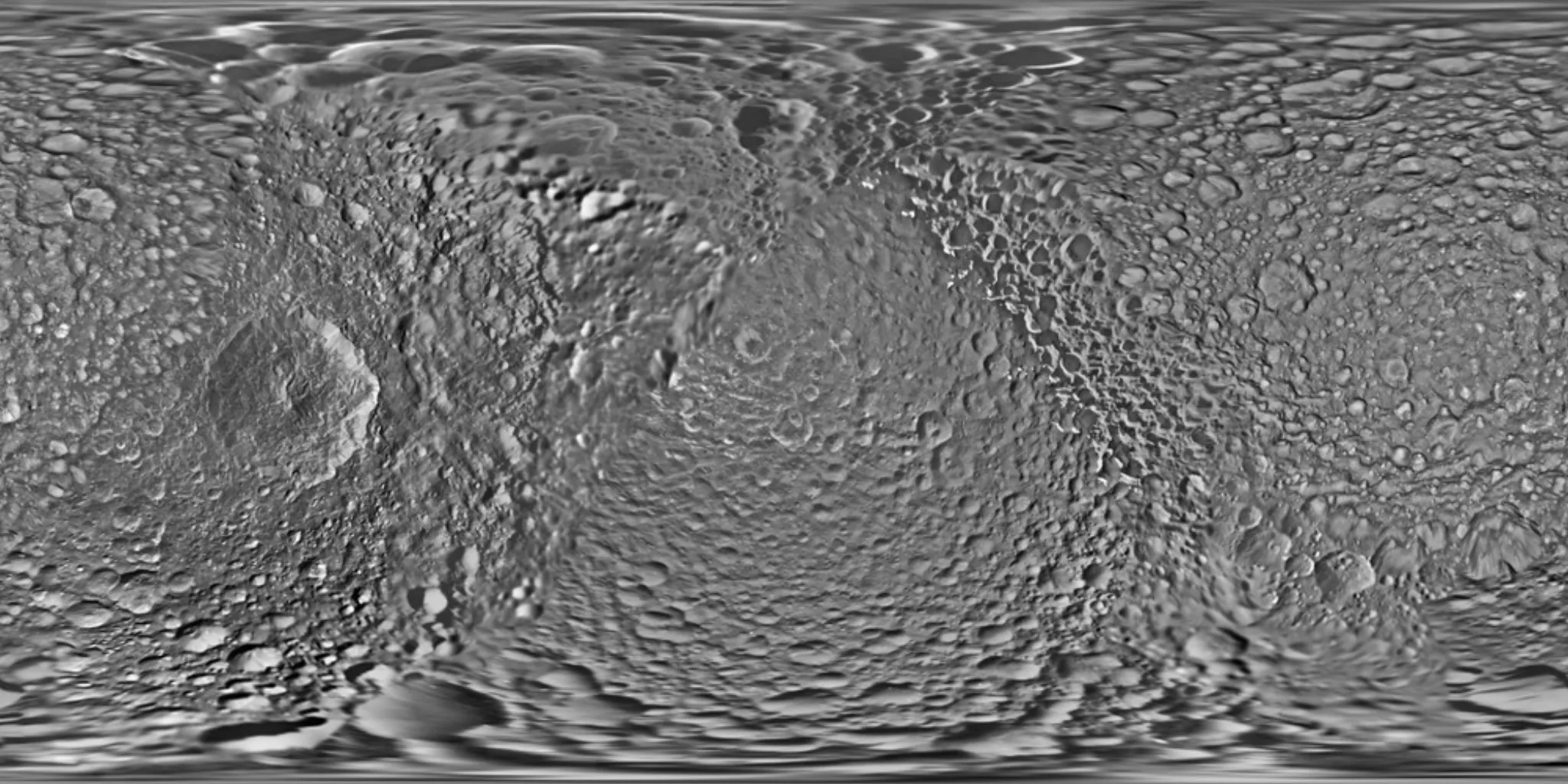
Mimas is the smallest and innermost of Saturn's round moons, and the most-cratered body its size in the solar system. Its iconic feature is the 130-km Herschel crater — one-third the moon's diameter — which gives Mimas a striking resemblance to the fictional Death Star. The impact that created Herschel was so violent it nearly shattered Mimas; fracture lines on the opposite hemisphere likely propagated through the moon as shock waves. Recent analysis of Cassini data suggests Mimas hides a global subsurface ocean beneath its battered icy crust — making it a possible "stealth ocean world."
02
Composition
Mimas is essentially a giant frozen snowball — 98% water ice with a small rocky core. Its low density and uniform brightness suggest the icy mantle is geologically inactive at the surface. The surprising 2024 finding of a subsurface ocean came not from imaging but from analysing Mimas's wobble in its orbit, which only matches a model with a liquid layer ~30 km below the surface.
05
Exploration
Voyager 1 captured the first close-up images of Mimas in 1980, revealing the iconic Herschel crater. Cassini's 13-year mission performed multiple Mimas flybys, mapping the surface in detail and gathering the orbital data later used to infer the subsurface ocean.
Did you know?
Mimas was discovered by William Herschel using his 40-foot telescope — the largest of its day.
Herschel crater's central peak rises 6 km above the crater floor — taller than Mauna Kea.
The 2024 discovery of Mimas's subsurface ocean caught researchers off-guard because the moon's heavily-cratered surface should imply a frozen, geologically dead interior.
Mimas's gravity sculpts the Cassini Division — the prominent gap visible in Saturn's rings.
If Mimas were any smaller, the Herschel impact would have completely destroyed it.
Mimas's "Death Star" appearance was noticed years before Star Wars released — but the resemblance has stuck.
Timeline
- 17891789
William Herschel discovers Mimas using his 40-foot telescope.
- 19801980
Voyager 1 reveals Herschel crater in close-up imaging.
- 20102010
Cassini finds Mimas's orbital wobble — a clue to subsurface structure.
- 20242024
Reanalysis of Cassini data confirms a young subsurface global ocean.