Miranda
Uranus's patchwork moon — a shattered-and-reassembled icy world with the solar system's tallest cliff.
Vital statistics
01
Overview
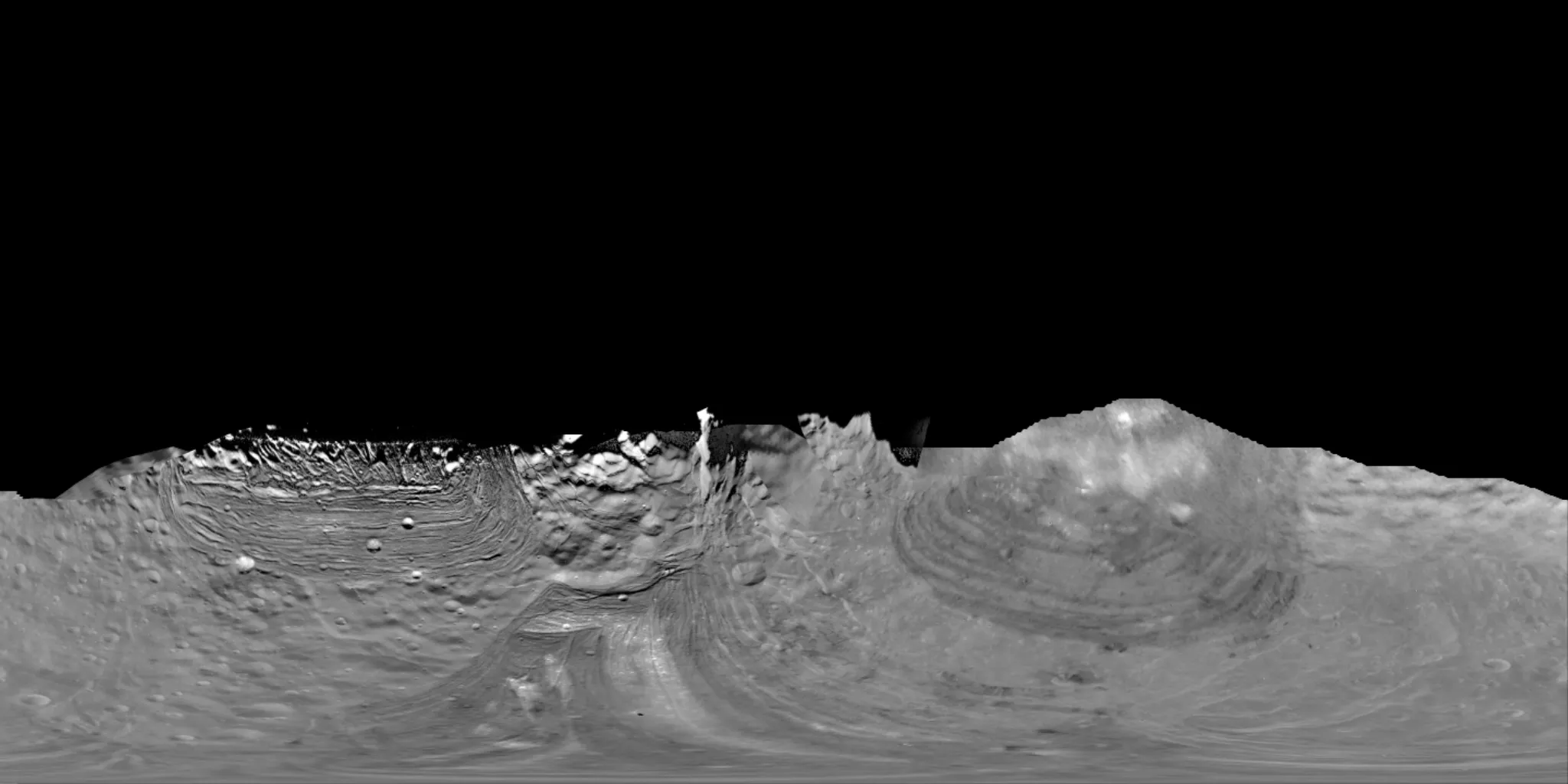
Miranda is the smallest of Uranus's five major moons and arguably the most geologically bizarre body in the solar system. Its surface is a patchwork of ancient cratered terrain and sharply different "coronae" — oval regions of parallel ridges, troughs, and faults — joined along stark boundaries that look as though the moon was shattered and reassembled. One leading hypothesis is exactly that: a major impact disrupted Miranda billions of years ago and the fragments re-coalesced gravitationally before settling into a new equilibrium. Verona Rupes, a fault scarp on Miranda, drops 20 km — the tallest cliff known in the solar system.
02
Composition
Miranda is roughly 60% water ice and 40% rock. Its coronae — Inverness, Arden, and Elsinore — show flow-like features suggesting cryovolcanic resurfacing. The moon's low density and surface variety hint at a complex thermal history despite its small size.
05
Exploration
Voyager 2 made the only close flyby of Miranda in January 1986, returning the only high-resolution images that exist. Most of what we know about Miranda comes from that single 1.5-hour encounter. No follow-up Uranus mission is currently scheduled, though NASA's Decadal Survey ranks a Uranus orbiter as a top priority for the 2030s.
Did you know?
Verona Rupes is so tall and Miranda's gravity so weak that an object falling off the cliff would take 12 minutes to hit the bottom.
Miranda was named after a character in Shakespeare's "The Tempest" — all 27 Uranian moons follow the Shakespeare/Pope naming tradition.
The 1986 Voyager 2 flyby was the only time human-made instruments have closely visited Miranda — we may not return for decades.
Inverness Corona is shaped like a chevron; Arden Corona is racetrack-shaped; Elsinore Corona is trapezoidal.
Miranda's surface variety in such a small body is unprecedented — Earth's Moon, twice the size, is more uniform.
Miranda may once have had a 1:3 orbital resonance with Umbriel that pumped tidal heating into its interior.
Timeline
- 19481948
Gerard Kuiper discovers Miranda using McDonald Observatory.
- 19861986
Voyager 2 flies by Uranus and returns Miranda's only close-up images.
- 20112011
Re-analysis of Voyager 2 imagery formally maps Verona Rupes — the tallest known cliff in the solar system at ~20 km.
- 2030s (proposed)2030s (proposed)
A flagship Uranus orbiter could return for follow-up imaging.