The Moon
Earth's tidally locked companion — a 4.5-billion-year-old fossil of the violent young solar system.
Vital statistics
01
Overview
Earth's only natural satellite formed when a Mars-sized body called Theia struck the proto-Earth roughly 4.5 billion years ago, flinging molten debris into orbit that coalesced into the Moon. Tidal locking means the same hemisphere always faces Earth, hiding the cratered far side from view until Soviet probe Luna 3 photographed it in 1959. The Moon stabilises Earth's axial tilt, drives the ocean tides, and remains the only world beyond our own where humans have walked.
04
Surface
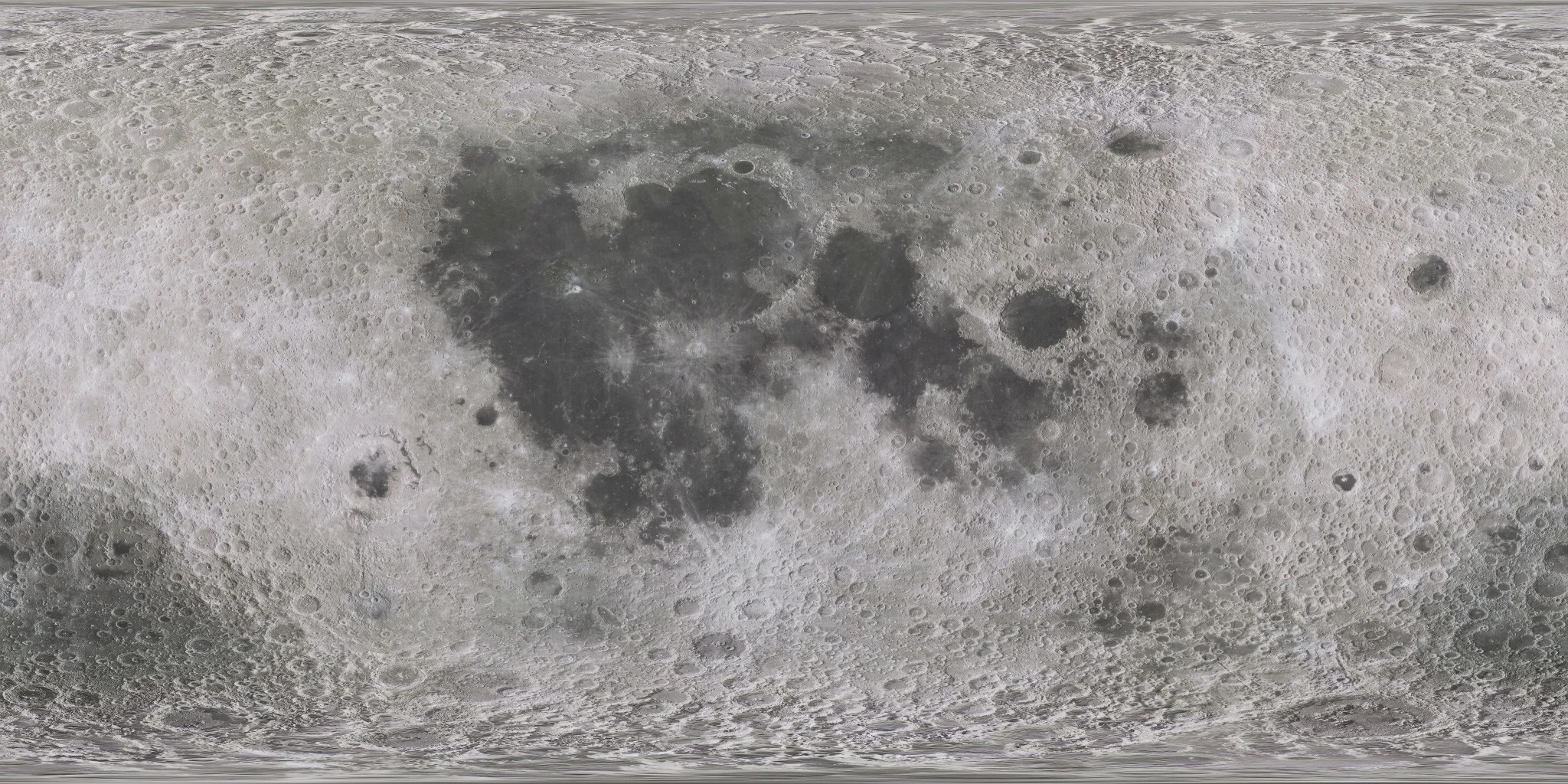
The lunar surface divides cleanly into bright, heavily cratered highlands and dark volcanic plains called maria — the basaltic floors of ancient impact basins flooded by lava more than three billion years ago. With no atmosphere or weather, footprints left by Apollo astronauts will remain undisturbed for millions of years. Permanently shadowed craters at the poles trap water ice that future crewed missions hope to mine for fuel and life support.
05
Exploration
Apollo 11 delivered the first humans to the surface in July 1969, followed by five more crewed landings through Apollo 17 in 1972 — the only times humans have left low Earth orbit. The 21st century brought a renewed wave: China's Chang'e program returned samples in 2020 and landed on the far side in 2019, India's Chandrayaan-3 touched down near the south pole in August 2023, and NASA's Artemis III is targeted for a 2026 crewed return.
Did you know?
The Moon is drifting away from Earth at 3.8 cm per year — about as fast as fingernails grow.
A solar eclipse only happens because the Sun is 400× larger than the Moon and 400× farther away.
Moonquakes detected by Apollo seismometers can last over an hour because the dry lunar interior rings like a bell.
The Moon has no global magnetic field, but localised magnetic anomalies create swirling bright patterns on the surface.
Apollo astronauts left retroreflectors that scientists still bounce lasers off today to measure the Earth-Moon distance to millimetre precision.
The far side is more rugged than the near side and has a far thinner mare coverage — the asymmetry remains an open scientific puzzle.
Moon dust smells like spent gunpowder according to Apollo crew reports — and is sharp enough to shred spacesuit seals.
Timeline
- 4.51 Bya4.51 Bya
Giant impact between proto-Earth and Theia forms the Moon.
- 19591959
Soviet Luna 3 returns the first photographs of the lunar far side.
- 19691969
Apollo 11 lands; Neil Armstrong and Buzz Aldrin become the first humans on the Moon.
- 19721972
Apollo 17 closes out the crewed Apollo program — last humans on the surface to date.
- 20192019
China's Chang'e 4 makes the first soft landing on the far side.
- 20232023
India's Chandrayaan-3 lands near the lunar south pole.
- 2026 (planned)2026 (planned)
NASA Artemis III targets the first crewed lunar landing of the 21st century.