Oberon
Uranus's outermost large moon — heavily cratered with mysterious dark crater floors hinting at carbon-rich ejecta.
Vital statistics
01
Overview
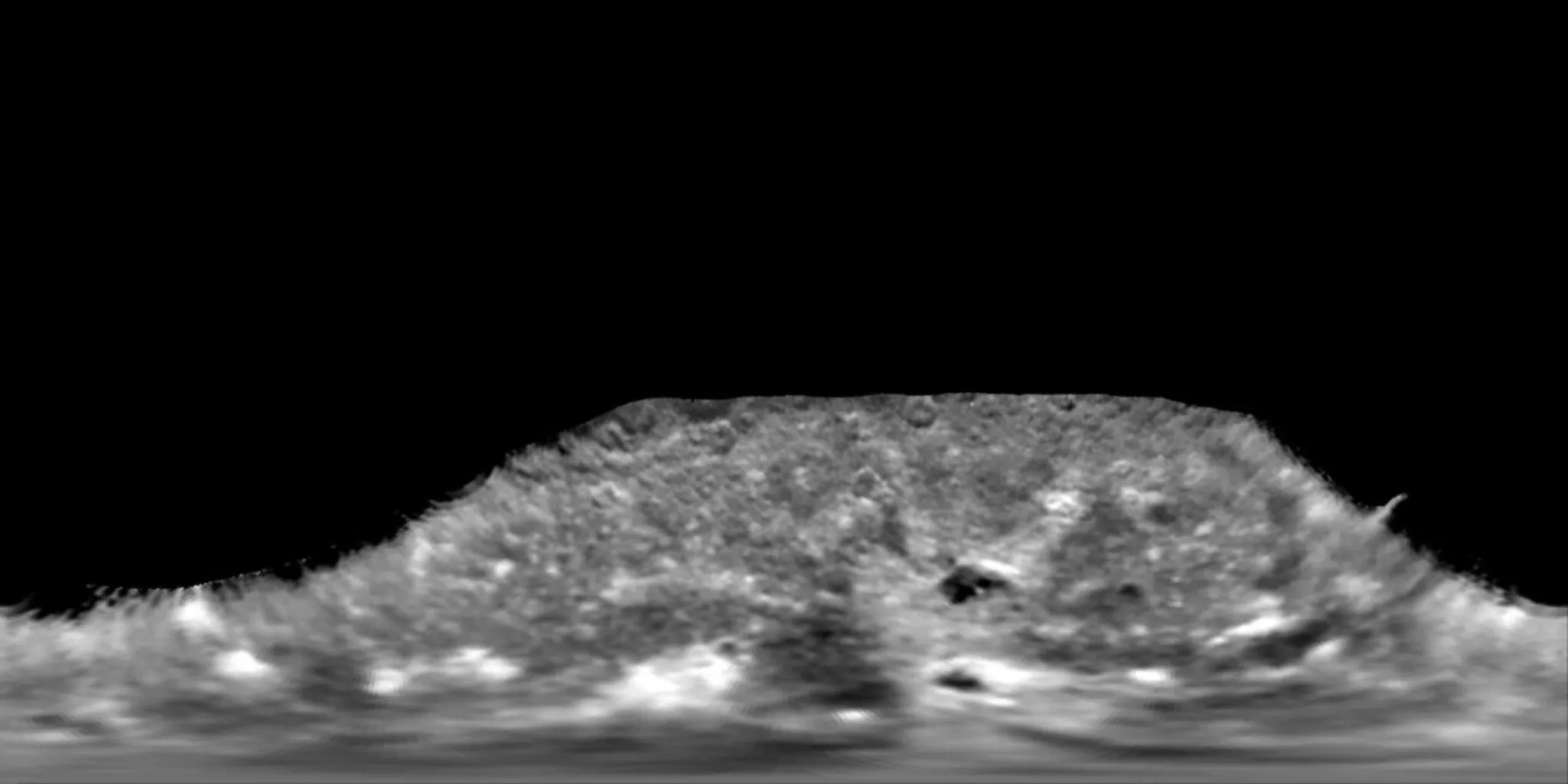
Oberon is the second-largest and outermost of Uranus's major moons. Unlike Titania, Oberon's surface is heavily cratered with little evidence of recent geological activity — the surface preserves a record of the early solar system's impact history. Several large craters have unusually dark floors, possibly from carbonaceous material exposed or excavated by the impacts. A 6-km-tall mountain rises near the south polar region — the only such feature visible in Voyager 2's flyby data. Oberon orbits far enough from Uranus that during parts of its orbit it lies outside the planet's magnetosphere, exposing its surface directly to the solar wind.
02
Composition
Oberon is approximately 50% water ice, 30% silicate rock, and 20% carbonaceous material. The dark crater-floor deposits may be primitive organic-rich material similar to D-type asteroids. Its bulk composition suggests differentiation into a rocky core, icy mantle, and crust during early heating from radioactive decay.
05
Exploration
Voyager 2 imaged Oberon during its 1986 Uranus flyby. As with the other Uranian moons, no follow-up has been performed.
Did you know?
Oberon is named for the king of the fairies, opposite his queen Titania in Shakespeare.
The 6-km mountain near Oberon's south pole is the tallest known feature on any Uranian moon.
Oberon's heavily cratered surface implies it has been geologically dead for 4+ billion years.
The dark crater-floor material may be carbonaceous compounds — a proxy for primitive organic chemistry.
Oberon orbits 23 Uranus-radii out — far enough that part of its orbit takes it outside Uranus's magnetic field.
Most of Oberon's surface features are named after characters from Shakespeare's tragedies.
Timeline
- 17871787
William Herschel discovers Oberon together with Titania.
- 18521852
John Herschel — William's son — formally proposes the Shakespearean naming convention later adopted for all Uranian moons.
- 19861986
Voyager 2 returns the only close-up images of Oberon.
- 2030s (proposed)2030s (proposed)
A NASA Uranus Orbiter and Probe — top priority of the 2023 Planetary Science Decadal Survey — would return for full surface mapping.