Phobos
Mars's inner moon — a captured asteroid spiralling toward a fiery end in 50 million years.
Vital statistics
01
Overview
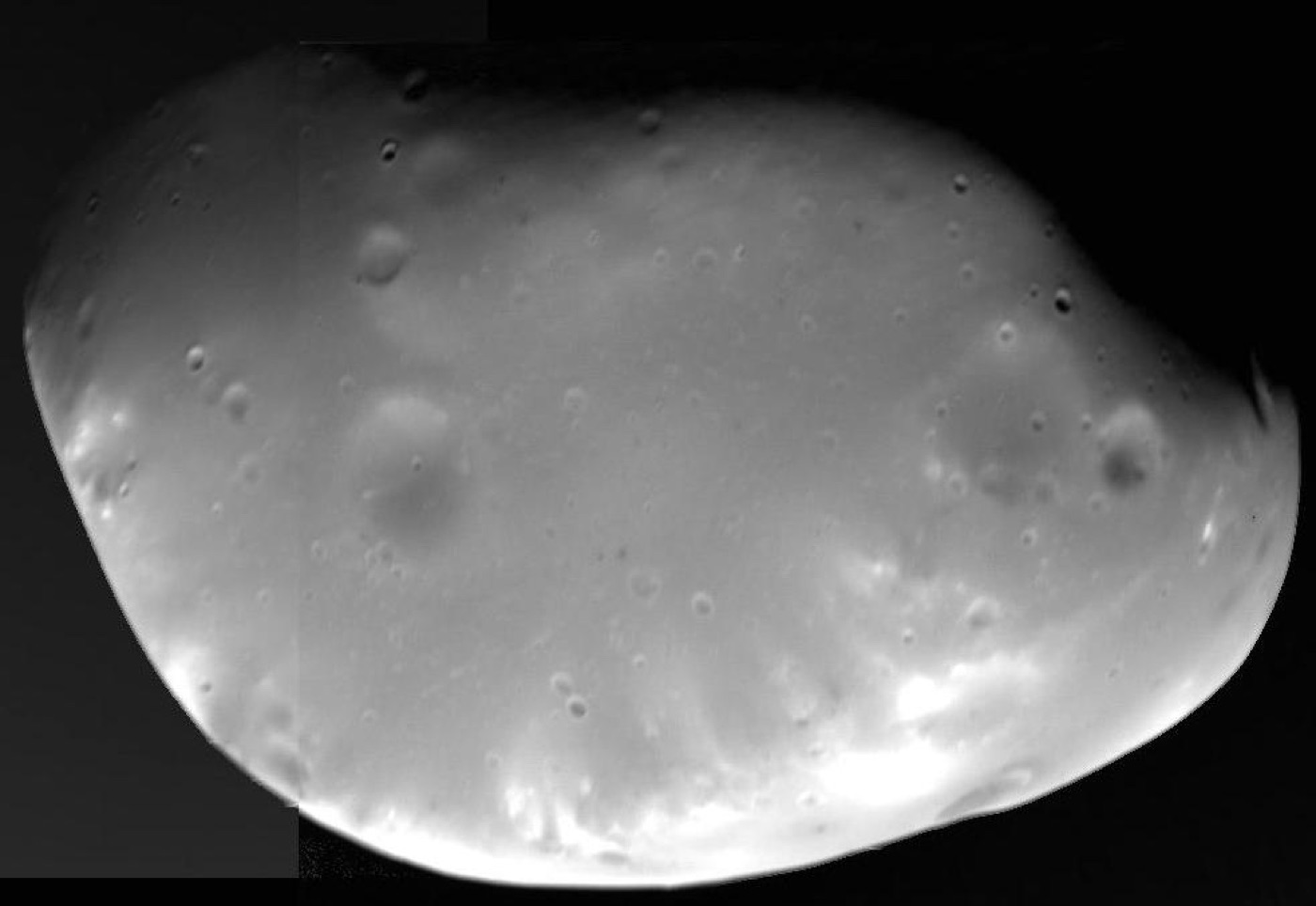
Phobos is the larger and inner of Mars's two tiny moons. Discovered by Asaph Hall in 1877 and named for the Greek god of fear, it orbits closer to its parent than any other moon in the solar system — just 6,000 km above the Martian surface. Phobos rises in the west and sets in the east twice each Martian day because it orbits Mars faster than Mars rotates. Tidal forces are pulling it inexorably inward by about 2 cm per year; in roughly 50 million years it will either crash into Mars or break apart into a temporary ring.
02
Composition
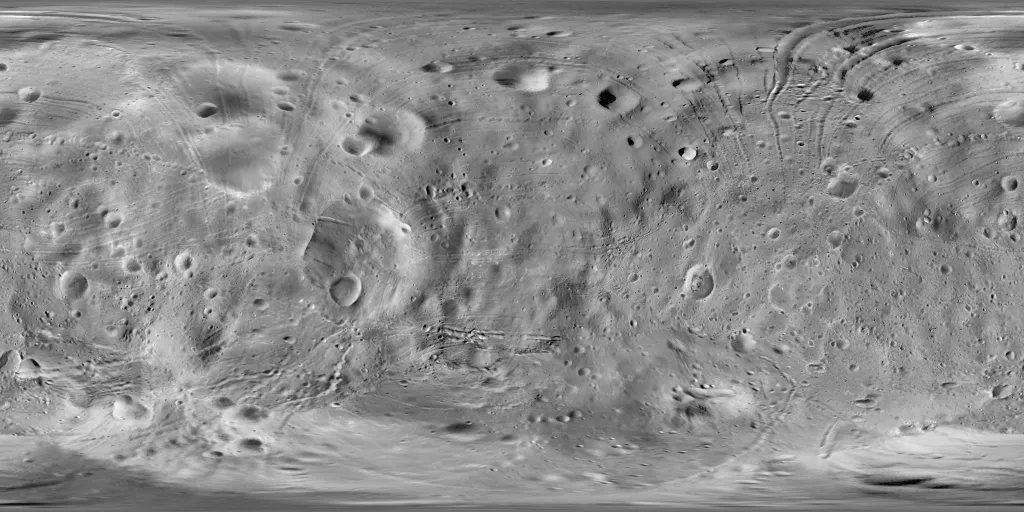
Phobos is dark and reddish, with a low density that strongly suggests a porous, rubble-pile interior. Spectra resemble carbonaceous chondrite meteorites and outer-belt D-type asteroids, supporting the hypothesis that Phobos is a captured asteroid rather than a co-formed moon. The dominant surface feature is the 9-km Stickney crater, whose impact almost shattered the moon and produced grooves that radiate across one hemisphere.
05
Exploration
Mariner 9 returned the first close-up images of Phobos in 1971. The Soviet Phobos 2 mission reached the moon in 1989 but was lost before deploying its lander. Mars Express has performed multiple flybys, returning the highest-resolution images yet. Japan's MMX (Martian Moons Exploration) mission, launching 2026, will land on Phobos and return samples to Earth in 2031 — the first ever sample return from a Martian moon.
Did you know?
Phobos orbits so low that from much of Mars's surface, it would set below the horizon while still visibly above you elsewhere.
A future Phobos crash into Mars would create a Roche-limit ring around Mars temporarily — Mars has had rings before, and may again.
The grooves radiating from Stickney crater were once thought to be impact fractures but may instead be drag chains from rolling boulders.
Stickney is named for Angeline Stickney, the wife of Phobos's discoverer Asaph Hall — she encouraged him not to give up the search.
Phobos is so close to Mars that it appears as a misshapen disc from the surface, not a point of light like Earth's Moon does from Earth.
NASA proposed using Phobos as a stepping stone for human Mars exploration — astronauts could relay rover commands without the speed-of-light delay from Earth.
Timeline
- 18771877
Asaph Hall discovers Phobos at the US Naval Observatory.
- 19711971
Mariner 9 returns first close-up images of Phobos.
- 19891989
Soviet Phobos 2 reaches the moon but is lost before lander deployment.
- 20082008
Mars Express captures the highest-resolution Phobos images to date.
- 20112011
Russia's Phobos-Grunt sample-return mission fails after launch.
- 2026 (planned)2026 (planned)
JAXA's MMX launches toward Phobos for sample return.
- 2031 (planned)2031 (planned)
MMX returns Phobos samples to Earth.