The Sun
A G-type main-sequence star halfway through a 10-billion-year life — the gravitational anchor of everything we know.
Vital statistics
01
Overview
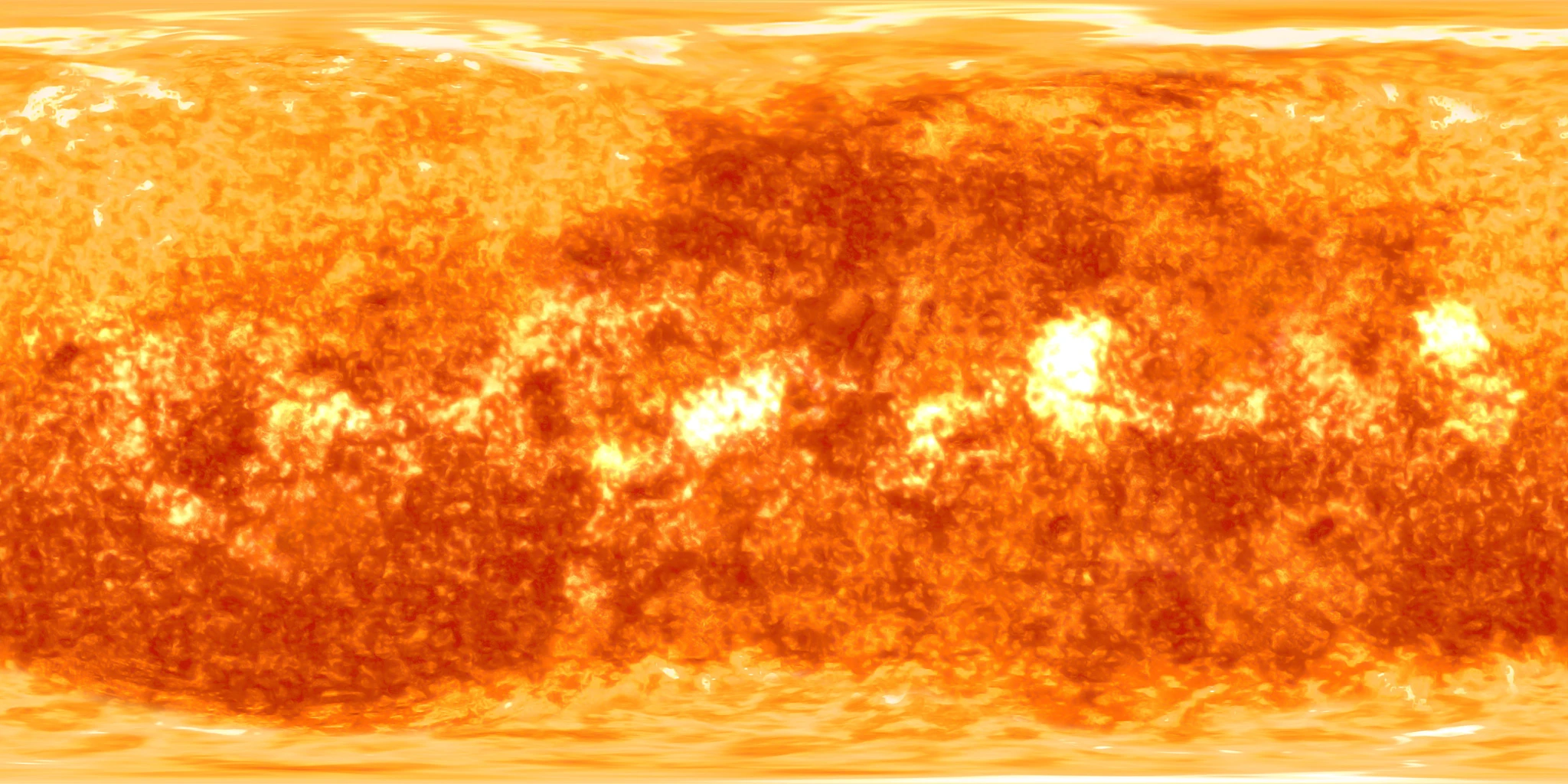
The Sun is an unremarkable yellow dwarf star — and the most consequential object in our existence. Every second it fuses roughly 600 million tonnes of hydrogen into helium in its core, releasing energy that takes around 170,000 years to crawl out as photons before sprinting the final 150 million kilometres to Earth in eight minutes. Its gravity holds the eight planets, dwarf planets, and trillions of small bodies in orbit. The Sun contains 99.86% of the mass of the entire solar system.
02
Composition
A vast plasma sphere of about 73% hydrogen and 25% helium by mass, with traces of oxygen, carbon, neon, and iron. Layers run from a fusion core at 15.7 million °C, outward through radiative and convective zones, to the visible photosphere, then the thin chromosphere and the tenuous, surprisingly hotter corona — a temperature inversion still not fully explained.
05
Exploration
The Sun has been studied from space since the 1960s, but the modern era belongs to two missions. NASA's Parker Solar Probe, launched in 2018, has flown closer than any spacecraft — within 6.1 million km of the surface in December 2024 — sampling the corona directly. ESA and NASA's Solar Orbiter, launched 2020, returns the first close-up images of the polar regions. Earlier workhorses include SOHO (1995), Ulysses, and the still-operating SDO.
Did you know?
Light leaving the Sun's core takes an estimated 100,000 to 200,000 years to random-walk to the surface.
The Sun loses about 4 million tonnes of mass every second to fusion and the solar wind.
The corona reaches over 1 million °C — hundreds of times hotter than the photosphere beneath it.
Sunspots can be larger than Earth and trace an 11-year magnetic cycle that flips the Sun's poles.
A grain of the Sun's core, scaled up, would emit enough heat to kill anyone within 150 km.
In about 5 billion years the Sun will swell into a red giant and engulf Mercury and Venus.
Parker Solar Probe became the fastest human-made object ever, exceeding 690,000 km/h on close approach.
Timeline
- 4.6 Bya4.6 Bya
Solar nebula collapses; the Sun ignites hydrogen fusion.
- 16101610
Galileo and contemporaries record the first telescopic sunspot observations.
- 18591859
The Carrington Event — the largest recorded geomagnetic storm — sets telegraph offices alight.
- 19951995
SOHO launches; begins continuous solar monitoring still ongoing today.
- 20182018
Parker Solar Probe launches toward the corona.
- 20202020
Solar Orbiter launches to image the Sun's polar regions.
- 20242024
Parker Solar Probe makes its closest approach yet — 6.1 million km from the surface.