Titan
The only moon with a thick atmosphere — methane rivers and lakes flow on a world drenched in organic chemistry.
Vital statistics
01
Overview
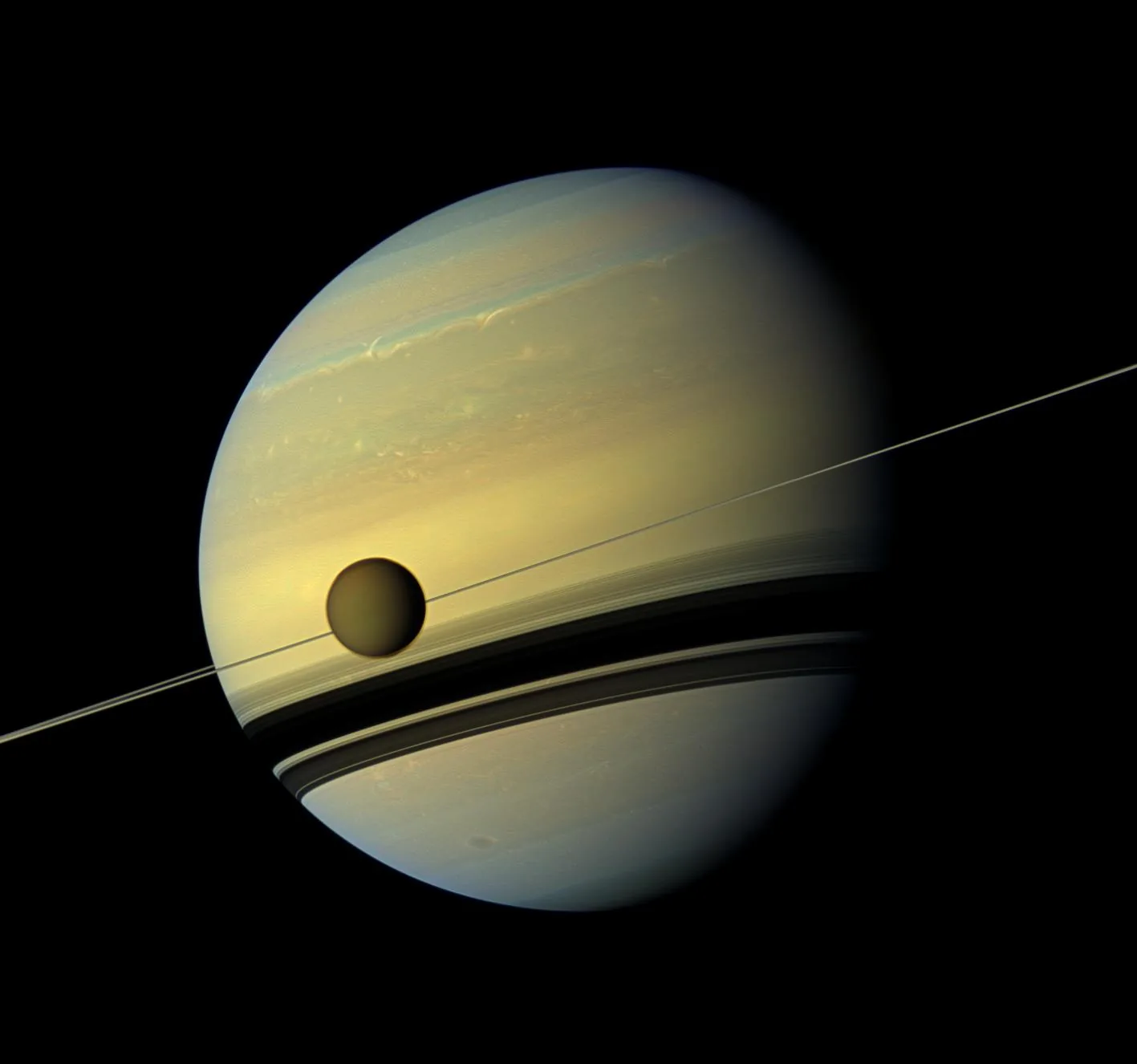
Titan is the second-largest moon in the solar system and the only one wrapped in a substantial atmosphere — denser at the surface than Earth's. Beneath an opaque orange haze of organic chemistry, it hosts the only known surface liquids beyond our planet: rivers, lakes, and seas of liquid methane and ethane that drizzle from clouds, carve channels through icy bedrock, and pool in polar basins. The familiar geology of a planet runs on completely different chemistry.
03
Atmosphere
Titan's atmosphere is roughly 95% molecular nitrogen and 5% methane, with surface pressure of 1.45 bar — about 45% greater than Earth's at sea level. Sunlight breaks methane apart in the upper atmosphere, kick-starting reactions that produce a haze of complex hydrocarbons (tholins) responsible for the moon's tangerine glow. Methane rains from clouds, replenishing surface liquids and driving a hydrological cycle that mirrors Earth's water cycle but with hydrocarbons instead of water.
04
Surface
Cassini's radar, peering through the haze, mapped vast equatorial dune fields of dark organic sand, river networks etched into icy bedrock, and polar seas — the largest, Kraken Mare, covers roughly 400,000 km². The moon's ice shell may overlie a buried liquid water ocean. The Huygens probe, descending to the surface in 2005, photographed rounded pebbles that look unmistakably like cobbles in a terrestrial streambed, evidence of past liquid flow.
05
Exploration
Christiaan Huygens spotted Titan in 1655. Pioneer 11 and the Voyagers made flybys in 1979-81, but its haze hid the surface. NASA-ESA-ASI Cassini-Huygens transformed our view: the Cassini orbiter (2004-2017) mapped Titan with radar over 127 flybys, and ESA's Huygens probe parachuted to the surface on 14 January 2005 — the most distant landing in history. NASA's Dragonfly rotorcraft is scheduled to launch in 2028 and arrive in 2034 to fly between Titan sites.
Did you know?
Titan is the only world other than Earth known to have stable liquid bodies on its surface.
Its atmosphere is so dense and gravity so low that a human in a flight suit could fly by flapping wings.
The Huygens probe still holds the record for the most distant soft landing ever made by a spacecraft.
Titan's methane lakes are clear enough that radar pulses penetrate over 100 m to map their floors.
Dragonfly will be the first rotorcraft to operate on another world — flying tens of kilometres between science stops.
Titan's nitrogen-rich atmosphere is chemically reminiscent of early Earth before oxygen accumulated.
A "year" on Titan covers about 29.5 Earth years — the time Saturn takes to orbit the Sun.
Timeline
- 16551655
Christiaan Huygens discovers Titan — the first moon found beyond our own.
- 19441944
Gerard Kuiper detects methane in Titan's atmosphere via spectroscopy.
- 19801980
Voyager 1 flyby characterises the dense nitrogen-methane atmosphere.
- 20042004
Cassini-Huygens enters Saturn orbit and begins targeted Titan flybys.
- 20052005
Huygens probe parachutes to Titan's surface — the most distant landing ever performed.
- 20172017
Cassini ends its mission; 127 Titan flybys completed.
- 2028 (planned)2028 (planned)
NASA Dragonfly rotorcraft launches toward Titan.
- 2034 (planned)2034 (planned)
Dragonfly arrives and begins powered flight on Titan.