Titania
Uranus's largest moon — an icy world with deep canyons and a surprising lack of craters.
Vital statistics
01
Overview
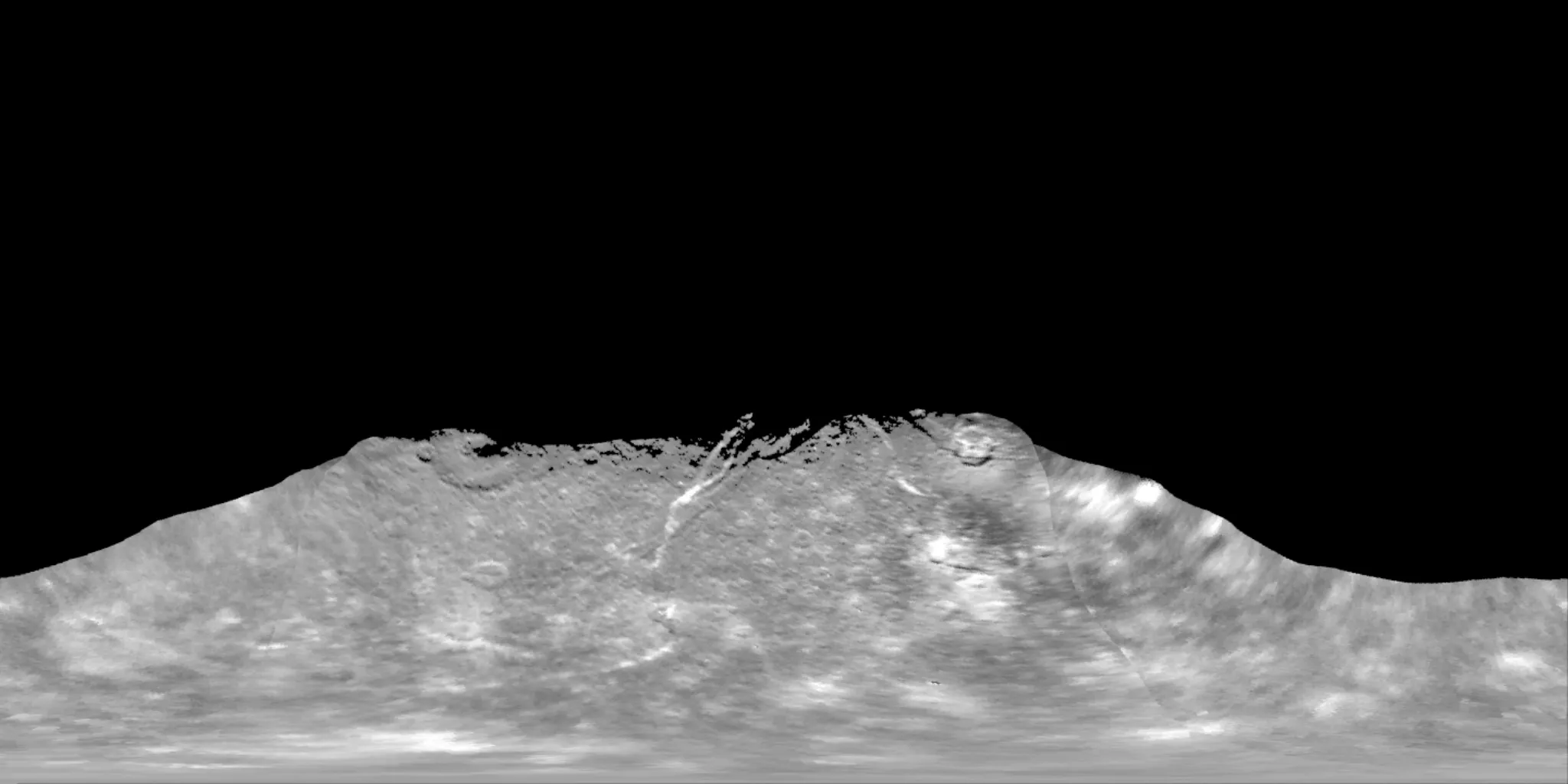
Titania is Uranus's largest moon and the eighth-largest in the solar system. Its surface is a mixture of cratered terrain and large canyon systems — Messina Chasma, the moon's longest, runs 1,500 km. The surface is less heavily cratered than expected, suggesting geologically recent resurfacing. A tenuous carbon-dioxide atmosphere was tentatively detected via stellar occultation, making Titania a possible host for trace volatile chemistry. Like all the major Uranian moons, our knowledge of Titania comes almost entirely from a single Voyager 2 flyby in 1986.
02
Composition
Titania is roughly equal parts water ice and rock by mass. Models suggest a differentiated interior with a rocky core, possibly a subsurface liquid ocean during its early history, and an icy mantle. The low density of impact craters on parts of the surface implies cryovolcanic resurfacing within the past few billion years.
05
Exploration
Voyager 2's 1986 flyby returned hemisphere-scale imaging — the southern hemisphere only, since Uranus's extreme axial tilt put the northern hemisphere in darkness. Hubble and ground-based occultations have refined estimates of Titania's atmosphere and surface composition, but no follow-up mission has visited.
Did you know?
Titania is named for the queen of the fairies in Shakespeare's "A Midsummer Night's Dream".
Messina Chasma, Titania's longest canyon, is twice as long as the Grand Canyon and three times as deep.
Despite being the eighth-largest moon in the solar system, Titania is invisible from Earth without a telescope — Uranus is too far.
Voyager 2's flyby imaged only ~40% of Titania's surface — most of the moon remains unmapped.
A 2001 stellar occultation tentatively detected CO₂ in Titania's atmosphere; the result remains unconfirmed.
Titania might have had an active subsurface ocean billions of years ago that has since frozen.
Timeline
- 17871787
William Herschel discovers Titania six years after discovering Uranus.
- 19861986
Voyager 2 returns the only close-up images of Titania.
- 20012001
Stellar occultation tentatively detects a thin CO₂ atmosphere.
- 2030s (proposed)2030s (proposed)
A NASA Uranus Orbiter and Probe — top priority of the 2023 Planetary Science Decadal Survey — would return for follow-up imaging.