Triton
Neptune's largest moon — a captured Kuiper-Belt object orbiting backward, with active nitrogen geysers.
Vital statistics
01
Overview
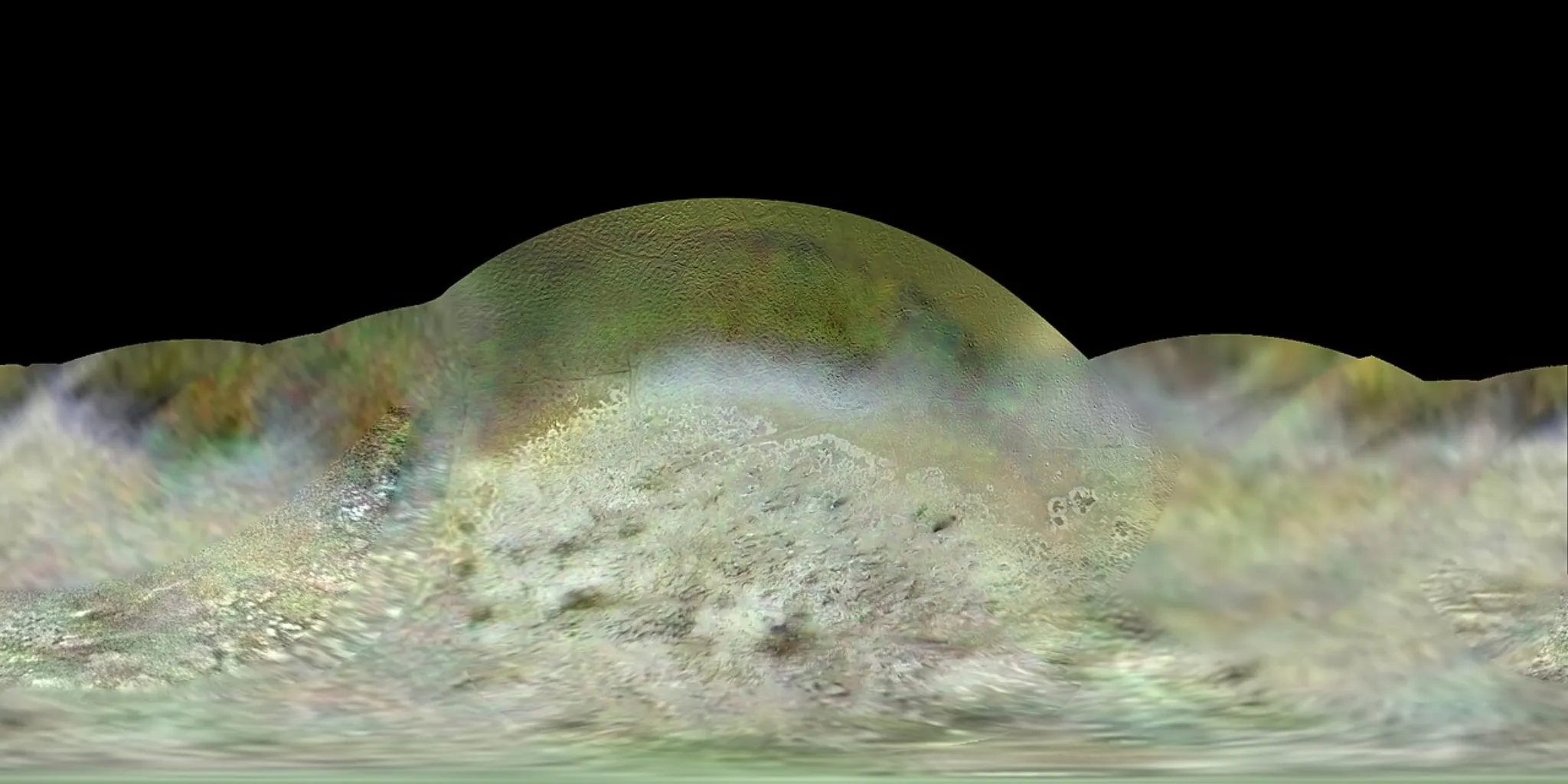
Triton is one of the most peculiar moons in the solar system. Its retrograde orbit — opposite to Neptune's rotation — is a sure sign that Triton wasn't born with Neptune but was captured from the Kuiper Belt billions of years ago. The capture process tidally heated and reshaped Triton; today its surface is geologically young, with a "cantaloupe terrain" of dimples and ridges, and active cryovolcanic plumes 8 km tall. Voyager 2's 1989 flyby caught those plumes mid-eruption — making Triton one of only a handful of bodies in the solar system with confirmed active geology.
02
Composition
Triton is roughly 50% rock and 50% ices (mostly water with frozen nitrogen, methane, and carbon dioxide on the surface). The interior may host a subsurface ocean kept warm by tidal heating from Neptune. The surface is the most reflective of any large moon (albedo 0.76) and dominated by frozen nitrogen — when sunlight warms the polar caps, nitrogen sublimates into the thin atmosphere, where it forms a haze and eventually condenses again at the colder pole.
05
Exploration
Voyager 2 conducted the only close flyby of Triton in August 1989, less than five hours after the Neptune encounter. The data captured during that brief pass — geysers, cantaloupe terrain, atmospheric pressure, surface composition — remain the basis for everything we know. Several proposed missions (Trident, NASA's Outer Solar System concepts) target a return; none are funded yet.
Did you know?
Triton is the only large moon in the solar system with a retrograde orbit.
Voyager 2 captured nitrogen plumes erupting from Triton's south polar cap — geysers powered by solar warming.
Triton's capture should have eventually flung Neptune's native moons into chaotic orbits — and Neptune's small inner moons today still bear the dynamical scars.
In ~3.6 billion years, tidal forces will pull Triton inside Neptune's Roche limit; it'll break up into a ring system.
Triton's "cantaloupe terrain" — dimples spaced 30 km apart — is unique in the solar system; nobody is sure how it forms.
Triton is colder than Pluto — at -235 °C, even nitrogen freezes solid on its surface.
Pluto and Triton are similar in size, density, and composition — Triton is essentially a captured Pluto-cousin.
Timeline
- 18461846
William Lassell discovers Triton 17 days after Neptune's discovery.
- 19891989
Voyager 2 flies past Triton, discovering active nitrogen plumes.
- 20192019
NASA selects the Trident mission concept for Discovery Program study — a proposed flyby targeting a Triton return.
- 2030s (proposed)2030s (proposed)
Trident or similar concept missions target a Triton return.