Second planet from the Sun
Venus
A runaway-greenhouse world hot enough to melt lead, shrouded in sulphuric-acid clouds and scarred by volcanism.
Vital statistics
01
Overview
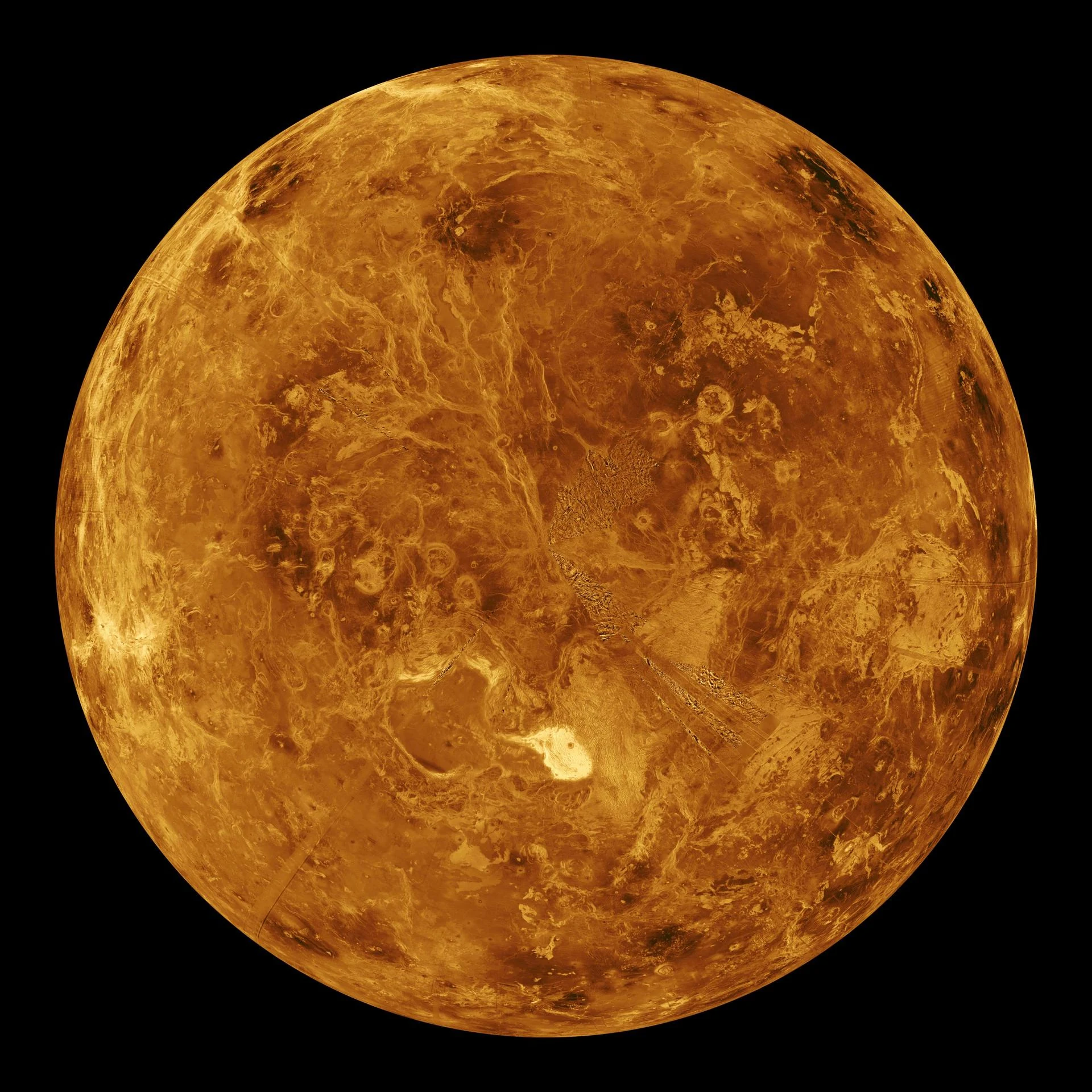
Venus is nearly Earth's twin in size and bulk composition — and a cautionary tale of climate gone catastrophic. A runaway greenhouse effect has driven its surface temperature to 465 °C, hotter than Mercury's noon, beneath a 92-bar atmosphere of CO₂ and clouds of sulphuric acid. It rotates backwards once every 243 Earth days, slower than its 225-day orbit. The surface, hidden from optical view, was finally mapped in the 1990s by radar — revealing volcanic plains, mountain ranges, and few impact craters, hinting at recent global resurfacing.
03
Atmosphere
The atmosphere is 96.5% carbon dioxide, with thick clouds of sulphuric acid droplets at 50-70 km altitude. Surface pressure is 92 times Earth's — equivalent to being nearly a kilometre underwater. Despite the slow rotation, super-rotating winds at cloud level whip around the planet in just four Earth days. Lightning has been detected, and the dayside glows a deep red at the surface.
04
Surface
Roughly 80% of the surface is volcanic plains, with two highland "continents" — Ishtar Terra in the north and Aphrodite Terra near the equator. There are over 1,600 major volcanoes, including Maat Mons. The crater record suggests the surface is geologically young — about 300-700 million years old — possibly resurfaced in a global volcanic event. In 2023, archival Magellan radar data revealed a volcanic vent that visibly changed shape, the first direct evidence of ongoing eruptions.
05
Exploration
More than 40 missions have been sent. The Soviet Venera programme achieved the only successful surface landings — Venera 7 transmitted from the surface for 23 minutes in 1970; Venera 13 returned colour panoramas in 1982. NASA's Magellan radar-mapped 98% of the surface from 1990-94. After a long lull, the late 2020s bring three new missions: NASA's DAVINCI atmospheric probe and VERITAS radar mapper, plus ESA's EnVision orbiter, all launching by 2031.
Did you know?
A day on Venus is longer than a year — 243 Earth days to rotate, 225 to orbit the Sun.
Venus rotates backwards relative to its orbit — likely the result of an ancient giant impact.
The Venera 13 lander survived 127 minutes on the surface in 1982 before succumbing to heat and pressure.
Venus is the brightest natural object in Earth's night sky after the Moon — bright enough to cast shadows.
Cloud-top winds circle the planet in 4 Earth days while the surface barely moves — atmospheric super-rotation still puzzles scientists.
Surface pressure is equivalent to diving 900 metres beneath Earth's ocean.
In 2020, phosphine was claimed in Venus's clouds — a controversial possible biosignature still under debate.
Timeline
- 16101610
Galileo observes Venus's phases, supporting the heliocentric model.
- 17611761
Mikhail Lomonosov detects an atmosphere around Venus during a transit.
- 19621962
Mariner 2 makes the first successful interplanetary flyby.
- 19701970
Venera 7 transmits the first data from another planet's surface.
- 19821982
Venera 13 returns the first colour panoramas of the Venusian surface.
- 19901990
Magellan begins radar mapping; eventually covers 98% of the surface.
- 20232023
Re-analysis of Magellan data reveals an actively erupting volcanic vent.
- 2030 (planned)2030 (planned)
DAVINCI, VERITAS, and EnVision missions begin a new era of Venus science.