Space weather · live from NOAA SWPC
Space weather right now: The sky is quiet tonight
Can you see aurora tonight?NoneAurora unlikely except near the poles (65°N+).
Kp index
1Quiet
Solar wind
400km/s
Bz (IMF)
0nT northward
Storm scale
G0 — Quiet
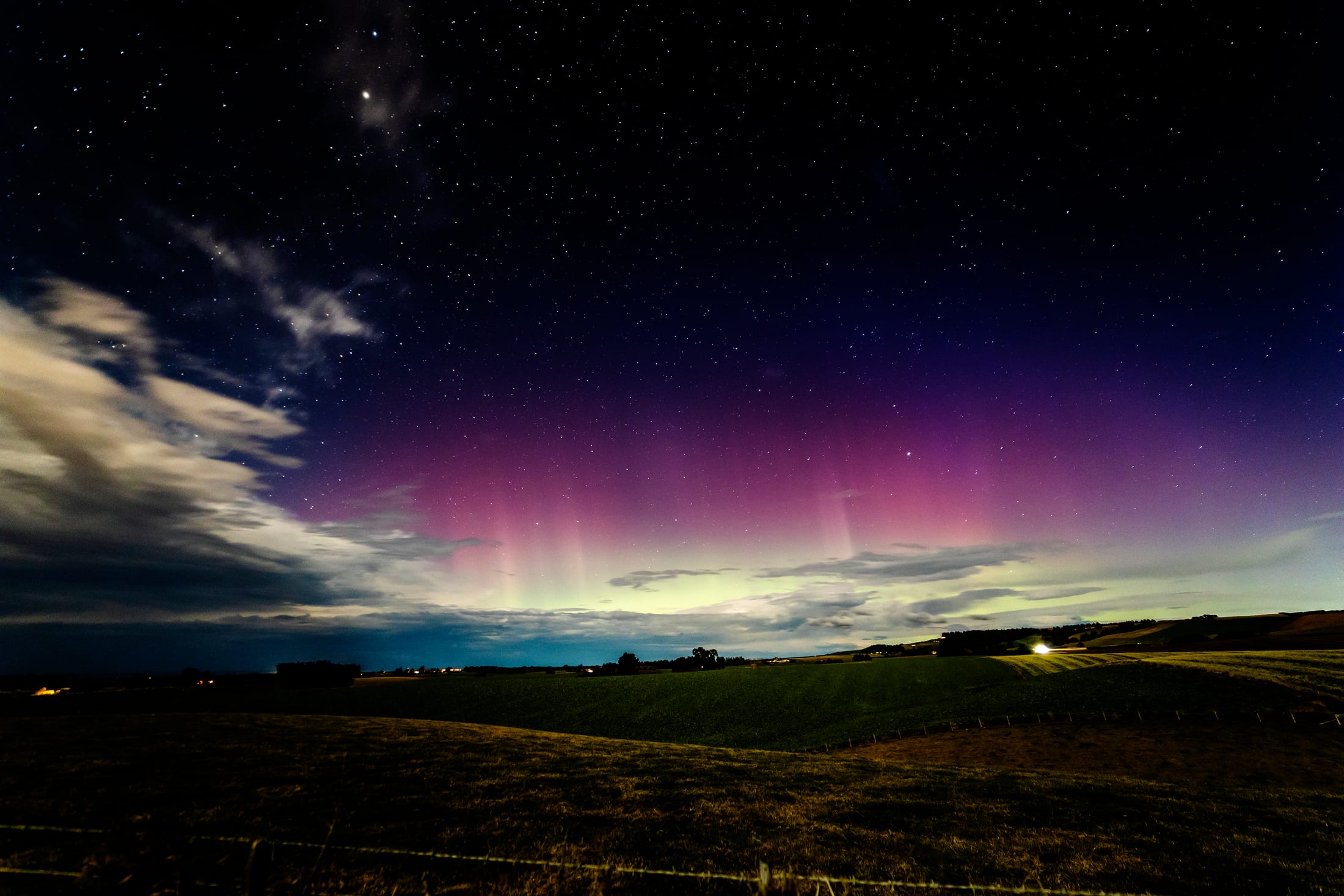
Paul Stewart (CC0 1.0)
Current conditions: Quiet — G0 — Quiet
Data source: NOAA Space Weather Prediction Center
Live· Updated just now
Kp Index
1
Quiet→Stable
0 Quiet5 Storm9 Extreme
24h forecast: Kp 1
Solar Wind
Speed400 km/s
300600900
Density5 p/cm³
Bz (IMF)0 nT(northward)
Aurora Forecast
Can I see aurora tonight?
None
Aurora unlikely except near the poles (65°N+).
Aurora Visibility Guide
Kp9
40°N+
New York, Madrid, Beijing, Tokyo
Kp7
50°N+
London, Berlin, Seattle, Calgary
Kp5
55°N+
Edinburgh, Copenhagen, Edmonton
Kp3
60°N+
Anchorage, Helsinki, Oslo
Kp1VISIBLE
65°N+
Reykjavik, Tromso, Fairbanks
Geomagnetic Storm Scale
G0
QuietCurrent
No impacts
G1
Minor
Weak power grid fluctuations, minor satellite operations impact
G2
Moderate
High-latitude power systems may see voltage alarms; HF radio fading
G3
Strong
Voltage corrections needed; satellite surface charging; GPS issues
G4
Severe
Widespread voltage problems; satellite tracking issues; HF blackout
G5
Extreme
Grid collapse possible; satellite damage risk; full HF blackout
Recent Solar Flares
Past 7 daysRadiation Belt Status
Inner Beltnormal
Outer Beltnormal
Solar Proton EventsNone
Where the aurora is tonight
NOAA's live aurora-oval forecast — the band where aurora is most likely overhead right now. Updates about every 30 minutes.
Northern Hemisphere
Aurora Borealis
Southern Hemisphere
Aurora Australis
Brighter bands = higher probability of visible aurora. Source: NOAA Space Weather Prediction Center (public domain).
What it looks like
Real aurora — from the ground at both poles, and from orbit.
Northern Lights — from the ground
Aurora borealis over the Arctic — Norway, Iceland, Alaska, Canada.
Southern Lights — from the ground
Aurora australis from Antarctica, Tasmania and the far south.
Aurora from Space
The auroral oval seen by astronauts aboard the International Space Station.
What Is Space Weather?
Space weather describes the conditions in space driven by the Sun's activity. Solar flares, coronal mass ejections (CMEs), and high-speed solar wind streams can all interact with Earth's magnetic field, creating geomagnetic storms that produce stunning aurora displays but can also disrupt satellite operations, GPS navigation, radio communications, and even power grids.
The Kp indexis the primary measure of geomagnetic activity, ranging from 0 (quiet) to 9 (extreme storm). It's derived from ground-based magnetometer stations worldwide and updated every 3 hours. When the Kp index rises above 5, NOAA issues geomagnetic storm warnings on the G1–G5 scale.
Solar flaresare classified by their X-ray intensity: C-class (small), M-class (medium), and X-class (major). Each class is 10 times more powerful than the previous. The strongest flares can cause radio blackouts lasting hours and launch CMEs that reach Earth in 1–3 days.
Understanding space weather is increasingly important as our civilization relies more on technology vulnerable to solar activity — from the satellites that power GPS and weather forecasting to the astronauts aboard the International Space Station and future lunar missions.
Data Sources & Further Reading
Dive Deeper
Explore more of the cosmos