Hubble Space Telescope
The 2.4-metre telescope that rewrote cosmology — still imaging the universe more than 35 years after launch.
Vital statistics
01
Overview
The Hubble Space Telescope is the most scientifically productive observatory ever built. Carried to orbit by Space Shuttle Discovery on April 24, 1990, its 2.4-metre primary mirror sits above Earth's shimmering atmosphere, delivering images of unmatched clarity in ultraviolet, visible, and near-infrared light. Operated jointly by NASA and ESA, Hubble has refined the age of the universe, confirmed the existence of supermassive black holes, and tracked the accelerating expansion driven by dark energy. More than three decades on, it continues to publish cutting-edge science.
02
Composition
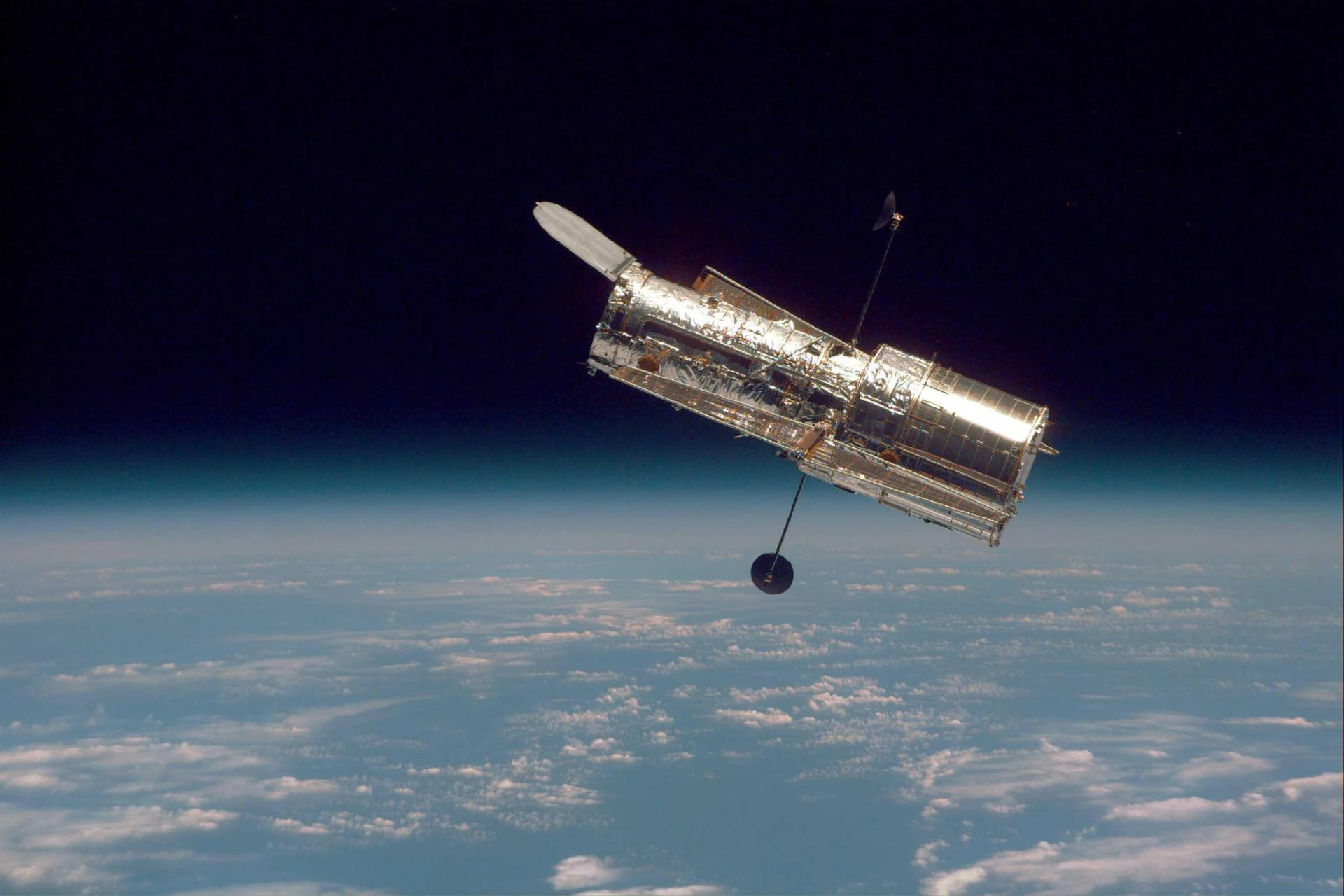
A 13.2-metre cylindrical observatory built around a Ritchey-Chrétien optical assembly with a 2.4 m primary and 0.3 m secondary mirror. Current instruments include the Wide Field Camera 3, Advanced Camera for Surveys, Cosmic Origins Spectrograph, Space Telescope Imaging Spectrograph, and Fine Guidance Sensors. Twin solar arrays power the spacecraft; six gyroscopes (three currently active) provide the exquisite pointing stability needed for long exposures.
05
Exploration
Soon after launch, engineers discovered the primary mirror had been ground to the wrong figure. The 1993 SM1 servicing mission installed corrective optics (COSTAR and WFPC2), restoring designed performance. Four further Shuttle missions — SM2 (1997), SM3A (1999), SM3B (2002), and SM4 (2009) — upgraded instruments, gyros, and batteries. Hubble has produced over 1.6 million observations and supported more than 21,000 peer-reviewed papers, making it the most-cited scientific instrument in history.
Did you know?
Hubble's primary mirror is polished so precisely that if it were scaled to the diameter of Earth, the largest bump would be just 15 cm tall.
Mission planners initially thought Hubble would fail — the mirror flaw was so severe that early images were less sharp than ground telescopes.
The Hubble Deep Field exposed a patch of "empty" sky for over 100 hours and revealed thousands of previously unseen galaxies.
Astronauts have carried out five Shuttle servicing missions and 23 spacewalks to keep Hubble operational.
Without periodic boosts, atmospheric drag will eventually pull Hubble back to Earth — reentry is currently expected in the mid-2030s.
Hubble observations were used to nail down the age of the universe at 13.8 billion years.
Its data archive is so rich that more papers are now written using archived Hubble data than from new observations.
Timeline
- 19901990
Hubble launches on STS-31 aboard Discovery on April 24.
- 19901990
Engineers diagnose a spherical aberration in the primary mirror weeks after first light.
- 19931993
SM1 installs COSTAR and WFPC2 — Hubble's vision is corrected.
- 19951995
The original Hubble Deep Field reveals thousands of distant galaxies in a tiny patch of sky.
- 20092009
SM4, the final servicing mission, installs WFC3 and COS — extending Hubble's life by more than a decade.
- 20242024
Hubble switches to one-gyro pointing mode to extend operational life.