International Space Station
Humanity's permanent outpost in low Earth orbit — a five-agency laboratory continuously crewed since 2000.
Vital statistics
01
Overview
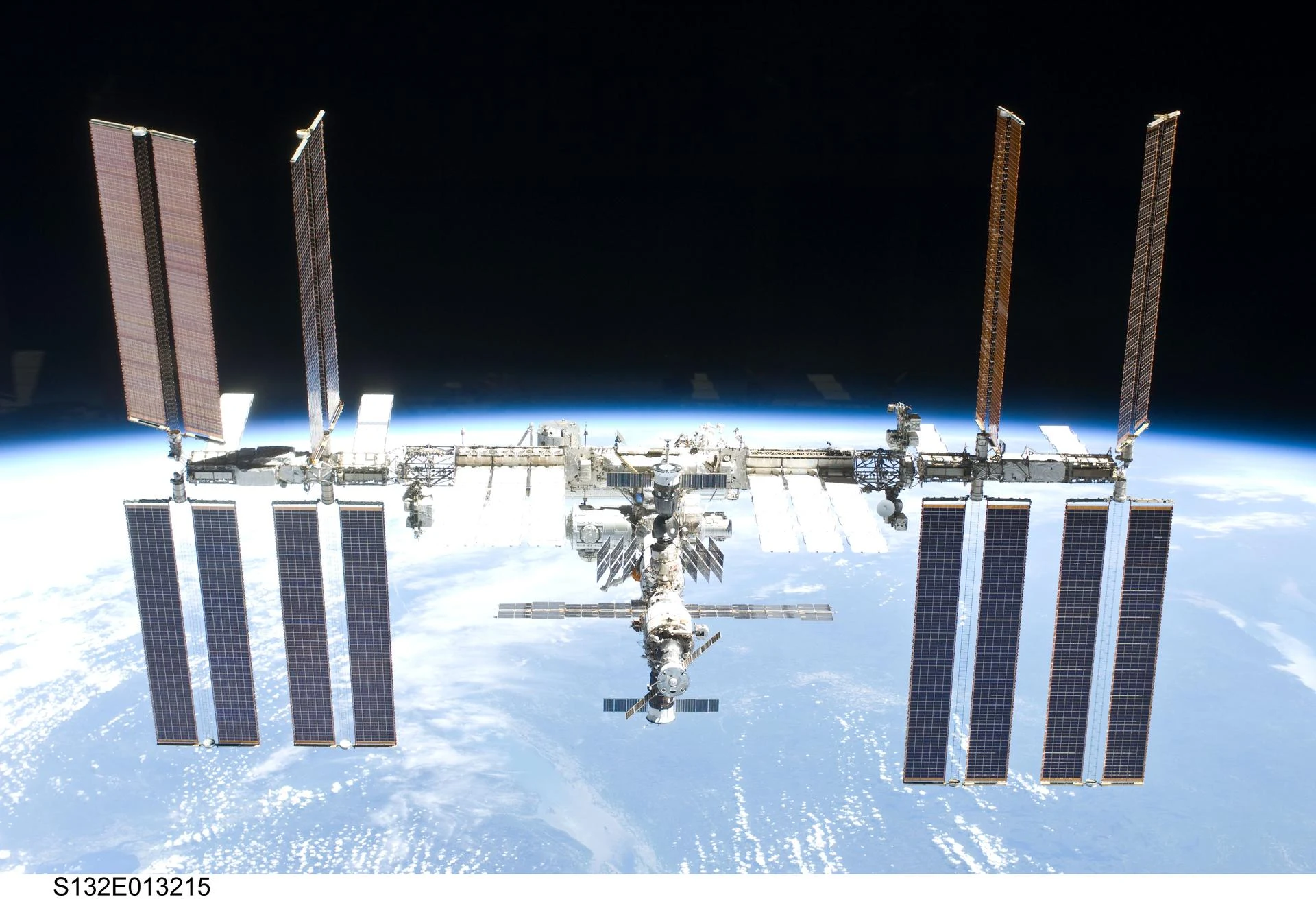
The International Space Station is the largest structure humans have ever assembled in orbit and the most ambitious peacetime engineering collaboration in history. A partnership of five space agencies — NASA, Roscosmos, ESA, JAXA, and CSA — it circles Earth roughly every 93 minutes at 400 km altitude. Crews of typically seven astronauts run microgravity science, medical research, and Earth observation around the clock. Since November 2000, the station has hosted an unbroken human presence — a 25-year streak that has become quietly historic.
02
Composition
The ISS is built around a 109-metre integrated truss carrying eight massive solar array wings. Pressurised volume is distributed across more than a dozen interconnected modules — Russian segments Zarya, Zvezda, and Nauka; American Destiny, Unity, Harmony, and Tranquility; ESA's Columbus laboratory; and JAXA's Kibo complex with its external exposed facility. Visiting Crew Dragons, Soyuz, Cygnus, Progress, and HTV-X freighters dock through multiple ports.
05
Exploration
Construction began with Zarya in November 1998; Expedition 1 boarded in November 2000, beginning the continuous-crew era. More than 270 individuals from 23 countries have visited. The station has hosted thousands of investigations — protein crystallography, cardiovascular studies, plant biology, AMS-02 cosmic-ray physics — that feed both Earth medicine and deep-space mission planning. NASA has contracted SpaceX to build a US Deorbit Vehicle that will guide the ISS to a controlled Pacific reentry around 2031.
Did you know?
The ISS travels fast enough to circle Earth in about 93 minutes — its crew sees 16 sunrises and sunsets every day.
Assembled across more than 40 launches and over 270 spacewalks, it is the most expensive single object ever built — well over $150 billion.
The pressurised living and working volume rivals that of a Boeing 747's passenger cabin.
Solar arrays span roughly 73 m tip-to-tip — wider than the wingspan of a Boeing 777.
When sunlit, the ISS is the third-brightest natural-looking object in the night sky after the Moon and Venus.
Microgravity research aboard the station has driven advances in osteoporosis drugs, water purification, and cancer therapies on Earth.
The station periodically performs reboost burns to counter atmospheric drag, which would otherwise drop it by about 2 km per month.
Timeline
- 19981998
Russian Zarya module launches in November — first ISS element on orbit.
- 19981998
STS-88 attaches the US Unity node, joining the first two modules.
- 20002000
Expedition 1 arrives on November 2 — continuous human presence begins.
- 20082008
ESA's Columbus and JAXA's Kibo laboratories join the station.
- 20112011
Final Space Shuttle flight STS-135 closes out US assembly.
- 20202020
SpaceX Crew Dragon Demo-2 returns crewed launches to US soil.
- 20212021
Russia's Nauka multipurpose laboratory module finally docks after a 14-year delay.
- 20312031
Planned controlled deorbit using a SpaceX-built US Deorbit Vehicle.