James Webb Space Telescope
A 6.5-metre infrared eye at Sun-Earth L2, peering back to the first galaxies after the Big Bang.
Vital statistics
01
Overview
The James Webb Space Telescope is the largest and most powerful observatory ever sent into space. Designed to capture infrared light from the universe's earliest galaxies and the atmospheres of distant exoplanets, it is a joint project of NASA, ESA, and the Canadian Space Agency. Webb launched on Christmas Day 2021 from Kourou aboard an Ariane 5, then spent six months unfurling and cooling at the Sun-Earth L2 Lagrange point. Its first full-colour images, unveiled on July 12, 2022, instantly redefined what space telescopes can show us.
02
Composition
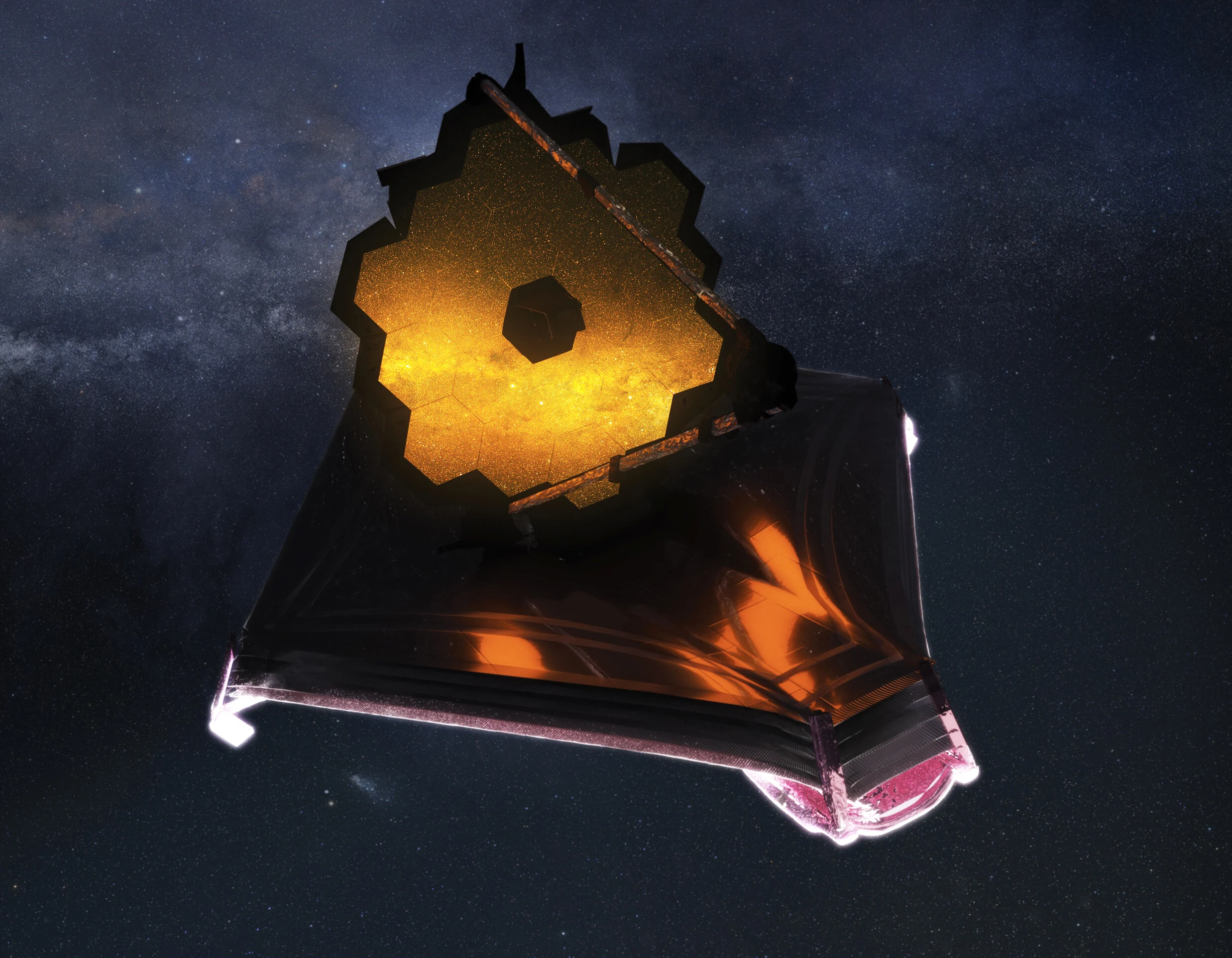
Webb's primary mirror is a 6.5-metre array of 18 hexagonal beryllium segments coated in a thin layer of gold to optimise infrared reflectivity. A tennis-court-sized five-layer sunshield, 21.2 by 14.2 metres, blocks heat from the Sun, Earth, and Moon, allowing the telescope to passively cool to roughly -223 °C. Four instruments — NIRCam, NIRSpec, MIRI, and FGS/NIRISS — span the 0.6 to 28.5 micrometre band; MIRI alone uses an active cryocooler to reach 7 K.
05
Exploration
After launch, Webb completed 344 single points of failure during its 30-day deployment — every one had to work. It reached its halo orbit around Sun-Earth L2 in January 2022 and was declared science-ready that summer. Early results have included the deepest infrared image of the universe, detailed atmospheric spectra of exoplanets including signs of carbon dioxide on WASP-39b, and observations of galaxies that appear to have formed startlingly early in cosmic history. Onboard fuel for station-keeping is expected to support roughly 20 years of operations.
Did you know?
Webb's 18 mirror segments must be aligned to within tens of nanometres — a fraction of the wavelength of visible light.
The 5-layer sunshield reduces incoming sunlight from roughly 200 kW to a few milliwatts on the cold side.
The telescope is so cold that you, sitting at your desk, are roughly 300 °C warmer than its main optics.
Webb sees light that left distant galaxies more than 13 billion years ago, when the universe was only a few hundred million years old.
It does not orbit Earth — it loops around the Sun-Earth L2 point in a halo orbit roughly four times wider than the Moon's orbit.
Mission designers chose December 25, 2021 because the trajectory was so efficient that Webb arrived with extra fuel — likely doubling its useful life.
A single MIRI observation of an exoplanet atmosphere can detect chemical fingerprints in light that has travelled hundreds of light-years.
Timeline
- 19961996
NASA begins concept studies for a "Next Generation Space Telescope" — later named James Webb.
- 20022002
The mission is formally named the James Webb Space Telescope.
- 20212021
Webb launches on an Ariane 5 from Kourou on December 25.
- 20222022
Webb reaches its Sun-Earth L2 halo orbit in January.
- 20222022
First full-colour science images released on July 12.
- 20232023
Webb detects carbon dioxide and other molecules in exoplanet atmospheres, including WASP-39b.