"Il n'y a qu'un seul heroisme au monde : c'est de voir le monde tel qu'il est, et de l'aimer." — Romain Rolland. There is only one heroism in the world: to see the world as it is, and to love it. France has always seen the world clearly — and then insisted on reaching beyond it. When France decided it would become a spacefaring nation, it did not have the industrial base of America, the military rocketry heritage of the Soviet Union, or the patience to wait for others to provide access to orbit. What it had was political will, technical ingenuity, and an unwillingness — bordering on philosophical conviction — to depend on anyone else for something as strategically vital as space. 🇫🇷
That conviction has produced results disproportionate to France's size. France is the third country in history to have independently launched a satellite into orbit, after the Soviet Union and the United States. It built and operates the most strategically located spaceport on Earth. It conceived, championed, and led the development of the Ariane rocket family, which has dominated the commercial launch market for decades and placed more than 1,100 satellites into orbit across 355 missions. It created the world's first commercial launch service provider. It spends more on space than any other European nation — roughly 3 billion euros per year — and serves as the intellectual and industrial engine of the European Space Agency.
This is Part 1 of a two-part deep dive on France's space program. It traces the story from the founding of CNES in 1961 through the Diamant rocket, the creation of the Guiana Space Centre, the rise and reign of the Ariane launcher dynasty, and the industrial architecture of ArianeGroup and Arianespace. It examines the doctrine of "autonomous access to space" that has driven French space policy for six decades, and the new generation of launchers — including the reusable Maia rocket — that will carry that doctrine into the 2030s. Part 2 will cover France's astronaut corps, its satellite industry giants Thales Alenia Space and Airbus Defence and Space, France's leadership role within ESA, military space ambitions, and the missions that are defining French space science in the current decade.
CNES and the Birth of French Space Sovereignty (1961-1965)
The Centre National d'Etudes Spatiales — CNES — was established on December 19, 1961, by President Charles de Gaulle. It was not, by the standards of the era, a late entry. NASA had been created just three years earlier, in 1958. The Soviet space program had no single civilian agency equivalent at all, operating instead through a network of design bureaus and military organizations. CNES was, and remains, one of the oldest dedicated space agencies in the world — the third after NASA and what would become Roscosmos.
De Gaulle's motivation was not primarily scientific. It was strategic. France in 1961 was in the process of building an independent nuclear deterrent — the force de frappe — and the ballistic missile technology required for that deterrent was essentially identical to the technology required for space launch. The Pierres Precieuses series of experimental rockets (named Agate, Topaze, Emeraude, Rubis, and Saphir — precious stones, in the French tradition of naming military programs with a certain elegance) were being developed by the military to test components for what would become France's first intercontinental ballistic missile. CNES was created to channel the civilian applications of that technology: satellite launches, scientific research, and the prestige that accompanied spaceflight in the early 1960s.
But de Gaulle wanted something more specific than prestige. He wanted souverainete — sovereignty. The same political philosophy that led France to develop its own nuclear weapons rather than sheltering under the American nuclear umbrella, the same instinct that would lead France to withdraw from NATO's integrated military command in 1966, drove the creation of CNES. Space was not a domain where France could afford to rent access from others. It needed its own rockets, its own launch site, and its own institutional capability.
CNES was headquartered in Paris, with its principal technical center in Toulouse — a city that would become the capital of the European aerospace industry, home not only to CNES but also to Airbus, the Toulouse Space Centre (CST), and a dense ecosystem of space and aviation companies. Today, CNES operates with approximately 2,350 employees across three sites: Paris, Toulouse, and the Guiana Space Centre in Kourou, French Guiana.
The agency's budget reflects France's seriousness about space. In recent years, CNES has operated with an annual budget of roughly 2.8 billion euros, including more than 1 billion euros contributed to the European Space Agency — making France ESA's largest contributor. When military space spending is included, France devotes approximately 3 billion euros per year to space activities, the largest space budget in Europe and among the top five globally. In November 2025, President Emmanuel Macron's National Space Strategy 2025-2040 announced a further acceleration: more than 16 billion euros for civil space programs through 2030, plus an additional 4.2 billion euros in military space funding for the same period — a roughly 70 percent increase in defense space spending.
The first four years of CNES's existence were consumed by a single overriding objective: put a French satellite into orbit on a French rocket before anyone else in Europe could do so. The vehicle that would achieve this was the Diamant.
Diamant: France Becomes the Third Spacefaring Nation (1965)
The Diamant rocket emerged directly from the military missile program. Its first stage was derived from the Emeraude missile, its second from the Topaze, and its third was newly developed. The complete vehicle stood 19 meters tall, weighed 18 tonnes at liftoff, and burned a combination of turpentine and nitric acid in its first stage — a hypergolic propellant combination that was corrosive, toxic, and effective.
But Diamant could not launch from France. CNES needed a launch site with an ocean-facing trajectory, sufficient isolation from populated areas, and political stability. France already operated a missile test range at Hammaguir, deep in the Algerian Sahara, which had been in use since 1947. But Algeria had gained independence from France in 1962, and the Evian Accords that ended the Algerian War included a provision allowing France to continue using Hammaguir only until 1967. The clock was ticking.
On November 26, 1965, a Diamant A rocket rose from the launch pad at Hammaguir and placed the Asterix satellite — a 42-kilogram capsule named after the popular French comic book character — into a 527-by-1,697-kilometer orbit. France became the third country in history to launch a satellite into orbit using its own rocket, after the Soviet Union (1957) and the United States (1958). It had beaten Japan, China, and the United Kingdom. The satellite was officially designated A-1, but the name Asterix stuck — a gesture toward French popular culture that was entirely deliberate. De Gaulle wanted the world to know this was a French achievement, and naming the satellite after the indomitable Gaul who resisted Roman occupation was a statement of national character as much as technological capability.
The Asterix launch was a propaganda triumph, but it was also a genuine technical milestone. France had designed and built every component of the Diamant rocket domestically. No American technology licenses. No Soviet assistance. The achievement placed France in an exclusive club that, at the time, had only two members.
Diamant would fly 12 times in total across three variants — Diamant A, Diamant B, and Diamant BP4 — from both Hammaguir and, after 1970, from the new launch site in French Guiana. Ten of those flights were successful. But Diamant was never intended to be a long-term operational launcher. It was a stepping stone — proof that France could reach orbit independently, and a bargaining chip in the European negotiations that would produce something far more consequential.

Kourou: The Most Strategically Brilliant Spaceport on Earth

The selection of Kourou, French Guiana, as France's permanent launch site is one of the most consequential decisions in the history of space infrastructure. It was announced on April 14, 1964, by Prime Minister Georges Pompidou, and it solved every problem that had plagued French launch operations from the Sahara.
French Guiana is an overseas department of France — not a colony, not a territory, but a fully integrated part of the French Republic, with the same legal status as any department in metropolitan France. It sits on the northeastern coast of South America, between Brazil and Suriname, covered almost entirely by equatorial rainforest. Kourou, the town adjacent to the space center, lies at 5.2 degrees north latitude — closer to the equator than any other operational spaceport except for a handful of equatorial launch platforms that have never achieved comparable scale.
That latitude matters enormously. The Earth rotates fastest at its equator, where the surface moves at approximately 1,670 kilometers per hour. A rocket launched eastward from an equatorial site inherits that rotational velocity as free delta-v — energy it does not have to generate from its own propellant. For missions to geostationary transfer orbit (GTO), the standard destination for communications satellites, this equatorial bonus translates directly into payload capacity. A Soyuz rocket launched from Baikonur, Kazakhstan (45.6 degrees north latitude), could place approximately 1.7 tonnes into GTO. The same rocket, launching the same mission from Kourou, could carry 2.8 tonnes — more than 60 percent more payload, using identical hardware, simply because of the launch site's location. For Ariane 5, the equatorial advantage was worth roughly 17 percent more payload capacity compared to a hypothetical launch from Cape Canaveral (28.5 degrees latitude).
The geography offered additional benefits. Kourou faces open ocean to the north and east, providing safe launch trajectories over water for a wide range of orbital inclinations — from the near-equatorial orbits used by GTO missions to the polar and sun-synchronous orbits used by Earth-observation satellites, which can be reached by launching northward. There is no populated land downrange for thousands of kilometers. The climate is warm and humid but stable, with no hurricanes (Kourou lies too close to the equator for Coriolis-driven cyclones to form). And the political situation was, from the French perspective, permanently resolved: French Guiana was France.
The Centre Spatial Guyanais — CSG, commonly called the Guiana Space Centre — became operational in 1968 with the launch of a Veronique sounding rocket. In 1970, a Diamant B rocket placed the Franco-German DIAL-WIKA satellite into orbit from Kourou — the first orbital launch from South American soil. The facility grew steadily through the 1970s as France transitioned from Diamant to the European-developed Ariane rocket family.
Today, the CSG covers approximately 850 square kilometers — an area roughly the size of Brussels or New York City. It contains multiple launch complexes built across five decades of operations:
- ELA-3: The Ariane 5 launch complex, operational from 1996 to 2023, featuring a massive mobile gantry that enclosed the rocket during final assembly and was rolled back before launch.
- ELA-4: The new Ariane 6 launch complex, a 170-hectare facility whose earthworks began in 2015 and was inaugurated in September 2021. ELA-4 was designed for faster turnaround and higher launch rates than its predecessor.
- ELS (Ensemble de Lancement Soyuz): A launch pad built specifically for the Russian Soyuz rocket, operational from 2011 to 2022.
- ELV (Ensemble de Lancement Vega): A pad for the European Vega small-lift rocket, shared with the original Ariane 1/2/3 complex.
The Soyuz story deserves particular attention, because its ending illustrates one of the central tensions in European space policy. In 2011, ESA began launching Soyuz-ST rockets from Kourou — modified versions of the Soyuz-2 designed to operate from the tropical climate and to exploit the equatorial latitude. The arrangement was genuinely useful: Soyuz filled the medium-lift gap between the small Vega and the heavy Ariane 5, and the equatorial boost gave it significantly more capability than it had from Baikonur. Between 2011 and February 2022, 27 Soyuz missions launched from Kourou, deploying everything from Galileo navigation satellites to components of the OneWeb broadband constellation.
Then, on February 24, 2022, Russia invaded Ukraine. Within 48 hours, Roscosmos announced it was suspending all Soyuz operations at Kourou. Russian personnel at the space center packed their equipment and left. The half-assembled Soyuz rocket in the integration building was abandoned. Arianespace CEO Stephane Israel confirmed publicly that "there will no longer be Soyuz launches" from French Guiana.
The departure exposed a vulnerability that French space strategists had warned about for years: Europe had become dependent on a Russian rocket to fill a critical gap in its launch lineup. With Ariane 5 nearing the end of its operational life and Ariane 6 not yet ready to fly, Europe faced a period in which it had no medium-lift launch capability from its own spaceport. The launcher gap — the months between Ariane 5's final flight in July 2023 and Ariane 6's maiden flight in July 2024 — became a source of political embarrassment and strategic anxiety.
The lesson was not lost on French policymakers. President Macron's 2025 National Space Strategy explicitly identifies "autonomous access to space" as its first strategic pillar, and calls for the modernization of the Guiana Space Centre — including the redevelopment of the abandoned Diamant and Soyuz launch pads to accommodate new commercial launchers from European startup companies. The goal is to transform Kourou from a facility built around a single heavy-lift rocket into a multi-operator spaceport serving an ecosystem of European launch providers. Isar Aerospace, a German company building the Spectrum rocket, has already been selected to become the first privately funded launch services company to fly from the CSG.
The Ariane Dynasty: Five Decades of European Launch Dominance
No rocket family in history has done more to establish a continent's presence in space than the Ariane series. From the first tentative flight in 1979 to the Ariane 6 launches occurring today, the dynasty spans six generations, hundreds of flights, and a commercial track record that reshaped the global launch industry.
Ariane 1: The Beginning (1979-1986)
The Ariane program was born from failure. In the early 1970s, Europe attempted to build a launch vehicle through the Europa program — a multinational effort plagued by technical problems, organizational dysfunction, and a fatal lack of systems-integration authority. Europa III, the most ambitious variant, was canceled in 1973 without ever flying. By February 1973, Europe's independent rocket program was dead.
France resurrected it. In March 1973, before any formal European agreement had been reached, France announced that it would shoulder a major share of the funding for a new "third-generation substitution launcher" designated L3S. The move was characteristically Gaullist — France acted unilaterally, then invited its neighbors to join. On July 31, 1973, space ministers from ten European countries met in Brussels and approved the development of what would be named Ariane, after the French form of Ariadne, the mythological Cretan princess who gave Theseus the thread to escape the Labyrinth. The metaphor was apt: Ariane would be Europe's thread out of the labyrinth of launch dependency.
France took 60 percent of the program's funding and assigned Aerospatiale (later merged into what is now Airbus) as the prime contractor. CNES served as the technical authority. The vehicle was a three-stage rocket, with the first two stages burning hypergolic propellants (UDMH and nitrogen tetroxide) and the third stage using cryogenic liquid hydrogen and liquid oxygen — a deliberate technological stretch that would position Europe to build larger cryogenic stages in the future.
Ariane 1 made its maiden flight on December 24, 1979 — Christmas Eve — from the newly completed ELA-1 launch pad at Kourou. The launch was a success. Over the next seven years, Ariane 1 flew 11 times, with 9 successes and 2 failures. It was never a commercial powerhouse — its payload capacity of roughly 1,850 kilograms to GTO limited it to single-satellite missions — but it proved the concept. Europe could build rockets. Europe could reach orbit. And Europe could do it from one of the best launch sites on the planet.
Ariane 2, 3, and 4: Building the Market (1984-2003)
The original Ariane design was deliberately evolutionary. Ariane 2 and Ariane 3, which first flew in 1986 and 1984 respectively (Ariane 3 actually debuted before Ariane 2 due to development timelines), featured improved engines, stretched tanks, and, in Ariane 3's case, two strap-on solid rocket boosters that increased GTO payload capacity to approximately 2,700 kilograms. Together, the first three Ariane variants accumulated 28 flights.
But it was Ariane 4 that transformed European launch from a political project into a commercial juggernaut. Development began in 1982, and the first flight occurred on June 15, 1988. Ariane 4 was the first truly modular Western launch vehicle — customers could select from six different configurations using combinations of liquid-fueled and solid-fueled strap-on boosters, tailoring the vehicle's performance (and price) to match their specific payload. The heaviest configuration, the Ariane 44L with four liquid boosters, could place 4,720 kilograms into GTO — enough to launch two mid-sized communications satellites simultaneously on a single mission.
The dual-launch capability was transformative. By offering to split the cost of a single launch between two satellite operators, Arianespace could undercut single-satellite launches on American rockets while still maintaining healthy margins. The business model was elegant and ruthlessly effective.
Ariane 4 flew 116 times between 1988 and 2003, with only 3 failures — a success rate of 97.4 percent. During the 1990s, Arianespace captured more than 50 percent of the global commercial launch market, a dominance that no other launch provider has matched before or since. Ariane 4 launched satellites for virtually every major telecommunications company on Earth, establishing the revenue streams and customer relationships that would sustain the European launch industry for decades.

Ariane 5: The Heavy-Lift Workhorse (1996-2023)
If Ariane 4 built the business, Ariane 5 built the legend. Designed from the outset as a heavy-lift vehicle capable of placing more than 10 tonnes into GTO — enough to launch two full-sized commercial communications satellites simultaneously — Ariane 5 represented the most ambitious technological leap in the program's history. Its core stage was powered by the Vulcain cryogenic engine, burning liquid hydrogen and oxygen. Two massive P230 solid-fuel boosters, each standing 31 meters tall and producing 630 tonnes of thrust at liftoff, provided the brute force needed to get the 780-tonne vehicle off the pad.
The debut was a disaster. On June 4, 1996, Ariane 5 Flight 501 veered off course 37 seconds after liftoff and was destroyed by the range safety system. The cause was one of the most famous software failures in engineering history: the inertial navigation system, reused from Ariane 4, attempted to convert a 64-bit floating-point number representing horizontal velocity into a 16-bit signed integer. The value exceeded the maximum that a 16-bit integer could hold. The software crashed. The backup computer crashed identically — it was running the same code. The rocket, receiving no guidance data, turned broadside into the supersonic airstream and broke apart. The four Cluster plasma-physics satellites aboard were lost.
It was a humbling start. But ESA and CNES methodically traced the failure, redesigned the software, and returned to flight. Over the next 27 years, Ariane 5 would fly 116 more times, accumulating a career total of 117 launches and delivering 239 payloads to orbit with an overall success rate of 95.7 percent. Between April 2003 and December 2017, Ariane 5 achieved an extraordinary streak of 83 consecutive successful missions — the longest unbroken run of any heavy-lift rocket in history at the time.
The payload manifest reads like a catalog of humanity's most important space infrastructure. Ariane 5 launched the Rosetta comet-chaser (2004), which would go on to orbit and land on Comet 67P/Churyumov-Gerasimenko. It launched ESA's Herschel and Planck space telescopes on a single mission (2009). It deployed 12 of Europe's Galileo navigation satellites across just three flights. It launched the BepiColombo Mercury mission (2018). And on December 25, 2021 — Christmas Day, just as Ariane 1 had launched on Christmas Eve 42 years earlier — Ariane 5 delivered its most consequential payload: the James Webb Space Telescope.
The JWST launch was the highest-stakes mission Ariane 5 ever carried. NASA's $10-billion flagship observatory had no backup. A launch failure would have meant the loss of a generation's worth of astrophysics capability. Ariane 5 performed, in NASA's word, "flawlessly." The insertion was so precise that the propellant Webb saved on mid-course corrections effectively doubled its projected operational lifetime — from the designed 10 years to roughly 20 years. When NASA engineers analyzed the trajectory data, they found that Ariane 5 had delivered the telescope with near-perfect accuracy. It was the crowning achievement of a 27-year career.
Ariane 5's final flight, VA261, launched on July 5, 2023, carrying the Heinrich Hertz and Syracuse 4B communications satellites. With that mission, the most successful European rocket ever built entered retirement. Its legacy was not merely technical but institutional: Ariane 5 had proven that Europe could build and operate a world-class heavy-lift launch system, compete head-to-head with American and Russian rockets in the commercial market, and sustain that capability across nearly three decades.
Ariane 6: The Current Generation (2024-Present)
Ariane 6 was conceived in the early 2010s to solve a problem that Ariane 5's success had, paradoxically, created: the rocket was too expensive. Ariane 5 cost approximately 150-180 million euros per launch. SpaceX's Falcon 9, with its reusable first stage, was offering comparable missions for under $67 million. The European launch industry was being priced out of its own market.
The solution was a new vehicle designed from the ground up for lower production costs and greater operational flexibility. Ariane 6 comes in two configurations: the Ariane 62, with two P120C solid-fuel boosters, and the Ariane 64, with four boosters. The core stage is powered by the Vulcain 2.1 engine — an evolution of the Ariane 5's Vulcain — producing 1,370 kilonewtons of thrust and burning liquid hydrogen and oxygen for approximately 468 seconds. The upper stage introduces the Vinci engine, a re-ignitable cryogenic motor producing 180 kilonewtons of thrust. The Vinci can be restarted up to five times in a single mission, enabling complex multi-orbit deployments and ensuring that the upper stage can be safely de-orbited after payload delivery — a critical capability in an era of growing concern about space debris.
The path from design to first flight was painful. Originally scheduled to debut in 2020, Ariane 6 suffered repeated delays driven by engine-development challenges, supply-chain disruptions during the COVID-19 pandemic, and the sheer complexity of qualifying a new launch system. The maiden flight finally came on July 9, 2024.
Flight VA262 was a partial success. The core stage and boosters performed nominally. The Vinci engine ignited and completed its first two burns, deploying multiple small satellites into their intended orbits. But during the third planned burn — a demonstration of the upper stage's multi-ignition capability — the Auxiliary Propulsion Unit (APU) shut down after a temperature sensor exceeded a predefined limit, triggering an automatic software-commanded shutdown. The APU failure prevented the final Vinci burn and the planned deorbit of the upper stage. Investigators traced the anomaly to a single temperature measurement in the APU's ignition sequence and resolved it with a software update — no hardware changes required.
The fix worked. On March 6, 2025, flight VA263 carried the French military's CSO-3 reconnaissance satellite into orbit on Ariane 6's first fully commercial mission. The launch was flawless. Three more missions followed in 2025: VA264 in August (deploying the Metop-SG-A1 polar weather satellite for EUMETSAT), VA265 in November (delivering the Sentinel-1D Earth-observation satellite for the European Union's Copernicus program), and VA266 in December (placing two Galileo navigation satellites into medium Earth orbit). All four commercial flights succeeded without anomaly.
Then came the milestone that announced Ariane 6's arrival as a major commercial player. On February 12, 2026, flight VA267 marked the debut of the four-booster Ariane 64 configuration, carrying 32 Amazon Leo satellites — the constellation formerly known as Project Kuiper — into low Earth orbit. With a capacity to haul more than 20 metric tons to LEO, the Ariane 64 is roughly twice as powerful as the Ariane 62 and carried the heaviest payload ever placed into orbit by a European launcher. The mission was the first of 18 Ariane 6 launches contracted by Amazon for its broadband constellation, a deal that alone guarantees years of production activity. As of April 2026, Ariane 6 has completed six flights in approximately 21 months, with the seventh — another Amazon Leo mission — scheduled for late April. Arianespace is targeting 7-8 launches in 2026, ramping toward 9-10 per year by 2027.
The Ariane 6 manifest already includes more than 30 booked flights, representing at least four years of guaranteed activity. The upcoming introduction of the Block II variant, featuring more powerful P160C solid boosters, will further expand payload capacity and is planned for qualification in 2026.
ArianeGroup and Arianespace: The Industrial Architecture of European Launch
The organizational structure behind the Ariane rocket family is unlike anything in the American or Chinese launch industries, and understanding it is essential to understanding both the strengths and the vulnerabilities of European space access.
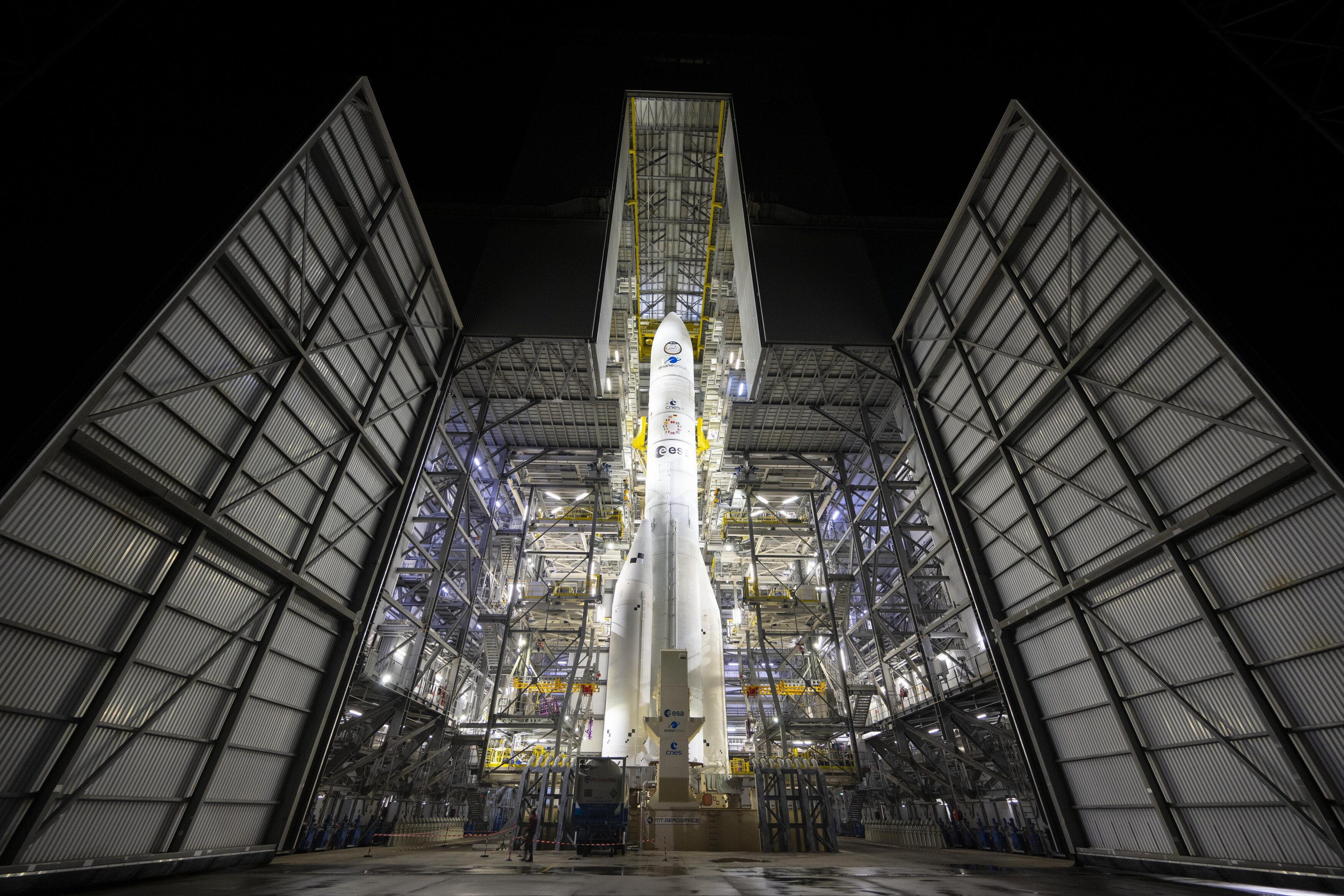
ArianeGroup is a 50-50 joint venture between Airbus and Safran, established in 2015 (initially as Airbus Safran Launchers, renamed ArianeGroup in 2017). Headquartered in Issy-les-Moulineaux near Paris, with approximately 7,600 employees across facilities in France and Germany, ArianeGroup is responsible for the design, development, and production of the Ariane 6 launch vehicle. It builds the rockets — the core stages, the upper stages, the engines, the avionics. ArianeGroup also manages France's nuclear-deterrent ballistic missiles, a dual responsibility that reflects the historical entanglement of French rocketry and defense policy that dates back to the Diamant era.
Arianespace, a subsidiary of ArianeGroup, is the commercial interface. Founded in March 1980 — immediately after Ariane 1's successful maiden flight — Arianespace was the world's first commercial launch service provider. It was created specifically by CNES and ESA to market and operate Ariane launches, separating the commercial function from the government development role. Arianespace signs contracts with satellite operators, manages the launch manifest, oversees payload integration at Kourou, and conducts launch operations. As of October 2025, Arianespace had conducted 355 missions across its 45-year history, deploying more than 1,100 satellites.
The separation of manufacturing (ArianeGroup) from operations and sales (Arianespace) is a distinctly European model, rooted in the multinational governance structures of ESA. Compare it to SpaceX, where a single company designs, builds, markets, launches, and even operates its own satellite constellation. SpaceX's vertical integration enables extraordinarily fast iteration: when a Falcon 9 upper stage exhibits a problem, the same engineering team that designed it can diagnose the issue, implement a fix, and validate it on the next flight, all within a single corporate structure. The European model, with its separation of roles and its requirement to distribute manufacturing across ESA member states according to their financial contributions (the "juste retour" or "fair return" principle), is inherently slower and more expensive.
This structural difference is the central challenge facing the European launch industry. Ariane 6 costs substantially more per launch than Falcon 9 — estimates range from 80 to 115 million euros for an Ariane 62 mission, compared to roughly 60 million euros for a Falcon 9. The gap is driven not primarily by inferior engineering but by the distributed supply chain mandated by ESA's multinational funding model, lower production volumes, and the absence of reusability. Ariane 6 is an expendable rocket in an era when SpaceX routinely lands and reflies first-stage boosters 20 or more times.
The European response to this competitive pressure has been two-pronged: sustain Ariane 6 as the guaranteed workhorse for European institutional missions (military, scientific, and commercial satellites that European governments consider too strategically sensitive to launch on American or Chinese rockets), while simultaneously investing in the next generation of European commercial launchers that can compete on cost.
MaiaSpace: Europe's Bet on Reusability
The most significant of those next-generation efforts is MaiaSpace, a wholly owned subsidiary of ArianeGroup established in April 2022 with a mandate that would have been heretical in the European launch establishment just five years earlier: build a small, reusable rocket that can compete with Rocket Lab's Electron and eventually scale to challenge SpaceX's Falcon 9.
The Maia rocket is a two-stage vehicle powered by the Prometheus engine — a next-generation propulsion system developed by ArianeGroup with ESA funding that represents a fundamental departure from the hydrogen-oxygen engines that have powered every Ariane rocket since 1979. Prometheus burns liquid oxygen and liquid methane (LOx/LCH4), the same propellant combination used by SpaceX's Raptor engine and Blue Origin's BE-4. Methane is cheaper than hydrogen, easier to handle, produces less coking (carbon buildup) in engine components, and is more practical for reusable engines that must be inspected and refurbished between flights.
Each Prometheus engine produces approximately 100 tonnes of thrust — roughly one-tenth the thrust of a Vulcain 2.1 but designed from the outset for reusability, low cost, and rapid production. The engines incorporate extensive 3D-printed components (additive manufacturing accounts for nearly 70 percent of the engine's total mass), digital engine control with throttling capability from 30 percent to 100 percent of maximum thrust, and an integrated health monitoring system using artificial intelligence for real-time diagnostics. The production target is a unit cost roughly ten times lower than the Vulcain.
Maia's first stage will use three Prometheus engines. The second stage will use a single re-ignitable Prometheus. In its reusable configuration — with the first stage performing a propulsive vertical landing on a sea-based barge, guided by grid fins and landing legs — the rocket will deliver approximately 500 kilograms to low Earth orbit. In expendable mode, capacity rises to roughly 1,500 kilograms.
MaiaSpace has already secured commercial customers. In March 2025, the company signed a multi-launch agreement with the French company Exotrail to carry its Spacevan orbital transfer vehicle to LEO. In January 2026, MaiaSpace landed a multi-launch contract with Eutelsat to deploy satellites for its OneWeb constellation. The inaugural suborbital flight is targeted for 2027, with first-stage recovery demonstrations planned for 2028.
The company is also one of five firms selected for ESA's European Launcher Challenge, a competitive program announced in July 2025 that allocates up to 902 million euros in funding across five preselected companies: MaiaSpace (France), Isar Aerospace (Germany), Rocket Factory Augsburg (Germany), PLD Space (Spain), and Orbex (United Kingdom). Each company is eligible for up to 169 million euros in ESA support for development, testing, and launch services through 2030. The program represents ESA's recognition that the era of relying on a single rocket family — the Ariane series — for all of Europe's launch needs is over. The future European launch landscape will be multi-provider, commercially competitive, and, crucially, reusable.
MaiaSpace's relationship to ArianeGroup is structurally unusual and strategically deliberate. By establishing a startup subsidiary with its own management, culture, and commercial autonomy — while still granting it access to ArianeGroup's engine technology, test infrastructure, and decades of launch experience — ArianeGroup is attempting to combine the agility of a startup with the institutional resources of a legacy aerospace prime. Whether this hybrid model can actually deliver SpaceX-competitive economics remains the open question at the heart of European launch policy.

The Doctrine of Autonomous Access
Every decision traced in this article — from de Gaulle's creation of CNES, to the selection of Kourou, to the rescue of the European launcher program after Europa's failure, to the current investments in Ariane 6 and MaiaSpace — flows from a single strategic conviction that has been the animating principle of French space policy for more than six decades: guaranteed autonomous access to space.
The phrase appears in virtually every French space policy document, every ESA ministerial declaration that France has shaped, and every speech by every CNES director since the agency's founding. It is not a slogan. It is a doctrine — as deeply embedded in French strategic thinking as nuclear deterrence or food sovereignty. The logic is straightforward: a nation (or continent) that cannot reach orbit on its own terms, using its own rockets from its own territory, is strategically dependent on whoever can. And strategic dependency, in the French view, is unacceptable.
This doctrine explains why Europe has continued to fund Ariane 6 even as SpaceX offers cheaper launches. It explains why ESA member states committed 902 million euros to the European Launcher Challenge even as their budgets face pressure from inflation and competing priorities. It explains why President Macron's National Space Strategy calls for transforming Kourou into a multi-operator spaceport rather than simply buying rides on Falcon 9. And it explains why France has consistently pushed for European space budgets to increase while other ESA members have preferred austerity.
The doctrine has costs. European institutional payloads — Galileo satellites, Copernicus Earth-observation spacecraft, military reconnaissance systems — are launched on Ariane even when cheaper alternatives exist. European taxpayers effectively subsidize the launcher industry through these guaranteed institutional missions. The 2022 Soyuz withdrawal demonstrated both the wisdom and the fragility of the approach: Europe's investment in Ariane insulated it from complete dependence on Russia, but the gap between Ariane 5's retirement and Ariane 6's readiness revealed that the policy of autonomous access had been implemented with insufficient urgency.
France's response has been to double down. More funding. More launchers. More launch pads. A multi-provider ecosystem rather than a single-vehicle monoculture. The bet is that Europe can maintain its strategic independence in space while building a launch industry competitive enough to win commercial customers in the open market. It is, in many ways, the defining challenge of European space policy in the 2020s — and France, as it has been since 1961, is the nation driving the answer.
Part 2 will examine France's astronaut corps — from Jean-Loup Chretien to Thomas Pesquet — the satellite industry powerhouses Thales Alenia Space and Airbus Defence and Space, France's leadership role within ESA, the military space strategy unveiled by President Macron, and the scientific missions that are defining French contributions to planetary science, Earth observation, and fundamental physics. France does not merely launch rockets. It builds the satellites on top of them, trains the astronauts who ride them, and designs the instruments that justify the entire enterprise.