Company / Organization Overview
Arianespace and ArianeGroup occupy the center of gravity of European access to space — a dual-entity structure that has defined the continent's launch ambitions for nearly half a century. Arianespace, founded in 1980 and headquartered in Courcouronnes, France, holds the distinction of being the world's first commercial launch services provider. It serves as the commercial operator and sales arm for European rockets, booking customer contracts and managing mission execution from the Guiana Space Centre (CSG) in Kourou, French Guiana.
ArianeGroup, the industrial manufacturer behind those rockets, was established in 2015 as a joint venture between Airbus and Safran (each holding 50%). Headquartered in Paris, ArianeGroup employs approximately 8,000 people across France and Germany and operates as the prime contractor responsible for designing, developing, and producing Ariane and Vega launch vehicles. Arianespace itself is majority-owned by ArianeGroup (~74%), with additional stakes held by the European Space Agency (ESA) and various national space agencies.
For most of the 1990s and 2000s, this ecosystem ran like clockwork. Ariane 5 — the heavy-lift workhorse that entered service in 1996 — notched 116 consecutive mission successes over its final decade of operation, delivering telecommunications satellites, interplanetary probes, and payloads for NASA to geostationary orbit with a reliability record few rockets in history could match.
Key Takeaways
- Revenue/Budget: ArianeGroup revenues ~€2.5–3.0 billion annually (2024); ESA member states contribute ~€340 million/year in Ariane 6 production support through 2030
- Key Achievement: Five successful Ariane 6 flights in 2025 plus the Ariane 64 maiden flight (Feb 2026) lofting 32 Amazon Leo (Kuiper) satellites; Vega-C returned to flight December 2024
- Key Program: Ariane 6 (Ariane 62 and Ariane 64 configurations) and the operational Vega-C, with Avio assuming Vega-C commercial operations from May 2026
- Key Risk: Sustained cadence and price competitiveness versus a fully reusable SpaceX fleet; Kourou throughput bottlenecks
- Outlook: Targeting ~10 Ariane 6 launches in 2026; Themis/Prometheus reusable demonstrator hop in 2026; MaiaSpace small reusable launcher first flight planned 2026
Notable Quotes
"Ariane 6 is not just a rocket — it is Europe's guarantee of sovereign, independent access to space. Without it, Europe becomes a passenger in the space economy rather than a driver."
— Stéphane Israël, CEO of Arianespace
"The challenge is not just to fly — it is to fly at a cadence and cost that makes European launch competitive in a market that has been fundamentally transformed by reusability. That is the work of the next decade."
— Stéphane Israël, Arianespace, on the post-Ariane 5 transition
Mission & Strategic Position
Europe's launch infrastructure serves a dual mandate: ensuring sovereign access to space for European governmental and institutional missions, and competing commercially in the global launch market. For decades, Arianespace was the dominant provider in the commercial GEO telecommunications satellite market, regularly capturing 50–60% of commercial GTO launches globally.
That strategic position has shifted dramatically. The rise of SpaceX — specifically the Falcon 9's reusability and aggressive pricing — plus China's Long March family of rockets offering cut-rate prices to some customers, has compressed Arianespace's commercial market share. The COVID-19 pandemic also disrupted commercial satellite demand. More structurally, the telecommunications satellite market itself contracted as operators moved from large GEO platforms to medium-Earth orbit constellations, a segment where Ariane 5 was not optimized.
Arianespace's response, backed by ESA and its member states, is a generational transition: retiring Ariane 5, ramping up Ariane 6, and eventually developing Ariane 6 Next (or a successor). The stakes are high. Without a competitive, regularly-flying launcher, Europe risks becoming dependent on non-European providers for its own institutional missions — a scenario that ESA's member states have consistently viewed as strategically unacceptable.
Key Products & Services
Ariane 6
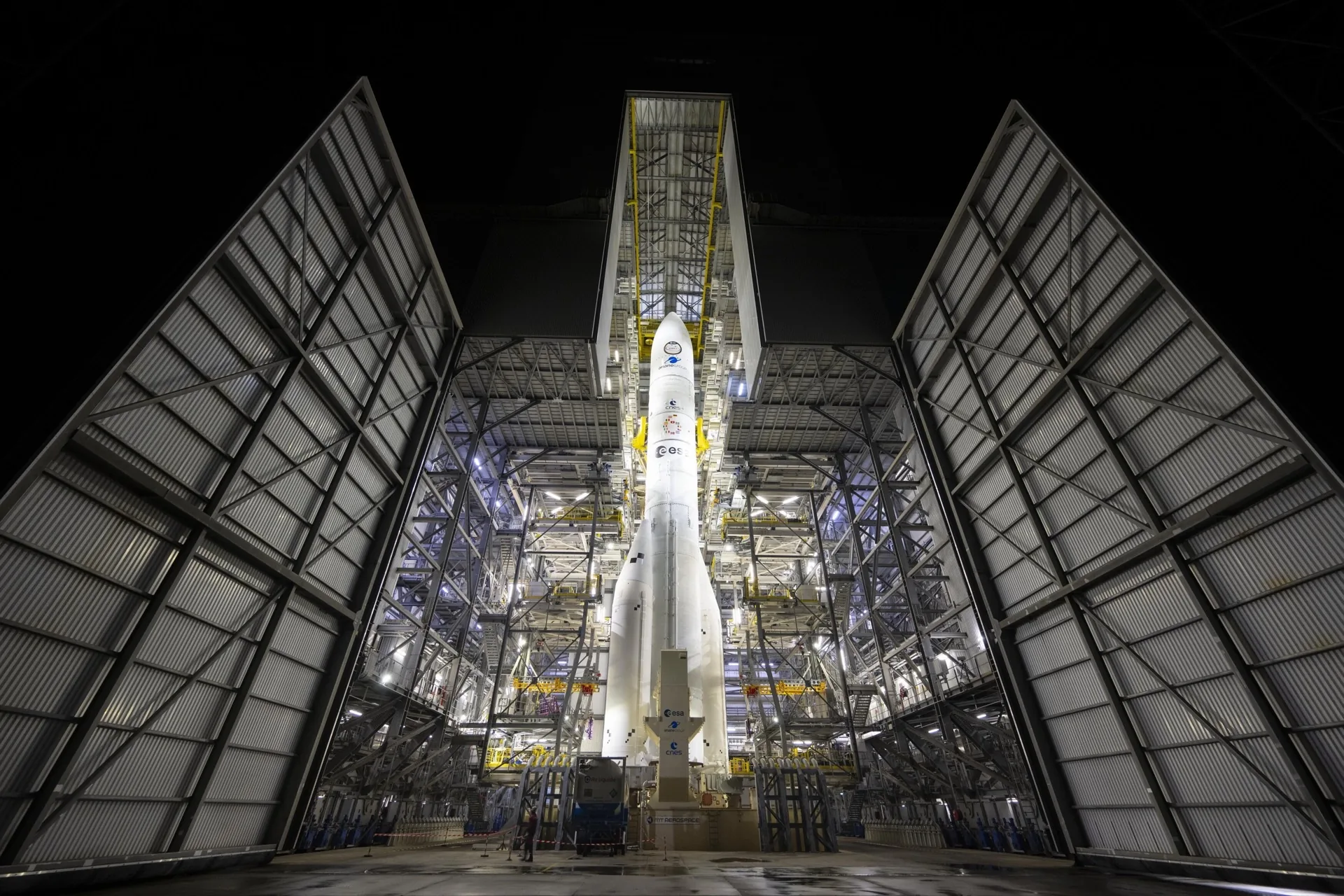
Ariane 6 is the centerpiece of Europe's current launch strategy. Developed by ArianeGroup under ESA's Future Launchers Preparatory Programme, the rocket comes in two configurations:
- Ariane 62: Two P120C solid boosters
- ~10.3 tonnes to GTO
- ~21.6 tonnes to LEO
- Ariane 64: Four P120C solid boosters
- ~11.5 tonnes to GTO
- ~21.6 tonnes to LEO
- List price: approximately $115 million per mission
Key technical differentiators:
- Vulcain 2.1 engine on first stage
- Vinci restartable upper stage — enables multi-payload missions to different orbits on one flight
- Deorbit burn capability — reduces orbital debris after payload deployment
- ELA-4 launch pad at Kourou, French Guiana
The Ariane 64 price positions it above SpaceX's Falcon 9 but competitive for large GEO dual-launch slots where customers value European heritage or political procurement preferences.
Vega-C
Vega-C is the small-to-medium lift vehicle developed by Italy's Avio (the prime) under ESA contract, marketed historically by Arianespace and now transitioning to direct Avio commercialisation:
- Payload capacity: Up to 2,350 kg to 700 km sun-synchronous orbit
- Propulsion: Solid propellants across all stages; liquid-propellant AVUM+ upper stage for precision insertion
- Return to flight: VV25 on December 5, 2024 successfully delivered Sentinel-1C to SSO after a two-year grounding
- 2025 cadence: Three further successes in 2025 — VV26 (BIOMASS, April), VV27 (CO3D + MicroCarb, July), VV28 (KOMPSAT-7, December)
- Operational handover: From the May 19, 2026 SMILE mission, Vega-C launches operate under Avio directly rather than through Arianespace
The December 2022 failure was traced to a defective carbon throat insert in the Zefiro-40 second-stage motor, supplied by Ukrainian manufacturer Yuzhnoye. ESA Council decisions in 2024 and 2025 also formalized Avio's autonomous commercial route, ending Arianespace's exclusive Vega marketing role.
Soyuz (Retired from Kourou)
Arianespace previously offered Russian Soyuz launches from Kourou under a longstanding cooperation agreement. Following Russia's invasion of Ukraine in February 2022, cooperation was suspended and Soyuz operations at Kourou ceased entirely, creating a near-term capability gap that compounded the Vega-C grounding.
Revenue & Financials
- ArianeGroup annual revenues: ~€2.0–2.5 billion (combined launcher production, Airbus/Safran subcontracts, defense activities)
- M51 missile program: France's submarine-launched ballistic missile prime contractor — provides substantial government revenue independent of commercial launches
- ESA institutional contributions: ~€400–500 million/year in launch guarantees and R&D to sustain the industrial base
- EU Space Programme budget: Additional allocation for guaranteed institutional launches on Ariane 6
- 2025 Ariane 6 cadence: 5 launches (CSO-3, MetOp-SG A1, Sentinel-1D, Galileo L14, plus the Ariane 64 Amazon Leo maiden in Feb 2026); peak Ariane 5 cadence was 6–8 launches/year
The European Commission has increasingly recognized launcher access as a strategic infrastructure issue, allocating additional funds through the EU Space Programme budget.
Major Programs & Contracts
ESA Institutional Missions: Long-term framework agreements to launch Galileo navigation constellation, Copernicus Earth observation satellites, and deep space science probes on Ariane 6.
Amazon Project Kuiper (2023): 18 Ariane 6 launches — one of the largest commercial launch contracts in European history, worth an estimated $1+ billion. Critical revenue certainty during the ramp-up phase.
SES / Eutelsat / Intelsat: Historically the backbone of Arianespace's commercial manifest. SES remains a notable customer for dual-launch GTO missions on Ariane 64.
Galileo 2nd Generation: Ariane 6 is the baseline launcher for next-generation Galileo navigation satellites, providing sustained institutional demand through the late 2020s.
Recent Milestones (2024–2026)
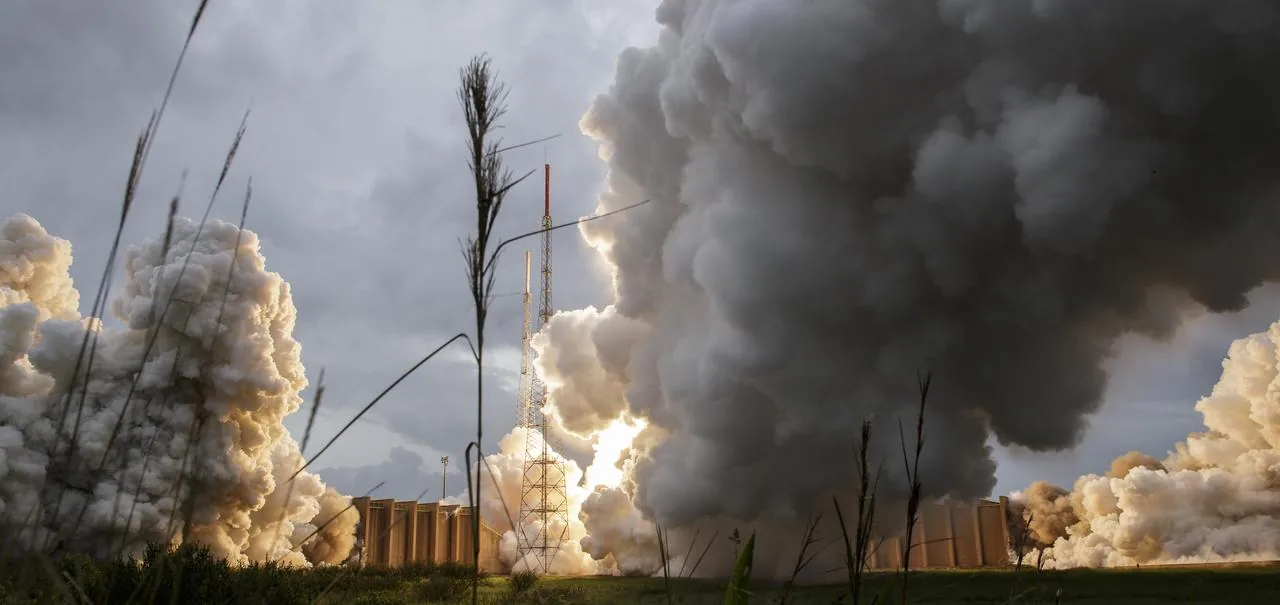
Ariane 6 Inaugural Flight VA262 (July 9, 2024):
- First flight from ELA-4 launch pad at Kourou
- Reached orbit; APU anomaly on upper stage prevented the planned deorbit burn
- Mission declared successful for primary objectives
Ariane 6 First Operational Mission VA263 (March 6, 2025):
- Lofted CSO-3 French military reconnaissance satellite to SSO
- Critically validated the upper-stage APU fix with a clean deorbit burn
Subsequent 2025 Successes:
- VA264 (Aug 13, 2025): MetOp-SG A1 / Sentinel-5A for EUMETSAT — first Ariane 6 night launch
- VA265 (Nov 4, 2025): Sentinel-1D for ESA Copernicus
- VA266 (Dec 17, 2025): Galileo L14 navigation satellites for ESA
Ariane 64 Maiden Flight VA267 (February 12, 2026):
- First flight of the four-booster heavy variant with the long fairing
- Deployed 32 Amazon Leo (Project Kuiper) satellites — the largest payload mass in European launch history (~18.25 tonnes)
- Validated the configuration that anchors the multi-year Amazon contract
Vega-C Return to Flight (December 5, 2024):
- VV25 launched Sentinel-1C to SSO, ending the two-year grounding
- Followed by three more 2025 successes (VV26 BIOMASS, VV27 CO3D, VV28 KOMPSAT-7)
Ariane 5 Retirement (July 5, 2023):
- Final mission VA261, carrying Heinrich Hertz and Syracuse 4B
- 27 years, 117 flights, 112 consecutive successes
Amazon Kuiper Manifest Underway: First 32 Kuiper satellites flown in February 2026, with additional Ariane 64 Kuiper missions scheduled across 2026–2028.
Competitive Landscape
SpaceX Falcon 9 / Falcon Heavy:
- List price: ~$67 million per mission
- Reusability: up to 20 reflights per booster
- Launch rate: 90+ missions/year by 2024
- Price per kg to GTO: ~$3,000–4,000 — significantly below Ariane 6's effective rate
United Launch Alliance (ULA) Vulcan: Primarily serves US government customers; less direct competition for European institutional missions.
China Long March Series (CZ-3B/E, CZ-5): Competitive pricing for ITAR-free commercial customers; taking market share in Asia and Africa.
Rocket Lab Electron / Neutron: Competes in the small satellite segment where Vega-C operates, with more competitive pricing and higher cadence.
European Newcomers: Isar Aerospace (Germany), Rocket Factory Augsburg (Germany), and MaiaSpace (ArianeGroup's micro-launcher startup) targeting first flights 2025–2026.
Future Roadmap (2025–2030)
Ariane 6 Ramp-Up: With the upper-stage APU anomaly resolved on VA263, the priority is reaching ~10 launches/year in 2026 and steady-state production of one core stage per month at Les Mureaux to support the Amazon Kuiper, Galileo G2, and ESA institutional manifest.
Ariane 6 Evolution: Evaluating upgrades including potential first-stage reusability features and improved upper stage performance.
Prometheus Engine: LOX/LCH4 engine designed to be 10x cheaper to produce than Vulcain via additive manufacturing. Key technology for future reusable launchers.
Themis Demonstrator: Reusable first-stage demonstrator using Prometheus engines — Europe's answer to SpaceX Grasshopper.
Ariane Next / Future Launcher: Studies for a next-generation reusable European launcher underway. A full development program would be a multi-billion-euro, decade-long commitment.
MaiaSpace: ArianeGroup subsidiary developing Maïa — a small partially reusable launcher targeting the small satellite market, with the first flight from Kourou's ELS pad targeted for 2026.
Key Risks & Challenges
Launch Cadence: Ariane 6 must demonstrate reliable, predictable launch operations to retain and expand its customer manifest. Low cadence creates a vicious cycle: fewer launches → higher per-unit costs → harder to compete on price.
Price Competitiveness: Without reusability, Ariane 6's economics will remain structurally disadvantaged versus SpaceX. European governments must decide how much of the cost differential to subsidize through institutional launch guarantees.
Vega-C Reliability: Rebuilding customer confidence after the 2022 failure is critical for retaining the small launcher market.
Market Contraction: The GEO telecom satellite market is contracting as operators favor LEO constellations. Ariane 6 must pivot its commercial value proposition toward constellation deployment and flexible multi-orbit missions.
Political Cohesion: European launcher policy requires sustained political alignment among ESA member states with sometimes divergent industrial interests (France, Germany, Italy), creating governance challenges for major investment decisions.
Sources
- ESA Ariane 6 Programme Documentation
- Arianespace Official Press Releases
- ESA Space Transportation Overview
- ArianeGroup Press Releases and Industrial Reports
- Amazon Project Kuiper Launch Contracts — SEC Filings and Press Releases, 2023
- ESA Ministerial Council 2023 Budget Allocations
- SpaceNews — Ariane 6 Inaugural Flight Coverage, July 2024
- Ars Technica — "Ariane 5 completes final mission," July 2023
- Euroconsult World Market Survey — Satellites to be Built and Launched, 2024