There is a question that hangs over every European space policy discussion, every ESA ministerial council, every ArianeGroup board meeting. It is the question that space journalists, satellite operators, and policymakers across Europe cannot stop asking: Why does Europe spend billions building Ariane 6 when SpaceX's Falcon 9 already exists and costs half as much?
The answer is more complicated than most people think. It involves geopolitics, industrial policy, national security, a Russian invasion, and a philosophical disagreement about what rockets are actually for. This is not a simple tale of one rocket being better than another. It is a story about what happens when commercial efficiency collides with strategic necessity.
Let us break it down, specification by specification, dollar by euro, flight by flight.
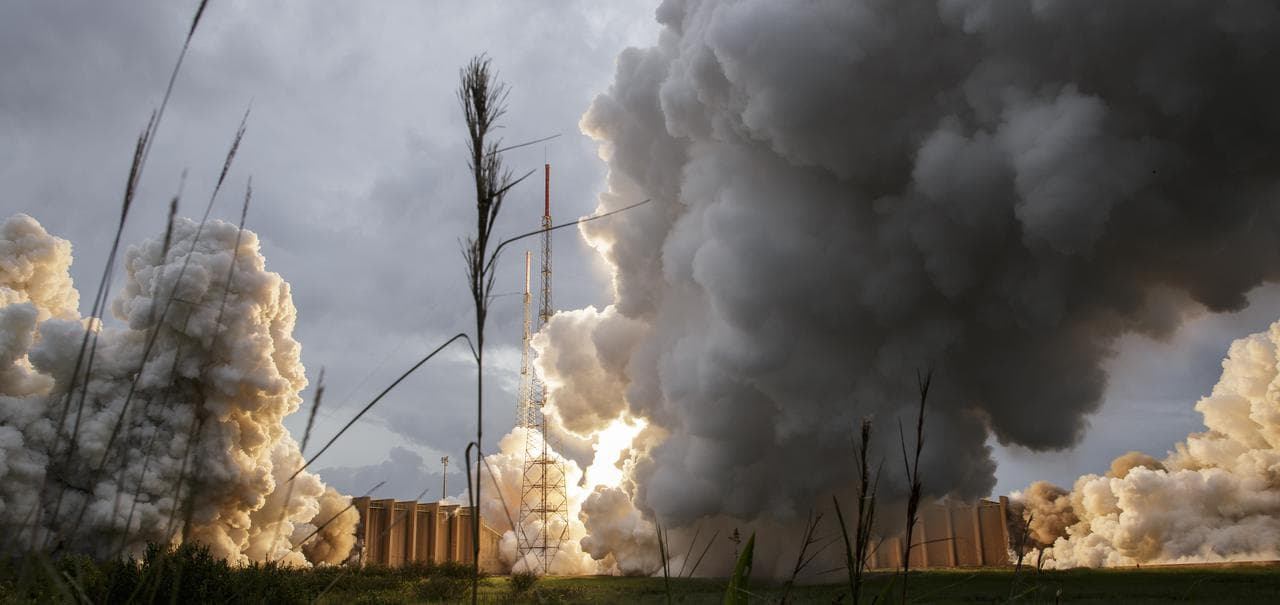
 Ariane 6 lifts off from the ELA-4 launch complex at the Guiana Space Centre in Kourou, French Guiana.
Side-by-Side Technical Specifications
Before diving into the strategic arguments, the engineering arguments, and the cost arguments, let us lay out exactly what these two rockets are.
| Specification | Ariane 62 | Ariane 64 | Falcon 9 Block 5 |
|---|---|---|---|
| Height | ~63 m | ~63 m | 70 m |
| Core diameter | 5.4 m | 5.4 m | 3.7 m |
| Liftoff mass | ~530,000 kg | ~860,000 kg | ~549,000 kg |
| Stages | 2 + 2 solid boosters | 2 + 4 solid boosters | 2 |
| First stage engine | Vulcain 2.1 (x1) | Vulcain 2.1 (x1) | Merlin 1D (x9) |
| First stage thrust | 1,371 kN (vacuum) | 1,371 kN (vacuum) | 7,607 kN (sea level) |
| Upper stage engine | Vinci (x1) | Vinci (x1) | Merlin 1D Vacuum (x1) |
| Upper stage thrust | 180 kN (vacuum) | 180 kN (vacuum) | 981 kN (vacuum) |
| Booster type | P120C solid (x2) | P120C/P160C solid (x4) | None |
| Booster thrust (each) | ~4,500 kN avg | ~4,500 kN avg | N/A |
| First stage fuel | LOX / LH2 | LOX / LH2 | LOX / RP-1 (kerosene) |
| Upper stage fuel | LOX / LH2 | LOX / LH2 | LOX / RP-1 (kerosene) |
| Payload to LEO | ~10,350 kg | ~21,500 kg | ~22,800 kg (expendable) / ~16,000 kg (reusable) |
| Payload to GTO | ~4,500 kg | ~11,500 kg | ~8,300 kg (expendable) / ~5,500 kg (reusable) |
| Reusable | No | No | Yes (first stage) |
| Upper stage restartable | Yes (Vinci) | Yes (Vinci) | Yes (Merlin Vacuum) |
| Fairing diameter | 5.4 m | 5.4 m | 5.2 m |
| Cost per launch (est.) | ~$100M | ~$106-150M | ~$67-74M |
| Launch site | Kourou, French Guiana | Kourou, French Guiana | Cape Canaveral / Vandenberg |
A few things jump out immediately. The Falcon 9 is a narrower, taller rocket with vastly more first-stage thrust from its cluster of nine Merlin engines. The Ariane 6 compensates with its solid rocket boosters -- two for the A62 configuration, four for the more powerful A64. Both rockets can deliver roughly comparable payloads to low Earth orbit in their maximum configurations, though they get there through fundamentally different engineering philosophies.
The Ariane 6 burns liquid hydrogen and liquid oxygen throughout -- a higher-performance but more expensive and complex propellant combination. The Falcon 9 uses RP-1 kerosene with liquid oxygen, a denser, cheaper, and easier-to-handle fuel that trades some specific impulse for practical advantages in manufacturing and operations.
But the specification that matters most in 2026 is not on this table. It is the one that defines the entire competitive landscape: reusability.
The Reusability Divide
This is where the comparison goes from "interesting technical discussion" to "existential question for European space policy."
As of April 2026, SpaceX has successfully landed Falcon 9 first-stage boosters approximately 598 times out of 611 attempts -- a 97.9 percent success rate. The Block 5 variant alone has achieved 573 successful landings out of 579 attempts, a staggering 99 percent rate. One booster, B1067, has flown 34 missions. Thirty-four times launched, thirty-four times landed, thirty-four times refurbished and reflown. A total of 53 individual boosters have completed multiple missions.
 A Falcon 9 first stage touches down on a drone ship in the Atlantic Ocean. SpaceX has now completed roughly 598 successful booster landings.
Ariane 6 is fully expendable. Every first stage, every solid booster, every component below the payload fairing is destroyed on every flight. There is no recovery, no reuse, no second chance.
This was a deliberate decision, and understanding why ESA made it requires rewinding to the early 2010s when Ariane 6 was being designed. At that point, SpaceX had just begun attempting booster landings and had not yet succeeded. The prevailing wisdom in European aerospace -- and indeed among most industry analysts -- was that booster recovery was a stunt, that the refurbishment costs would eat any savings, and that expendable rockets optimized for reliability were the smarter bet.
They were wrong. SpaceX proved that reusability could work at scale, that refurbishment costs could be managed, and that a reused booster could be just as reliable as a new one. By the time this became undeniable, Ariane 6's design was locked in. Redesigning it for reusability would have added years and billions to an already delayed program.
ESA and ArianeGroup are not ignoring this gap. They are addressing it through several parallel efforts:
The P160C Booster Upgrade. In December 2025, ESA certified the P160C solid booster for operational use. This upgraded booster carries approximately 160 tonnes of solid propellant -- 14 tonnes more than the P120C it replaces. It will debut in 2026 on the Ariane 64 variant, providing a meaningful performance boost. But it is still expendable.
MaiaSpace. The most direct European answer to SpaceX's reusability is MaiaSpace, a wholly-owned subsidiary of ArianeGroup. MaiaSpace is developing a two-stage rocket with a reusable first stage powered by three Prometheus engines -- next-generation LOX/methane engines designed from scratch for reusability. The company completed full-scale separation tests and propellant tank burst tests in 2025, secured its first commercial customer (Exotrail), and is targeting a suborbital demonstration flight in late 2026 with full orbital capability by 2027. In February 2026, MaiaSpace announced the inaugural orbital flight had slipped to 2027.
The BEST! Initiative. In late 2024, ESA selected ArianeGroup (through MaiaSpace) and Isar Aerospace for the Boosters for European Space Transportation (BEST!) program, which aims to develop reusable rocket first stages or boosters. ArianeGroup has proposed evolving Ariane 6 itself by replacing its solid boosters with liquid reusable boosters derived from MaiaSpace's first stage -- a "plug-and-play" upgrade concept.
Ariane Next. The long-term vision is Ariane Next, a partially reusable two-stage rocket that would eventually succeed Ariane 6. This remains a concept study, with no firm development timeline.
The bottom line: Europe recognized the reusability gap, but closing it will take years. In the meantime, every Ariane 6 flight throws away hardware that SpaceX reflies dozens of times.
Launch Record: The Numbers Do Not Lie

Falcon 9: Relentless Cadence
The Falcon 9 launch record is, by any historical standard, extraordinary. As of mid-April 2026, the Falcon 9 family has flown 639 missions with 636 full successes -- a success rate exceeding 99.5 percent. In 2025 alone, SpaceX launched 165 Falcon 9 missions, more than the rest of the world combined. In 2026, SpaceX is targeting 140 to 145 Falcon 9 launches, and through mid-April had already completed 46.
To put this in perspective: SpaceX launched more Falcon 9 rockets in the month of December 2025 than most countries launch in an entire year. The company has achieved a cadence that was considered physically impossible just a decade ago. Reusability makes this possible -- you cannot build 165 brand-new rockets per year, but you can fly 53 reusable boosters multiple times each.
Ariane 6: A Slow but Steady Ramp-Up
Ariane 6's launch history is, by necessity, much shorter. The rocket made its maiden flight on July 9, 2024, deploying multiple payloads from Kourou, French Guiana -- though an anomaly during the final deorbit burn of the upper stage prevented a completely clean debut.
In 2025, Ariane 6 flew four missions:
- March 2025 (VA262): First commercial flight, successfully delivering the CSO-3 French military reconnaissance satellite to orbit
- August 2025 (VA264): Successfully launched the Metop-SGA1 weather satellite into Sun-synchronous orbit for EUMETSAT
- November 2025 (VA265): Carried the Sentinel-1D Earth observation radar satellite
- December 2025 (VA266): Deployed two Galileo navigation satellites aboard an Ariane 62
In early 2026, the rocket reached a milestone with its first Ariane 64 flight (VA267) on February 12, carrying 32 Amazon Kuiper (Leo) broadband constellation satellites. This was the debut of the four-booster configuration and the first of 18 Amazon launches contracted with Arianespace.
As of April 2026, Ariane 6 has completed six flights total -- five successes and one partial success (the maiden flight anomaly). Arianespace is targeting seven to eight Ariane 6 launches for all of 2026.
Ariane 5: The Legacy It Must Live Up To
 Ariane 5 lifts off on its final mission, VA261, on July 5, 2023, after 27 years of service and 117 flights.
Ariane 6 carries the weight of its predecessor's reputation. Ariane 5 flew 117 missions between 1996 and 2023, achieving 112 full successes -- a 96 percent success rate. The rocket set a record of 82 consecutive successful launches between April 2003 and December 2017. Its payload manifest reads like a hall of fame of space missions: the James Webb Space Telescope, ESA's Rosetta comet chaser, a dozen Galileo navigation satellites, and hundreds of commercial communications satellites.
When Ariane 5 retired with its final flight on July 5, 2023, it left a gap. Ariane 6 was not ready. Europe was without its own heavy-lift launch capability for over a year, a humbling period that reinforced why the continent needs autonomous access to space.
Flight Cadence Comparison
The cadence gap is stark:
| Year | Falcon 9 Launches | Ariane 6 Launches |
|---|---|---|
| 2024 | ~130 | 1 |
| 2025 | ~165 | 4 |
| 2026 (projected) | ~140-145 | 7-8 |
Ariane 6 is ramping up, but it is starting from a completely different baseline. Even at its target cadence of 8 to 12 launches per year, Ariane 6 will never match Falcon 9's volume. It is not designed to. The question is whether it can launch frequently enough to serve Europe's institutional needs and attract enough commercial customers to sustain the program economically.
Cost Analysis: Why Ariane 6 Costs Twice as Much
The cost disparity between Ariane 6 and Falcon 9 is not a mystery. It is the product of specific, identifiable factors -- some technical, some political, some structural.
The Price Tags
A Falcon 9 launch is commercially priced at approximately $67 to $74 million as of 2025-2026. SpaceX raised the price from $62 million to $67 million in 2022, citing inflation, and further increases have brought the list price to approximately $74 million for some mission types. However, SpaceX's internal cost per launch is estimated at roughly $28 million for Starlink missions using well-worn boosters, meaning the company enjoys substantial margins on commercial flights.
An Ariane 62 launch is estimated at roughly $100 million. An Ariane 64 launch runs $106 to $150 million, depending on the mission profile and whether upgraded P160C boosters are used. ArianeGroup initially projected Ariane 6 flight costs at around 70 million euros, but real-world costs have come in significantly higher. The CNES director has publicly blamed contractors for the cost overruns.
Even so, ESA notes that Ariane 6 has achieved a 40 percent reduction in cost per kilogram to orbit compared to Ariane 5 -- a real improvement, just not enough to match a rocket that reuses its most expensive component.
Why the Gap Exists
Reusability. This is the single largest factor. The Falcon 9 first stage represents roughly 60 to 70 percent of the vehicle's total cost. By reusing it up to 34 times (and counting), SpaceX amortizes that cost across dozens of flights. Ariane 6 builds a new first stage for every launch. Even with the most efficient manufacturing in the world, you cannot compete with a rocket that reuses its most expensive piece.
Industrial return policy. ESA operates under a principle called "juste retour" (fair return), which requires that contracts be distributed among member states in proportion to their financial contributions to a program. Ariane 6 is manufactured across a network of more than 600 companies in 13 European countries. This ensures broad political support for the program and distributes economic benefits across Europe, but it also means components are manufactured in locations chosen for political reasons rather than cost efficiency. Parts crisscross the continent, adding logistics costs, coordination overhead, and complexity.
Labor costs and industrial structure. European aerospace labor costs are higher than comparable US costs, and the distributed manufacturing model adds overhead. ArianeGroup employs thousands of workers across France, Germany, and other ESA member states. These are highly skilled jobs that European governments are reluctant to cut or consolidate.
Scale. SpaceX launches 10 to 15 times more Falcon 9 rockets per year than Arianespace launches Ariane 6 rockets. Manufacturing costs drop with volume. SpaceX's Hawthorne factory is optimized for high-rate production of a single rocket family. ArianeGroup's facilities, spread across multiple countries, produce at much lower rates.
Subsidies and institutional pricing. ESA provides support payments to Arianespace to bridge the gap between Ariane 6's production costs and commercially competitive pricing. This is, in effect, a subsidy -- though ESA and European officials prefer to frame it as paying for guaranteed access to space. The European Commission and ESA institutional missions (Galileo, Copernicus, Meteosat) are the anchor customers that make the program viable.
Vertical integration. SpaceX designs, manufactures, and operates Falcon 9 in-house, with aggressive vertical integration. ArianeGroup is the prime contractor but relies on a sprawling supplier network across Europe. Each interface between companies adds cost, schedule risk, and coordination burden.
The Sovereignty Argument: Why Europe Builds Ariane 6 Anyway
If Ariane 6 costs more, launches less often, and cannot reuse its hardware, why does Europe pour billions into it?
The answer arrived on February 26, 2022, when Russian space agency director Dmitry Rogozin ordered all Russian personnel to leave the Guiana Space Centre in Kourou, French Guiana. Russia was retaliating against European sanctions imposed after the invasion of Ukraine. Overnight, 27 Soyuz rockets' worth of launch capability vanished from Europe's manifest. Eighty-seven Russian workers packed their bags and went home. The Soyuz launch pad at Kourou went silent.
Europe was left without a medium-lift launcher. Ariane 5 was winding down. Ariane 6 was not ready. Vega C had suffered a launch failure and was grounded. For roughly two years, from early 2022 until Ariane 6's maiden flight in July 2024, Europe had severely limited independent access to space.
This was not a theoretical risk. European military reconnaissance satellites waited on the ground. Weather satellites that track storms and climate change were delayed. Galileo navigation constellation expansion stalled. Europe's entire space infrastructure calendar was disrupted because the continent had depended on a Russian rocket for medium-lift missions.
"Guaranteed autonomous access to space" is not just a bureaucratic slogan printed on ESA brochures. It is an insurance policy, and in February 2022, it paid out. The nations that had argued for decades that Europe needed its own rockets -- even expensive ones -- were vindicated overnight.
This is the core of the sovereignty argument: rockets are strategic infrastructure, like aircraft carriers or power grids. You do not outsource them to potential adversaries or even to allies whose interests may not always align with yours. The United States controls ITAR (International Traffic in Arms Regulations) export rules that can restrict what payloads fly on American rockets. A European military satellite on a Falcon 9 must comply with US export regulations. An Ariane 6 launch is under European jurisdiction, period.
For France, which hosts the Guiana Space Centre and provides the largest share of ESA launcher funding, this is also about projecting technological power. For Germany, the second-largest contributor, it is about high-tech manufacturing jobs and supply chain control. For smaller ESA member states, it is about participating in a flagship technology program and receiving contracts through juste retour.
The sovereignty premium -- the extra cost Europe pays for Ariane 6 over what a Falcon 9 launch would cost -- is essentially an insurance payment against geopolitical disruption. In 2022, that insurance proved its value.
Market Position: Two Rockets, Two Worlds
Falcon 9: The Commercial Juggernaut
Falcon 9 dominates the global commercial launch market with a share that most industries would consider monopolistic. In 2025, SpaceX accounted for approximately 165 of the roughly 260 orbital launches worldwide -- nearly two-thirds of global launch activity. The majority of those flights carried SpaceX's own Starlink satellites, but the company also serves NASA, the US Department of Defense, commercial satellite operators, and international customers.
Falcon 9's customer base is global and diverse: Starlink broadband constellation (the single largest customer by flight volume), NASA crew and cargo missions to the International Space Station, US national security launches, commercial GEO satellite operators, rideshare customers through the Transporter program, and international government agencies.
The rocket's combination of low cost, high reliability, and near-weekly launch availability makes it the default choice for any satellite operator who is not specifically required to launch on something else.
Ariane 6: The Institutional Anchor
Ariane 6's market position is fundamentally different. Its primary customers are European institutional missions -- satellites and spacecraft funded by ESA, the European Commission, EUMETSAT, and European national space agencies. These include Galileo navigation satellites, Copernicus Earth observation satellites (Sentinel series), Meteosat and Metop weather satellites, and European military reconnaissance satellites like CSO-3.
The commercial crown jewel is the Amazon Kuiper contract: 18 Ariane 64 launches to deploy Amazon's Leo broadband constellation. This is a massive commercial win that provides Arianespace with years of launch manifest certainty. The first of these flights occurred in February 2026, carrying 32 Amazon satellites.
At the end of 2025, Ariane 6 had more than 30 flights booked, representing roughly four years of activity at target launch cadence. This backlog includes the Amazon contract, ongoing ESA institutional missions, and some additional commercial customers.
But the commercial satellite market beyond Amazon has largely moved to Falcon 9. Ariane 6 struggles to compete on price for commercial GEO satellite launches, and the smallsat and mega-constellation markets have gravitated toward SpaceX's Transporter rideshare program and dedicated Falcon 9 flights. Ariane 6's commercial viability depends heavily on institutional demand and the Amazon contract.
The Market Reality
The launch market in 2026 is effectively bifurcated:
- Commercial market: Falcon 9 dominates. Operators choose SpaceX for cost, cadence, and reliability unless regulatory or policy requirements dictate otherwise.
- European institutional market: Ariane 6 is the mandated launch provider. European government payloads fly on European rockets as a matter of policy. This guaranteed demand is what keeps the program economically viable.
- Overlap zone: Amazon Kuiper is the notable exception -- a major commercial customer choosing Ariane 6 for diversification and schedule assurance alongside its SpaceX and Blue Origin contracts.
 Ariane 6 (left) and Falcon 9 (right) represent fundamentally different approaches to orbital launch: European multilateral cooperation versus American commercial innovation.
The Future: Where Does Each Rocket Go from Here?
Ariane 6's Evolution Path
Ariane 6 is not standing still. The near-term evolution path includes several key milestones:
P160C Boosters (2026-onward). The upgraded solid boosters, certified in December 2025, add approximately 14 tonnes of propellant each. On the Ariane 64, this translates to a meaningful payload increase, particularly important for Amazon Kuiper missions that need to maximize the number of satellites per flight.
Block II Upgrades. The first "Block II" Ariane 64 with P160C boosters is expected to fly in 2026, inaugurating a more capable variant that will serve as the workhorse configuration for the Amazon contract.
Liquid Reusable Booster Concept. ArianeGroup has proposed replacing Ariane 6's solid boosters with liquid-fueled reusable boosters derived from MaiaSpace's first stage. This would be a "plug-and-play" upgrade that could give Ariane 6 some degree of reusability without a complete redesign. This remains in the study phase.
Ariane Next. The eventual successor to Ariane 6 will be a partially reusable rocket, incorporating lessons learned from MaiaSpace and the BEST! initiative. No firm development timeline has been set, but the concept envisions a vehicle competitive with next-generation American and Chinese rockets in the 2030s.
Europe's Broader Launcher Ecosystem
Ariane 6 is not Europe's only launcher bet. The European Launcher Challenge (ELC), announced by ESA, is funding five companies to develop small and medium-lift launch vehicles:
- MaiaSpace (France): Reusable two-stage rocket with Prometheus engines, targeting orbital flights by 2027
- Isar Aerospace (Germany): Spectrum rocket, still working toward first orbital flight after a failed first attempt
- Rocket Factory Augsburg (Germany): RFA ONE, targeting first orbital test flight in summer 2026 from SaxaVord Spaceport in Scotland
- PLD Space (Spain): Developing the Miura 5 small launch vehicle
- Orbex (UK): Was developing the Prime rocket but entered administration in February 2026 and withdrew from the ELC
ESA has committed over 900 million euros to the European Launcher Challenge, with framework contracts expected to be signed in 2026 and successful launch demonstrations required by 2027. The goal is to create a diverse European launcher ecosystem that reduces dependence on any single vehicle -- including Ariane 6.
Falcon 9's Trajectory
Falcon 9 is, in a sense, a mature vehicle. Block 5 has been flying since 2018 and SpaceX has no plans for a Block 6. The rocket's evolution now is primarily operational -- flying boosters more times (the current record is 34 flights on a single booster), increasing launch cadence, and optimizing turnaround time.
The real disruption comes from Starship. SpaceX's fully reusable super-heavy-lift vehicle, currently in active flight testing, promises to make Falcon 9 look expensive. If Starship achieves even a fraction of its cost targets -- Elon Musk has stated goals as aggressive as $10 per kilogram to LEO -- it would not just outcompete Ariane 6, it would make Falcon 9 itself obsolete for many mission types.
For European planners, Starship represents the next wave of disruption. Just as they were caught off-guard by Falcon 9's reusability, they risk being caught off-guard again by Starship's scale. The question is whether Europe's reusability investments -- MaiaSpace, BEST!, Ariane Next -- can close the gap before Starship opens it even wider.
The Chinese Factor
Both Ariane 6 and Falcon 9 face growing competition from China. The Long March 5 series provides heavy-lift capability for Chinese government missions, while a new generation of Chinese commercial launch companies -- LandSpace, iSpace, Galactic Energy, Space Pioneer -- are developing reusable rockets at a pace that mirrors SpaceX's trajectory a decade ago. LandSpace's Zhuque-2 became the world's first methane-fueled rocket to reach orbit in 2023. By the 2030s, Chinese reusable rockets could compete for international commercial launches, further complicating the market landscape for both Ariane 6 and Falcon 9.
Verdict: Not a Contest, but a Conversation
If the question is "which rocket is better," the answer depends entirely on what you mean by "better."
If better means cheaper: Falcon 9 wins. It is not close. Reusability, vertical integration, and manufacturing scale give SpaceX a structural cost advantage that Ariane 6 cannot match in its current expendable configuration. At $67-74 million versus $100-150 million per launch, a commercial satellite operator choosing purely on price will choose Falcon 9 every time.
If better means more reliable: Falcon 9 wins again, though this is partly a function of having 639 flights of data versus six. Falcon 9's 99.5 percent success rate is historically extraordinary. Ariane 6 is too early in its flight history to draw meaningful reliability conclusions, though its predecessor Ariane 5 achieved 96 percent over 117 flights.
If better means higher cadence: Falcon 9, overwhelmingly. SpaceX launched 165 times in 2025. Ariane 6 launched four times. Even at full production rate, Ariane 6 will top out at 8 to 12 launches per year.
If better means strategically essential: Ariane 6 wins. For Europe, autonomous access to space is not optional. The 2022 Soyuz crisis proved that depending on foreign rockets -- even from partners, let alone adversaries -- creates unacceptable vulnerabilities. Ariane 6 ensures that European military, intelligence, weather, navigation, and Earth observation satellites can always reach orbit on European terms, under European jurisdiction, regardless of geopolitical conditions.
If better means serving different purposes: Both win. They are not really competitors in the traditional sense. Falcon 9 is a commercial product optimized for maximum efficiency in an open market. Ariane 6 is a strategic capability that also serves commercial customers. Comparing them head-to-head is like comparing a commercial airline to an air force -- they both fly, but they exist for fundamentally different reasons.
The honest assessment is this: Falcon 9 is the commercially superior rocket by virtually every measurable metric. Ariane 6 is a strategically essential capability for a continent that learned the hard way what happens when you lose autonomous access to space. Europe pays a premium for sovereignty, and in a world of shifting alliances and unpredictable geopolitics, that premium is worth paying.
The real question is not whether Ariane 6 can beat Falcon 9 today. It cannot. The real question is whether Europe's investments in reusability -- MaiaSpace, BEST!, the European Launcher Challenge, and eventually Ariane Next -- can close the gap before it becomes a chasm. SpaceX is not standing still. Starship is coming. And the next chapter of this comparison will be written not in Kourou or Cape Canaveral, but in the design offices and test stands where Europe's next generation of rockets is being born.
The race is not over. But Europe needs to run faster.