"The only way to discover the limits of the possible is to go beyond them into the impossible." Arthur C. Clarke wrote those words in 1962, from the desk of a man who had grown up in Somerset, joined the British Interplanetary Society as a teenager, and would go on to conceive the geostationary communications satellite — arguably the single most commercially valuable idea in the history of spaceflight — in a 1945 paper published in Wireless World magazine. Clarke was British. The idea that reshaped global telecommunications was British. And yet, for the better part of half a century, Britain treated space as something that happened to other countries.
🇬🇧 This is the story of a nation that became the sixth country in history to launch its own satellite into orbit using its own rocket — and then, in a decision that still generates disbelief among space historians, immediately cancelled the program that made it possible. It is the story of four decades of institutional ambivalence, followed by a revival that is now unfolding across the windswept islands of northern Scotland, the satellite factories of Glasgow, the insurance floors of Lloyd's of London, and a regulatory framework that has quietly become one of the most sophisticated in the world. Britain's relationship with space is a study in contradictions: visionary thinkers, cautious treasuries, world-class engineers, and a political establishment that spent decades convinced that rocketry was someone else's business.
This is Part 1 of a two-part deep dive on the United Kingdom's space program. It traces the arc from the Black Knight sounding rockets of the 1950s through the bittersweet triumph of Black Arrow and the Prospero satellite in 1971, the wilderness years without a dedicated space agency, the creation of UKSA in 2010, the current state of the UK space sector, the Scottish space coast and its emerging spaceports, and the strategic gamble on the OneWeb satellite constellation. Part 2 will examine Orbex's collapse and its aftermath, Reaction Engines and the SABRE propulsion concept, Surrey Satellite Technology's pioneering role in small satellites, Skyrora's orbital ambitions, the UK's growing defense space posture, space insurance at Lloyd's of London, and the missions that will define Britain's next decade in orbit.
Black Knight, Blue Streak, and the Roots of British Rocketry (1950s–1960s)
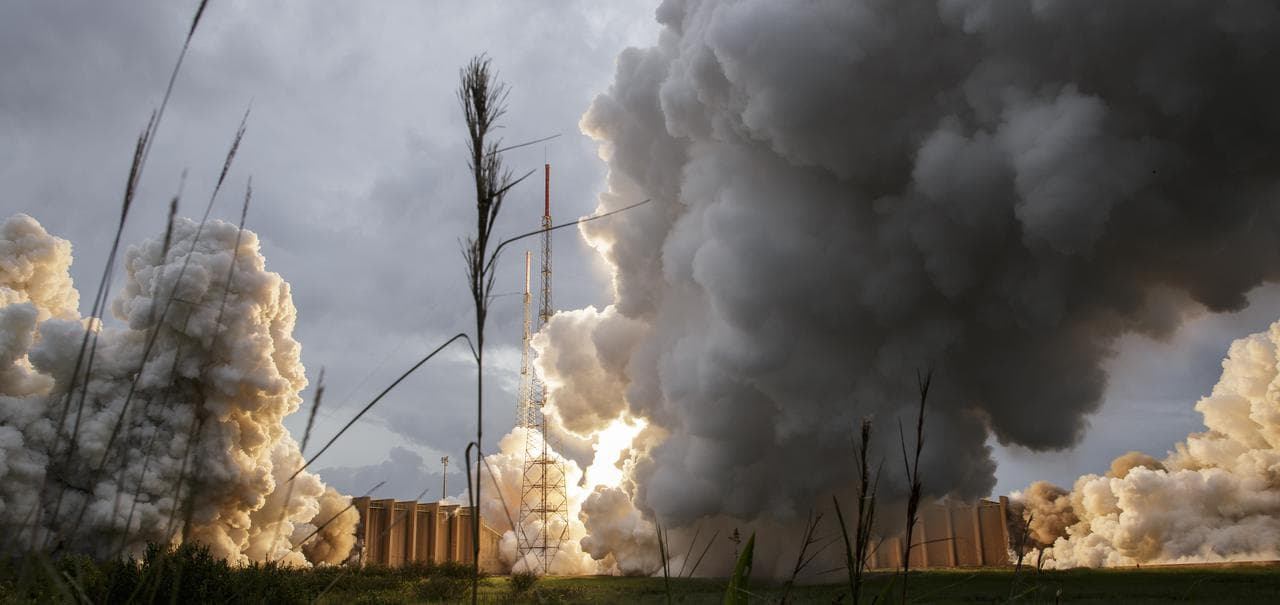
Britain's rocket program did not begin with aspirations of orbit. It began with the Cold War, the hydrogen bomb, and the need to deliver a nuclear warhead across continental distances.
In the early 1950s, the British government initiated the Blue Streak program — a medium-range ballistic missile intended to serve as the UK's independent nuclear deterrent. Blue Streak was to be a liquid-fueled rocket using kerosene and high-test peroxide (HTP), a concentrated form of hydrogen peroxide that served as both oxidizer and monopropellant. The engine, designated Gamma, was developed by Bristol Siddeley (later Rolls-Royce) at the rocket propulsion establishment in Westcott, Buckinghamshire. The airframe was built by de Havilland at Stevenage.
But before you could build a missile capable of delivering a warhead, you needed to understand what happened to a re-entry vehicle as it plunged back through the atmosphere at hypersonic velocities. That research requirement gave birth to Black Knight.
Design work on Black Knight began in 1955 at the Royal Aircraft Establishment (RAE), with the airframe contracted to Saunders-Roe on the Isle of Wight. Black Knight was a single-stage sounding rocket standing 11.6 meters tall, powered by a Gamma engine burning kerosene and HTP — the same propellant combination that would later power Black Arrow. The first Black Knight was test-fired at High Down on the Isle of Wight in 1957, and the first launch from the Woomera test range in the South Australian desert took place on September 7, 1958.
What followed was one of the most remarkable records of reliability in early rocketry. Between 1958 and 1965, 22 Black Knight vehicles were launched from Woomera. Not a single one suffered a major failure. That 100 percent success rate — across 22 flights of an expendable rocket in the late 1950s and early 1960s — was unmatched by any other British rocket program before or since, and it stood favorably against anything the Americans or Soviets were flying in the same period.
Black Knight's primary mission was to loft re-entry test vehicles to altitudes of several hundred kilometers, allowing researchers to study ablative heat shields and the aerodynamic behavior of warhead shapes during re-entry. The data fed directly into the Blue Streak program — and, when Blue Streak was cancelled as a military weapon in 1960 (its liquid-fueled design required lengthy pre-launch preparation, making it vulnerable to a Soviet first strike), the rocket expertise did not disappear. Blue Streak found a second life as the first stage of Europa, a collaborative European launch vehicle developed under the auspices of ELDO (the European Launcher Development Organisation), and the propulsion knowledge from Black Knight laid the groundwork for something more ambitious: an orbital launch vehicle.

Black Arrow and the Prospero Satellite: Triumph and Cancellation (1964–1971)
The project that became Black Arrow was authorized by the British government in late 1964. The goal was straightforward: build a small satellite launch vehicle using the propulsion technology already proven by Black Knight. The rocket would be developed by the RAE and manufactured by Westland Aircraft (which had absorbed Saunders-Roe) at their facility on the Isle of Wight.
Black Arrow was a three-stage rocket, standing approximately 13 meters tall. The first stage used a Gamma 8 engine — an arrangement of eight combustion chambers fed by a single turbopump — burning kerosene and HTP, producing roughly 256 kilonewtons of thrust. The second stage used a smaller Gamma 2 engine with two chambers. The third stage was a solid-fuel motor built by Bristol Aerojet. The vehicle could place a payload of approximately 73 kilograms into a 500-kilometer low Earth orbit — modest by any standard, comparable to the American Scout rocket rather than the much larger Thor-Delta or Atlas vehicles.
Four Black Arrow launches were attempted, all from Woomera:
R1 (June 28, 1969): A test flight to validate the first and second stages. The first stage performed well, but the second stage lost thrust prematurely due to a fault in the HTP feed system. The flight was classified as partially successful — it gathered valuable data but did not achieve its full trajectory objectives.
R2 (March 4, 1970): A suborbital test flight carrying a dummy payload. Both stages performed nominally, and the mission was a complete success.
R3 (September 2, 1970): The first orbital attempt, carrying the Orba test satellite. The first stage functioned correctly, but the second stage underperformed due to a roll-control issue, and the payload failed to reach orbit.
R4 (October 28, 1971): The flight that made history. Black Arrow's fourth launch placed the Prospero satellite — a 66-kilogram technology demonstration spacecraft designed to study the effects of the space environment on communications technology — into a 537-by-1,582-kilometer orbit. The United Kingdom became the sixth nation to orbit a satellite using an indigenously developed launch vehicle, after the Soviet Union (1957), the United States (1958), France (1965), Japan (February 1970), and China (April 1970).
Prospero was designed and built at the RAE's facility in Farnborough. Named after the magician in Shakespeare's The Tempest — a character who ultimately renounces his powers, in what turned out to be an uncomfortably apt piece of literary symbolism — the satellite carried experiments to test the degradation of solar cells and electronic components in the space radiation environment. It operated successfully until 1973 and was contacted annually by enthusiasts and researchers for more than 25 years afterward, its beacon still transmitting from an orbit that will not decay for centuries.
Here is the part of the story that makes space historians wince.
Frederick Corfield, the Minister of State for Aerospace at the Department of Trade and Industry, had announced the cancellation of the Black Arrow program in the House of Commons on July 29, 1971 — three months before the R4 launch that would successfully orbit Prospero. The reasoning, as stated to Parliament, was that "the maintenance of a national programme for launchers of a comparatively limited capability both unduly limits the scope of the National Space Technology Programme and absorbs a disproportionate share of the resources available for that programme." In plainer terms: the rocket was too small to be commercially competitive, and the money was better spent elsewhere. Britain would henceforth rely on American Scout rockets for any future satellite launches.
The R4 mission went ahead because the rocket and satellite were already built, the Woomera range was booked, and cancelling a ready-to-fly mission would have saved nothing. So Britain became the sixth nation to launch its own satellite — on the last flight of the rocket it had just cancelled. The team at Woomera knew, as they watched Prospero's telemetry confirm successful orbital insertion, that they were witnessing both a beginning and an end.
The Black Arrow program had cost approximately £9 million over its lifetime — roughly £140 million in 2026 money. For context, the Concorde supersonic airliner program, running concurrently, ultimately cost the British and French governments over £1.3 billion (1970s pounds). Britain chose the supersonic jet over the space rocket. The consequences of that choice echoed for decades.
The Wilderness Years: From Cancellation to UKSA (1971–2010)

What followed the cancellation of Black Arrow was not a complete withdrawal from space — Britain remained active in satellite design, Earth observation, and telecommunications — but it was an unmistakable retreat from autonomous launch capability and from any coherent national space strategy.
The institutional landscape was fragmented by design. Space activities were scattered across multiple government departments and research councils, none of which had space as its primary mandate. The Ministry of Defence handled military satellite communications. The Science and Engineering Research Council funded university space research. The Department of Trade and Industry oversaw commercial satellite policy. There was no single voice for space in Whitehall, no unified budget, and no strategic vision.
In 1985, the government created the British National Space Centre (BNSC) to coordinate these activities. The name sounded impressive. The reality was not. BNSC was not an executive agency with its own budget and hiring authority — it was a "partnership arrangement" among ten different government departments and research councils, each contributing staff on a part-time basis. BNSC had a coordination role, not a command role. It could convene meetings. It could write strategy documents. It could not direct spending, initiate programs, or speak with a single voice in international negotiations.
Despite these structural handicaps, BNSC managed to maintain Britain's position as a significant contributor to the European Space Agency. This point is worth emphasizing, because it is one of the most commonly misunderstood aspects of UK space policy: ESA is not an EU institution. The European Space Agency was established by an international convention in 1975 as an intergovernmental organization open to any European country and, increasingly, to associate members worldwide. Canada has been an ESA associate member since 1979. The UK's departure from the European Union in 2020 had no effect whatsoever on its ESA membership. Britain was a founding ESA member state and remains one today, contributing approximately £374 million per year to ESA programs — roughly 70 to 75 percent of UKSA's annual budget.
The BNSC years were not devoid of achievement. The UK's university space science community, particularly at institutions like the Mullard Space Science Laboratory (part of University College London), the University of Leicester, and Imperial College London, contributed instruments to ESA missions including Giotto (the first spacecraft to fly through a comet's tail, in 1986), Herschel (the largest infrared space telescope ever launched, in 2009), and Rosetta (which achieved the first controlled landing on a comet in 2014). British industry built satellite components and subsystems for programs around the world. And at the University of Surrey, a research group led by Martin Sweeting was quietly building a revolution in small satellite technology that would reshape the global space industry — a story we will tell in full in Part 2.
But there was no rocket. No launch site. No astronaut program. No national ambition in space that could be articulated in a single sentence. When the British public thought about space — to the extent they thought about it at all — they thought of NASA, or ESA, or Russia. Not Britain.
The turning point came in the late 2000s, driven less by visionary leadership than by economic arithmetic. Studies commissioned by BNSC and later by the Department for Innovation, Universities and Skills demonstrated that the UK space sector was already generating significant economic value — billions of pounds in revenue, tens of thousands of jobs — despite the absence of a dedicated agency to champion it. The argument shifted from "can we afford a space agency?" to "can we afford not to have one?"
The Creation of UKSA and the New Space Ambition (2010–Present)
On March 23, 2010, Lord Mandelson and Lord Drayson, joined by a then-little-known Army Air Corps officer and test pilot named Timothy Peake, announced the creation of the UK Space Agency at the Queen Elizabeth II Conference Centre in London. UKSA came into formal existence on April 1, 2010, replacing the BNSC and, for the first time, giving the United Kingdom an executive agency with a dedicated budget, a chief executive, and the authority to represent Britain in all international space negotiations.
The transformation was not instantaneous, but its effects have been cumulative and substantial.
UKSA's creation coincided with a broader shift in UK government thinking about space as an economic engine rather than a scientific luxury. The 2010 Space Innovation and Growth Strategy (IGS), developed by an industry-government task force, set what became a defining — and ultimately controversial — target: the UK would capture 10 percent of the global space economy by 2030, up from approximately 6 percent at the time. The target was ambitious, concrete, and politically useful. It was also, as subsequent events would demonstrate, more aspirational than achievable.
The global space economy did not cooperate with British ambitions. Falling launch costs, the explosion of small satellite constellations, and the sheer scale of American and Chinese investment expanded the denominator of the "global space economy" far faster than Britain could grow its numerator. By the mid-2020s, the 10 percent target had been quietly abandoned. Rebecca Evernden, director for space at the Department for Business, Energy and Industrial Strategy, acknowledged that the government "needed a more sophisticated way to measure growth in the various parts of the UK space sector which is less clumsy than a single headline growth target." Lord Willetts, a former science minister, was more candid: "It would be wonderful if we were on 10 percent, but we are working hard to keep it at about 5 percent."
The target may have been shelved, but the underlying growth was real. The most recent comprehensive survey — the Size and Health of the UK Space Industry 2024, published by London Economics for UKSA — reported the following for the 2022/23 financial year:
- Total UK space industry income: £18.6 billion
- Direct employment: 55,550 full-time equivalents (up 6.8 percent from 52,000 in 2021/22)
- Total jobs supported (including supply chain): approximately 137,000
- Number of organizations with space-related activities: 1,907
- Gross value added (GVA) to the UK economy: £7.2 billion directly, £16.7 billion including indirect and induced effects
- Labour productivity: £129,000 per employee — more than double the UK average of £61,729
These are not the numbers of a country dabbling in space. They are the numbers of a mid-tier space power with specific areas of genuine global dominance, particularly in satellite telecommunications, Earth observation data services, and — uniquely — space insurance.
UKSA's budget for 2025/26 stands at £668 million, with the government committing nearly £3.5 billion across the five-year period to 2029/30. By international standards, this places the UK well below NASA (approximately $25 billion), ESA (approximately €7.8 billion across all programs), or the national agencies of France and Germany, but well above most European nations. The majority of UKSA's budget — roughly 70 to 75 percent — flows to ESA programs under the principle of "geographic return," meaning that ESA contracts generated by UK contributions must flow back to UK industry in broadly proportional value.
In August 2025, the UK government announced a significant structural change: UKSA would be absorbed into the Department for Science, Innovation and Technology (DSIT) from April 2026, merging with the DSIT Space Directorate to form a single unit responsible for civil space strategy, policy, and delivery. The UKSA name will be retained, but the agency will no longer operate as a standalone executive agency. Whether this represents a bureaucratic consolidation or a diminution of institutional authority remains to be seen — the space community received the news with the mixture of pragmatism and mild anxiety that characterizes most British responses to government reorganization.
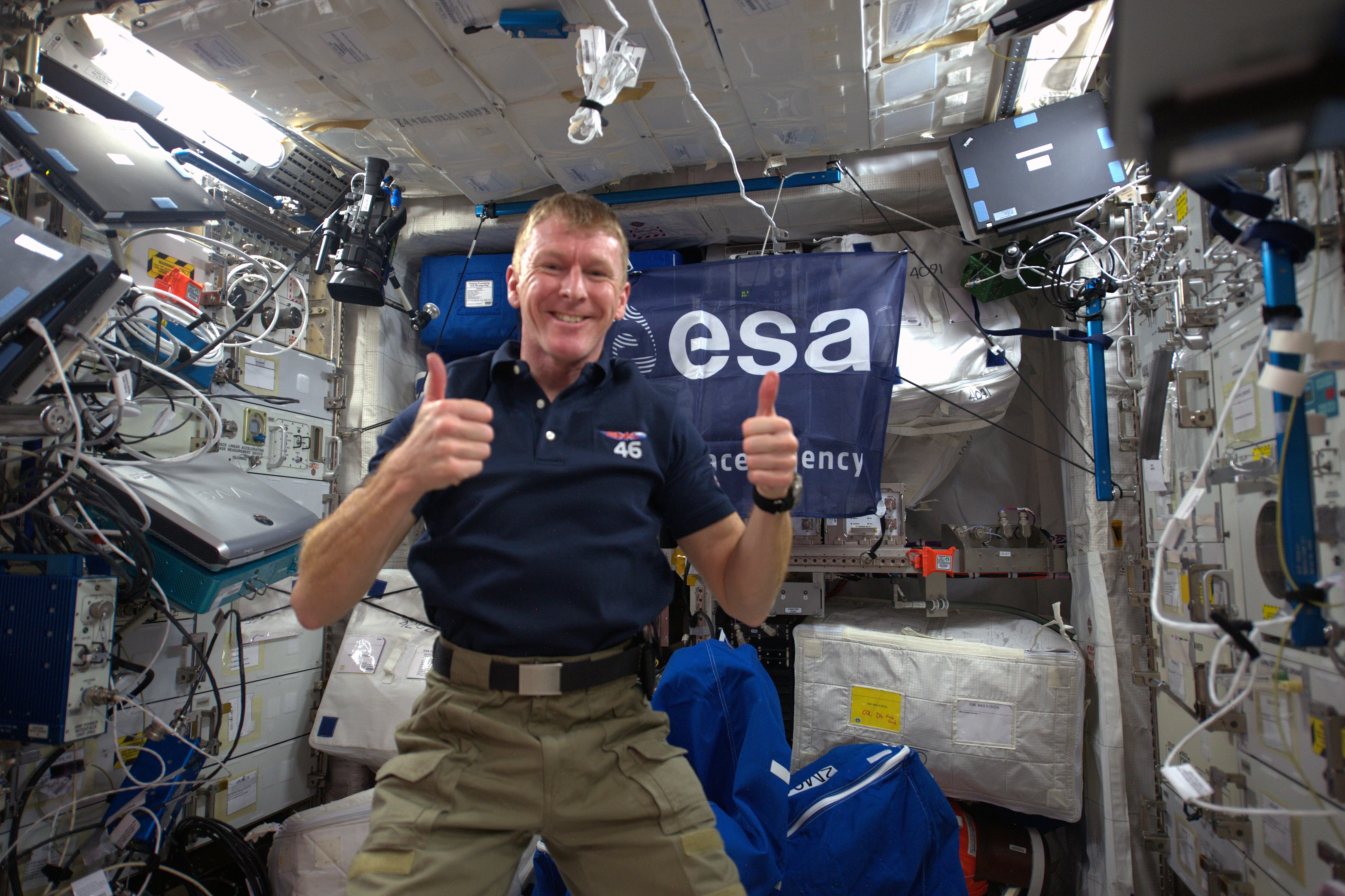
Five years after UKSA's creation, the agency's profile received an enormous boost from an unexpected direction: a human one. On December 15, 2015, Tim Peake launched from Baikonur Cosmodrome aboard a Soyuz TMA-19M spacecraft alongside NASA astronaut Tim Kopra and Roscosmos cosmonaut Yuri Malenchenko, bound for the International Space Station. Peake was the first British ESA astronaut to visit the ISS and the first official British astronaut to perform a spacewalk — a 4-hour, 43-minute EVA on January 15, 2016, to repair a failed power regulator on the station's truss structure.
Peake's six-month mission, designated Principia after Isaac Newton's Philosophiae Naturalis Principia Mathematica, was a public-engagement phenomenon. Over a million UK schoolchildren participated in experiments linked to the mission. Peake ran the London Marathon on a treadmill aboard the ISS, finishing in 3 hours and 35 minutes. He became a Commander of the Order of the British Empire. More importantly for the long-term health of the UK space sector, applications to science and engineering degree programs at British universities surged measurably in the years following the Principia mission — the "Tim Peake effect" became a documented influence on STEM recruitment.
The UK Space Sector Today: Strengths, Structure, and Strategic Position
The UK space sector's £18.6 billion in annual revenue masks a distinctive structural profile that sets it apart from almost every other national space economy. Britain is not a launch power — at least not yet. It is not a crewed spaceflight power. It does not build its own GPS constellation or operate its own space station. What it does, it does in areas that are high-value, high-margin, and deeply embedded in the global space infrastructure.
Satellite telecommunications dominate the revenue picture. The UK is home to Inmarsat (now part of Viasat), which has operated geostationary satellite services since 1979 and remains one of the world's largest providers of mobile satellite communications for maritime, aviation, and government users. London is the administrative headquarters of the International Telecommunications Satellite Organization (ITSO), the intergovernmental body that oversees the Intelsat system.
Earth observation and data services represent a growing segment, with companies like Airbus Defence and Space (which operates its synthetic aperture radar satellite constellation from the UK), CGI, and Telespazio UK providing analysis services to government and commercial customers.
Small satellite manufacturing has become a particular UK strength, led by Glasgow, Scotland, which produces more small satellites than any other city in Europe. Companies including AAC Clyde Space, Spire Global (which manufactures satellites at its Glasgow facility), and the pioneering Surrey Satellite Technology Ltd (SSTL) in Guildford have established the UK as a global hub for spacecraft weighing tens to hundreds of kilograms.
Space insurance, centered on Lloyd's of London, is perhaps the most distinctively British contribution to the space economy. Lloyd's has insured space assets since 1965, when it underwrote the first satellite insurance policy for Intelsat I (the "Early Bird" satellite). Today, Lloyd's specialist space underwriters provide coverage across the entire satellite lifecycle — manufacturing, launch, in-orbit testing, and operational service. The London market handles approximately 35 percent of global space insurance premiums (with Europe overall, including Lloyd's and continental insurers, accounting for that share). No other country has a comparable concentration of space insurance expertise.
Navigation and positioning is one area where Brexit did create a concrete impact on UK space capabilities. As an EU member, Britain had been a full participant in the Galileo satellite navigation program, with UK companies contributing significantly to the system's design and construction. Following Brexit, the UK was excluded from the encrypted Public Regulated Service (PRS) of Galileo — the high-security signal intended for government and military users. UK troops, aircraft, and naval vessels lost access to Galileo's most secure signals. The government briefly explored building an independent British navigation satellite constellation, but the estimated cost (upward of £5 billion) proved prohibitive, and the plan was shelved. The OneWeb acquisition, discussed below, was partly motivated by the hope that a LEO constellation could eventually provide positioning capabilities — though this remains more aspiration than engineering plan.

The Scottish Space Coast: Spaceports on the Edge of the World
The most dramatic development in the UK space sector in the 2020s is not happening in London or the Home Counties. It is happening in Scotland — specifically, on the remote northern islands and coastlines where geography, latitude, and regulatory ambition have converged to create what is increasingly called Europe's space coast.
The logic is simple. Rockets launching northward from Scotland fly over nothing but open ocean on their way to polar and sun-synchronous orbits — the orbital regimes most in demand for Earth observation, weather monitoring, and many communications constellations. Scotland's high latitude (the Shetland Islands sit at roughly 60.7 degrees north) provides an efficient trajectory for these orbits, and the absence of populated landmasses along the flight path eliminates the safety constraints that limit launch directions from most European sites. French Guiana's Kourou spaceport, Europe's primary launch facility, is optimized for equatorial and geostationary orbits; it is poorly suited to polar launches. Scotland fills that gap.
The numbers underscore the concentration: Scotland is home to more than 8,500 space industry employees, representing nearly one in five of all UK space jobs. Glasgow alone has earned the nickname "satellite city" for its concentration of small satellite manufacturers. And Scotland now hosts the two most advanced spaceport developments in the United Kingdom.
SaxaVord Spaceport, Unst, Shetland
SaxaVord Spaceport occupies the Lamba Ness peninsula on Unst, the most northerly inhabited island in the Shetland archipelago — and therefore the most northerly point in the United Kingdom. The site is a former Royal Air Force radar station, decommissioned after the Cold War, whose existing infrastructure (roads, buildings, hardstanding) and extreme northerly position made it an obvious candidate for a polar-orbit launch facility.
The spaceport has been developed by a private consortium and has received both a spaceport operator license from the Civil Aviation Authority and planning approval from Shetland Islands Council. Its location at 60.7 degrees north latitude offers the highest payload capacity to polar orbit of any potential UK launch site, and its northward launch azimuth passes over nothing but the Norwegian Sea and the Arctic Ocean.
SaxaVord is designed to host multiple launch operators simultaneously. As of early 2026, its primary customer is Rocket Factory Augsburg (RFA), a German launch startup developing the RFA ONE — a two-stage kerosene/liquid-oxygen rocket powered by nine Helix engines on the first stage, capable of placing approximately 1,300 kilograms into low Earth orbit.
On January 16, 2025, the Civil Aviation Authority granted RFA the first-ever orbital launch license in UK (and European) history, authorizing up to 10 launches per year from SaxaVord, with a maximum of two per month. The license represented a regulatory milestone: the culmination of the Space Industry Act 2018, which had established the legal framework for commercial spaceflight from British soil, and years of work by the CAA's space regulation team to build a licensing process from scratch.
The road to actual launch has been neither straight nor smooth. In August 2024, a static fire test of the RFA ONE first stage at SaxaVord ended in catastrophe when an anomaly in a single engine triggered a fire that spread through the entire stage, destroying the vehicle and significantly damaging the launch mount. RFA identified a turbopump failure as the root cause and spent the following 18 months redesigning the affected systems, rebuilding the stage, and implementing upgraded ground operating procedures. By March 2026, first and second stages of a new RFA ONE vehicle had been shipped to SaxaVord, and the company was targeting an integrated hot-fire test on the pad ahead of an orbital launch attempt in summer 2026.
If that launch succeeds, it will be the first orbital launch from UK soil — and the first orbital launch from Western Europe outside of French Guiana.
Sutherland Spaceport and the Orbex Story
The second Scottish spaceport, Space Hub Sutherland, was planned for the A'Mhoine peninsula in Sutherland, on the Scottish mainland's north coast. Unlike the privately developed SaxaVord, Sutherland received significant public funding — £17.3 million from UKSA and Highlands and Islands Enterprise — and was intended as the launch site for Orbex, a British-German rocket company developing the Prime micro-launcher.
Orbex Prime was an elegantly designed two-stage rocket fueled by bio-propane (a renewable fuel derived from biological feedstock) and liquid oxygen, intended to place payloads of up to 180 kilograms into sun-synchronous orbit. The company, headquartered in Forres in the Scottish Highlands with engineering facilities in Copenhagen, had developed its own 3D-printed rocket engine and attracted significant venture capital investment. Groundbreaking at the Sutherland site took place on May 5, 2023.
The story did not end well. In November 2024, Orbex announced that its first launch of Prime would be conducted from SaxaVord rather than Sutherland, citing the more advanced state of SaxaVord's infrastructure. Throughout 2025, the company faced mounting financial difficulties and drew scrutiny over its slow progress toward a launch-ready vehicle. In December 2025, The Exploration Company (TEC), a Franco-German space startup, entered acquisition talks with Orbex. A letter of intent was signed in January 2026. In February 2026, the talks collapsed, and Orbex entered insolvency proceedings, ceasing operations on February 18, 2026.
The collapse of Orbex sent shockwaves through the UK space community. It was a painful reminder that building rockets is extraordinarily difficult, that venture capital timelines and rocket development timelines rarely align, and that the path from prototype engine to operational launch vehicle is littered with the wreckage of companies that ran out of money before they ran out of engineering challenges.
The Sutherland spaceport itself may yet find a second life. Skyrora, an Edinburgh-based rocket company developing the Skyrora XL orbital launch vehicle, announced in February 2026 that it was exploring a bid for select Orbex assets, with particular interest in the Sutherland site. Whether Sutherland becomes an operational spaceport under new management or remains a monument to unfulfilled ambition is one of the open questions of British space policy.
The Regulatory Framework: Space Industry Act 2018
Underpinning the entire Scottish space coast is the Space Industry Act 2018, which established the legal framework for spaceflight activities conducted from UK territory. The Act empowered the Civil Aviation Authority (CAA) to serve as the UK's spaceflight regulator — a role historically alien to an organization best known for overseeing airlines and airports.
The CAA's space licensing regime covers spaceport operators, launch operators, orbital operators, and range control services. Key requirements include a safety case demonstrating that risks to the public are "as low as reasonably practicable" (ALARP), an assessment of environmental effects, and third-party liability insurance. The licensing process takes at least nine months from application to decision — a timeline that reflects the inherent complexity of assessing novel launch systems but that has drawn criticism from industry for its length.
By early 2026, the CAA had issued:
- A spaceport operator license to SaxaVord
- The first UK orbital launch license to Rocket Factory Augsburg (January 2025)
- The first UK launch license to a British company — Skyrora, authorized for up to 16 suborbital launches per year of its Skylark L rocket from SaxaVord (August 2025)
Skyrora's license was a particular milestone: the first time a UK-registered company had been authorized to launch rockets from British soil. The Skylark L is a suborbital vehicle, but Skyrora's orbital-class Skyrora XL — a three-stage rocket capable of placing 315 kilograms into sun-synchronous orbit — is in development, with a potential first launch as early as late 2026 or 2027, depending on licensing timelines and launch site availability.
The regulatory architecture is deliberately modular. The Space Industry Act does not prescribe specific technologies or vehicle types; it establishes a framework within which the CAA assesses each application on its merits. This flexibility is important because the UK launch market, if it materializes as planned, will involve multiple vehicle types (suborbital sounding rockets, small orbital launchers, and potentially air-launched systems) from multiple operators at multiple sites. The Act was written, in other words, to accommodate an industry that did not yet exist — a legislative bet on a future that is now, fitfully, arriving.
OneWeb and the Satellite Broadband Gamble
No single investment captures the ambition — and the risk — of the UK's modern space strategy more vividly than the government's decision to invest $500 million of taxpayer money in OneWeb, a bankrupt satellite broadband company, in the summer of 2020.
The backstory is worth telling in full. OneWeb was founded in 2012 by Greg Wyler, a satellite industry veteran who had previously created O3b Networks (the name stood for "Other 3 Billion," a reference to the world's unconnected population). OneWeb's plan was to build a constellation of 648 small satellites in low Earth orbit, approximately 1,200 kilometers above the Earth, to provide global broadband internet connectivity. The satellites would be manufactured at a purpose-built factory in Florida in partnership with Airbus Defence and Space, launched in batches of 36 aboard Soyuz rockets from Baikonur, and would provide service through ground-based user terminals.
The plan was plausible, the technology was sound, and the market — connecting the unconnected — was vast. But OneWeb burned through capital at a rate that outpaced its fundraising. After launching 74 satellites, the company filed for Chapter 11 bankruptcy protection in March 2020, citing an inability to secure additional funding amid the COVID-19 pandemic.
What happened next was driven by a convergence of strategic anxieties. Brexit had just ejected the UK from full participation in the EU's Galileo navigation satellite program. The government was acutely aware that Britain lacked sovereign satellite navigation capability, and some officials speculated — optimistically, in the view of most engineers — that a modified OneWeb constellation could eventually provide positioning, navigation, and timing (PNT) services in addition to broadband. More broadly, the UK government recognized that LEO satellite broadband was becoming a strategic technology, with SpaceX's Starlink and Amazon's Project Kuiper demonstrating that major powers were investing heavily in orbital internet infrastructure.
In July 2020, the UK government and India's Bharti Global jointly won the bankruptcy auction for OneWeb with a combined bid of $1 billion — $500 million from each party. The sale closed in November 2020, with the UK government receiving a significant equity stake and, crucially, a "special share" providing veto power over national security matters, including the ability to prevent OneWeb's technology from being transferred to hostile states or its ground stations from being relocated away from UK soil.

The constellation was completed over the following years, with launches shifting from Soyuz rockets (which became unavailable after Russia's invasion of Ukraine in February 2022) to SpaceX Falcon 9 and ISRO's GSLV-Mk III. By 2024, the full constellation of over 648 satellites was operational, providing global coverage from 12 orbital planes at 1,200 kilometers altitude.
In September 2023, OneWeb merged with Eutelsat, a French geostationary satellite operator, to form the Eutelsat Group — a combined entity operating both LEO and GEO satellite fleets, creating what the companies described as a "multi-orbit" connectivity platform. The UK government retained its special share and its rights over OneWeb's LEO operations within the merged entity. However, the value of the government's stake was widely reported to have approximately halved relative to its original investment — a source of political discomfort, though government officials argued that the strategic value of the investment (sovereign influence over a global LEO constellation) was not captured by market valuation alone.
The Eutelsat-OneWeb entity has continued to expand. In January 2026, Eutelsat awarded Airbus a contract for 340 additional LEO satellites, bringing the total next-generation OneWeb spacecraft on order to 440 units. These will augment and eventually replace the first-generation constellation, with enhanced capacity, 5G compatibility, and delivery beginning in late 2026. A second-generation LEO network, with an estimated cost of $4 billion, is planned to enter service by 2028.
The strategic significance of the UK's OneWeb stake is best understood in context. As of 2026, there are only three operational large-scale LEO broadband constellations in the world: SpaceX's Starlink (American, with over 6,000 satellites), Eutelsat OneWeb (European, with UK government influence, 648 satellites), and — distantly — Amazon's Project Kuiper (American, in early deployment). China's Guowang constellation is under development but not yet operational. The UK, through its OneWeb investment, has a seat at a very exclusive table.
Whether that seat justifies the $500 million price tag — and whether the government's PNT aspirations for OneWeb were ever realistic — will be debated for years. What is not debatable is that the investment gave Britain a stake in one of the defining infrastructure technologies of the 21st century, at a moment when most nations were still drafting strategy documents about satellite broadband rather than buying satellite companies.
The British Paradox: Ambition, Austerity, and Understatement
Understanding the UK space program requires understanding a cultural dynamic that has no direct equivalent in the American, Chinese, or Indian space narratives. Britain does not do triumphalism well — at least not about its own space achievements. The national instinct is toward understatement, self-deprecation, and a particular form of irony that treats excessive enthusiasm about anything technological as faintly embarrassing.
This cultural posture has real consequences. When India's Chandrayaan-3 landed on the Moon in August 2023, the Indian government declared a national holiday and the Prime Minister appeared on live television. When Japan's SLIM lander reached the lunar surface in January 2024, NHK ran continuous coverage and the mission became a national talking point. When Prospero reached orbit in 1971, the achievement was mentioned briefly in the broadsheets and then the program was cancelled.
The tension between ambition and austerity has been the defining feature of British space policy for seven decades. The Black Arrow program was cancelled to save £9 million. The Galileo replacement was abandoned because it would have cost £5 billion. UKSA's budget, while growing, remains a fraction of what France or Germany invest through their own national programs on top of ESA contributions. The House of Lords' 2025 report on the UK space economy was titled, with characteristically British bluntness, The Space Economy: Act Now or Lose Out.
The report's central finding was that the UK space sector lacks the strategic direction necessary for sustained success, and that the government's funding model — heavily reliant on grants rather than procurement contracts — fails to provide the long-term demand signal that allows companies to scale. The global space economy, the report noted, could be worth more than a trillion dollars within the next decade. Britain's share of that economy is not guaranteed.
And yet, for all the institutional caution, the UK space sector keeps growing. The numbers — £18.6 billion in revenue, 55,000 direct jobs, nearly 2,000 organizations — represent a sector that has expanded through a combination of ESA collaboration, commercial satellite expertise, and the kind of quiet technical competence that the British do well but rarely celebrate loudly. Arthur C. Clarke imagined the geostationary communications satellite. Martin Sweeting at Surrey built the first modern microsatellite. The British Interplanetary Society, founded in Liverpool in 1933, is the oldest space advocacy organization in the world still in existence. Lloyd's of London has insured satellites since 1965. The intellectual and commercial roots of Britain's space capability run deep, even when the political roots run shallow.
Looking Ahead to Part 2
Britain stands at an inflection point. The spaceports are built but have not yet launched. The regulatory framework is in place but has yet to be tested by a successful orbital mission from UK soil. The OneWeb investment is deployed but its long-term return is uncertain. The collapse of Orbex has removed one of the most visible players from the field, while RFA and Skyrora press forward with their own orbital ambitions.
Part 2 of this deep dive will examine the stories still unfolding: Reaction Engines and its SABRE air-breathing rocket engine concept, which promises to revolutionize access to space — if the engineering works. Surrey Satellite Technology, the Guildford-based company that pioneered the modern small satellite and is now a subsidiary of Airbus. Skyrora's path from Edinburgh startup to licensed launch operator. The UK's growing defense space capabilities, including the Space Command established in 2021. The Lloyd's of London space insurance market in detail — how you underwrite a satellite launch, what happens when a rocket explodes, and why London remains the global center for space risk. And the missions and technologies that will determine whether Britain's return to space is a sustainable trajectory or another false start.
The question is not whether the UK belongs in space — fifty-five years of continuous satellite operations, ESA membership, and an £18.6 billion industry have answered that definitively. The question is whether Britain will match its commercial and scientific capability with the institutional ambition and sustained investment that a serious space program requires. The spaceports of Shetland and Sutherland, the satellite factories of Glasgow, the underwriting rooms of Lloyd's, and the corridors of DSIT will provide the answer.
It will be, as the British like to say, interesting to watch.