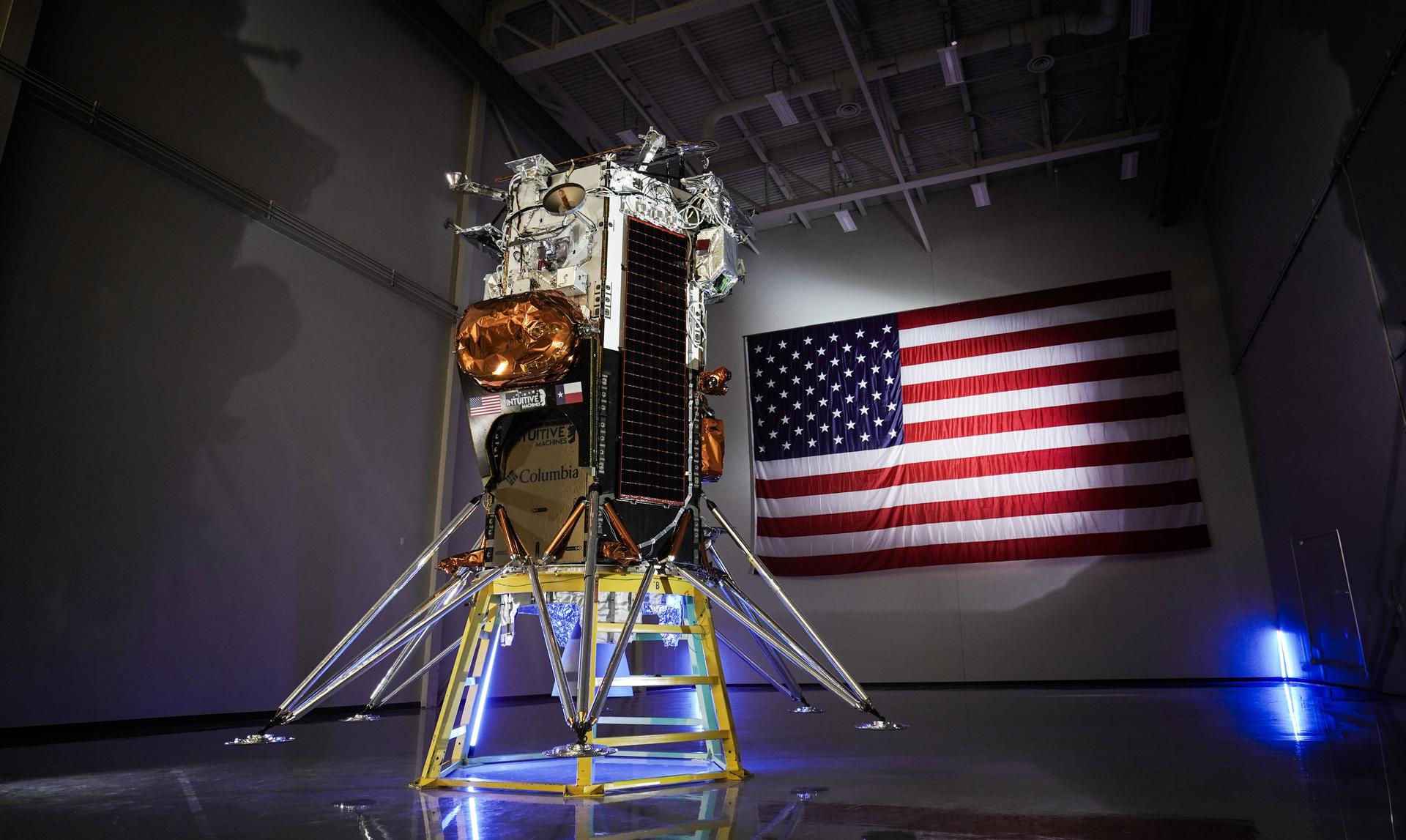
On February 22, 2024, the United States returned to the Moon for the first time in 52 years. The vehicle that carried America back wasn't a NASA-built spacecraft — it was Odysseus, a hexagonal robotic lander built by a 525-person Houston startup called Intuitive Machines. It tipped over on landing. The stock soared anyway. That contradiction — impressive achievement, imperfect execution, enormous ambition — is the central story of one of the most interesting companies in the modern space economy.
This is the complete investor and enthusiast deep dive into Intuitive Machines: what they do, how they make money, what makes them defensible, where they fall short, and whether the stock makes sense at current prices.
Company Background: From Houston Startup to Lunar Infrastructure Company
Intuitive Machines was founded in 2013 by three veterans of NASA's Johnson Space Center: Stephen Altemus (CEO and President), Kam Ghaffarian (Executive Chairman and largest individual shareholder), and Tim Crain (CTO). All three spent decades inside NASA before betting that the agency's new commercial partnerships model would open the door for private companies to own and operate lunar infrastructure.
Headquartered in Houston, Texas and incorporated in Delaware, the company began life as an engineering services firm doing work for NASA before pivoting to become a developer of lunar landing systems after winning its first CLPS (Commercial Lunar Payload Services) contract in 2018 — just one year after NASA launched the program.
The company went public on February 13–14, 2023 via a reverse merger with SPAC Inflection Point Acquisition Corp. (NASDAQ: IPAX), trading on NASDAQ under the ticker LUNR at a reference price of $10 per share, implying an enterprise value of approximately $817 million.
As of April 2026, Intuitive Machines employs approximately 525 people and — following two major acquisitions in late 2025 and early 2026 — has transformed from a pure-play lunar lander company into a multi-segment lunar and cislunar infrastructure business with over $850 million in combined annual revenue run-rate.
What Intuitive Machines Actually Does: Four Business Segments
Understanding Intuitive Machines requires moving past the lander narrative. The company's long-term thesis is to own the foundational infrastructure layer of the cislunar economy — the way AWS owns cloud infrastructure, or Comcast owns cable networks. Here are the four pillars:
1. Lunar Surface Delivery (CLPS Missions)
The business most people know: flying NASA science payloads and technology demonstrations to the Moon aboard the Nova-C lander under NASA's Commercial Lunar Payload Services (CLPS) program.
NASA's CLPS model is a deliberate departure from traditional contracting. Rather than NASA designing and operating landers, it purchases payload delivery as a service — paying fixed prices per kilogram delivered, with the commercial company retaining ownership of the vehicle and building reusable flight systems. This creates a marketplace with Intuitive Machines, Astrobotic, Firefly Aerospace, and ispace competing for task orders.
Intuitive Machines has won five CLPS task orders totaling approximately $539.4 million:
| Mission | Value | Target | Status |
|---|---|---|---|
| IM-1 (Odysseus) | ~$118M | Malapert A (near south pole) | Completed Feb 2024 |
| IM-2 (Athena) | ~$47M | Lunar south pole | Completed (partial) Mar 2025 |
| IM-3 (Trinity) | ~$77.5M | Reiner Gamma (lunar swirl) | Planned H2 2026 |
| IM-4 | $116.9M | Lunar south pole | Planned ~2027 |
| IM-5 | $180.4M | Mons Malapert (Nova-D) | Planned ~2028 |
IM-5 will be the first flight of the larger Nova-D lander, designed for heavy cargo including fission surface power units and crewed lunar terrain vehicles — opening a higher-margin delivery tier.
2. Lunar Communications and Data Relay (Near Space Network)
This is the business with the transformative contract. In September 2024, NASA awarded Intuitive Machines a sole-source contract for Near Space Network Services (NSNS) — making them the exclusive commercial provider of lunar relay communications for NASA through 2034, with a maximum potential value of $4.82 billion.
To fulfil this contract, the company is building a constellation of five small satellites in High Earth Orbit (HEO) and lunar orbit to provide continuous data relay between Earth and surface missions. The model is subscription and usage-based — a pay-per-minute relay service that serves NASA under the NSN contract and commercial operators at market rates. The first satellite launches as a secondary payload on IM-3 in the second half of 2026. Partnerships with Italy's Leonardo and Telespazio add a European customer pipeline and ground network integration.
This segment is what separates Intuitive Machines from every competitor in the field. No other lunar lander company has this contract.
3. Deep Space Navigation Services (KinetX)
In October 2025, Intuitive Machines acquired KinetX Aerospace for $30 million — adding 30+ years of proven deep space navigation expertise to the company. KinetX has provided navigation support across the solar system and currently operates constellation management software for government programs including Iridium satellite systems and the Mobile User Objective System (MUOS) supporting U.S. defense operations.
This acquisition expands Intuitive Machines into orbit modeling, trajectory design, secure constellation operations, and potential roles in Space Development Agency layered satellite architectures. KinetX also brings relationships with DoD customers beyond NASA — a critical diversification.
4. Spacecraft Manufacturing (Lanteris, formerly Maxar Space Systems)
The biggest and most transformative move came in January 2026: Intuitive Machines completed the acquisition of Lanteris Space Systems (previously the spacecraft manufacturing division of Maxar Technologies) for $800 million ($450 million cash + $350 million stock).
Lanteris brings flight-proven spacecraft manufacturing capabilities for LEO, MEO, GEO, and cislunar orbits, plus existing government and commercial satellite customers. Lanteris alone generated approximately $601 million in FY2025 revenue — instantly turning Intuitive Machines from a sub-$300M revenue company to one guiding for up to $1 billion in 2026. Critically, Lanteris means Intuitive Machines can now manufacture its own cislunar relay satellites in-house rather than outsourcing — significantly improving economics for the NSN constellation build-out.
Technology: The Nova-C Lander and What Comes Next
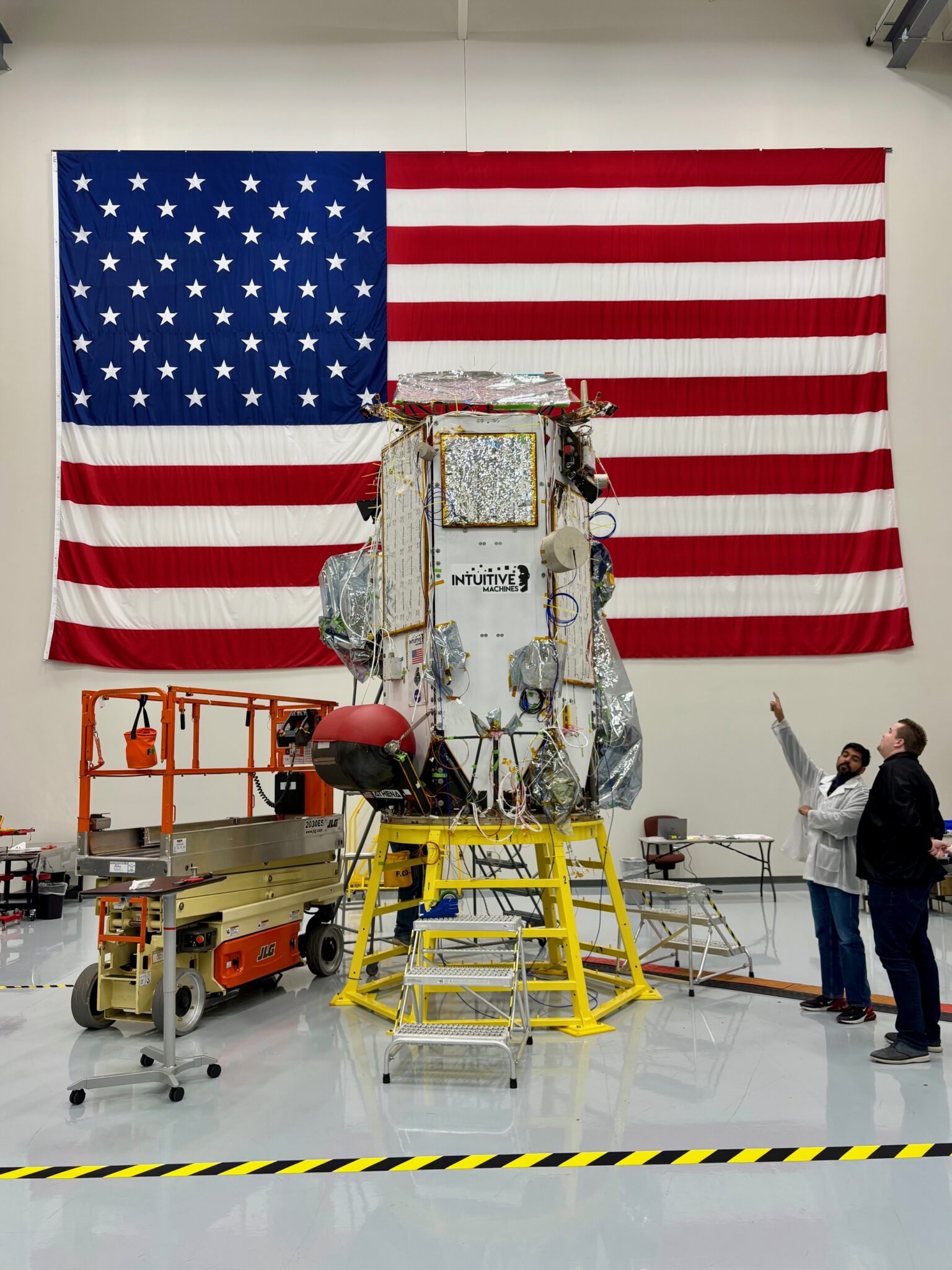
Nova-C: Specifications
The Nova-C is Intuitive Machines' first-generation operational lander — a hexagonal cylindrical spacecraft designed for the lunar surface:
- Height: 3.938 m (12.92 ft)
- Launch mass: 1,908 kg (4,206 lb)
- Payload capacity: ~100 kg (220 lb) to the lunar surface
- Propulsion: Gimbaled VR900 main engine burning liquid methane (LCH4) and liquid oxygen (LOX) — cryogenic propellants that are storable on-orbit and relevant to future Mars missions
- Thrust: 3,100 N (700 lbf) main engine; helium reaction control system thrusters at 4.45 N each
- Launch vehicle: SpaceX Falcon 9 (via CLPS rideshare arrangement)
The Nova-C uses Navigation Doppler Lidar (NDL) — a three-beam laser sensor providing precise velocity and range measurements during powered descent. This NASA-developed technology was critical in IM-1's improvised recovery when the primary rangefinder was inadvertently disabled before launch.
Nova-D: Heavy Cargo Class
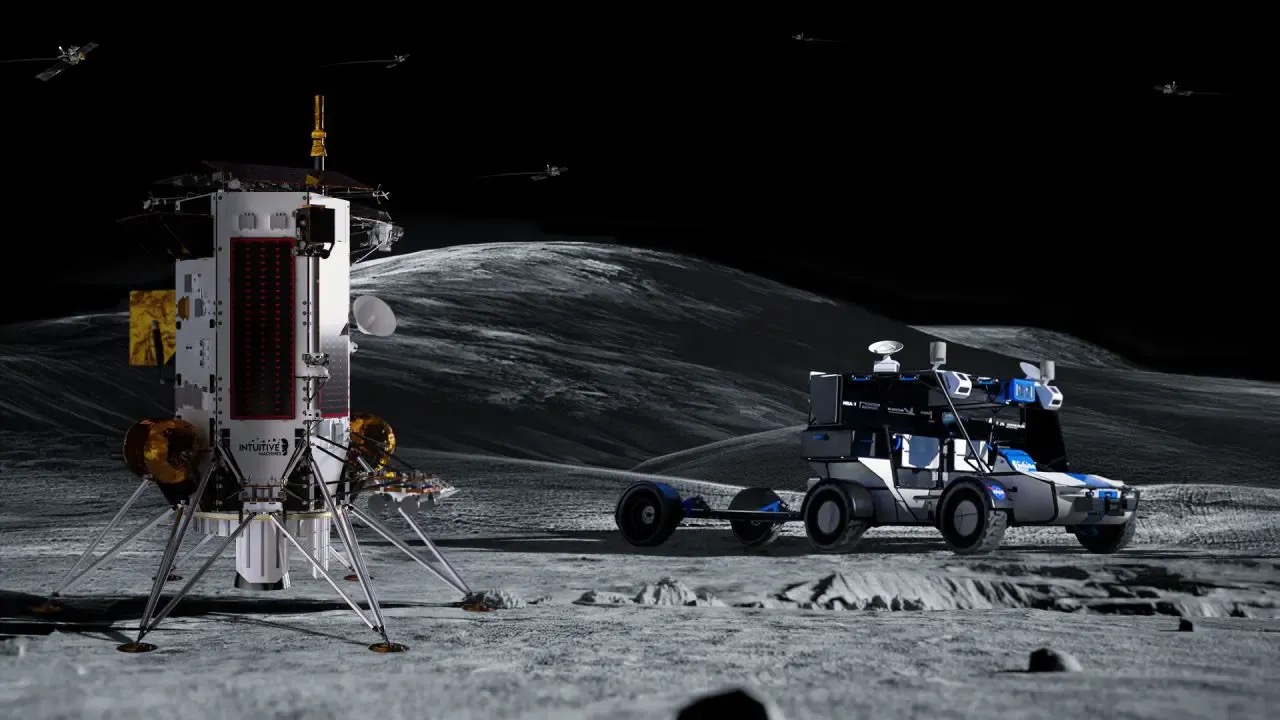
Currently in development, the Nova-D lander is designed for a dramatically higher payload capacity — capable of carrying large infrastructure items like fission surface power systems, pressurized habitats, and crewed lunar terrain vehicles. Its first flight is planned for IM-5 targeting Mons Malapert near the lunar south pole. Nova-D opens an entirely new market tier that smaller competitors cannot address.
The Cislunar Communications Network
Five small satellites in HEO and lunar orbit will form a persistent data relay backbone. Powered by Dcubed deployable solar arrays, these satellites will close the "shadow zones" where lunar surface missions lose direct line-of-sight to Earth. The first satellite launches on IM-3. Intuitive Machines can now manufacture all subsequent satellites in-house via Lanteris.
Mission History: Two Landings, Two Tip-Overs, and What Was Learned
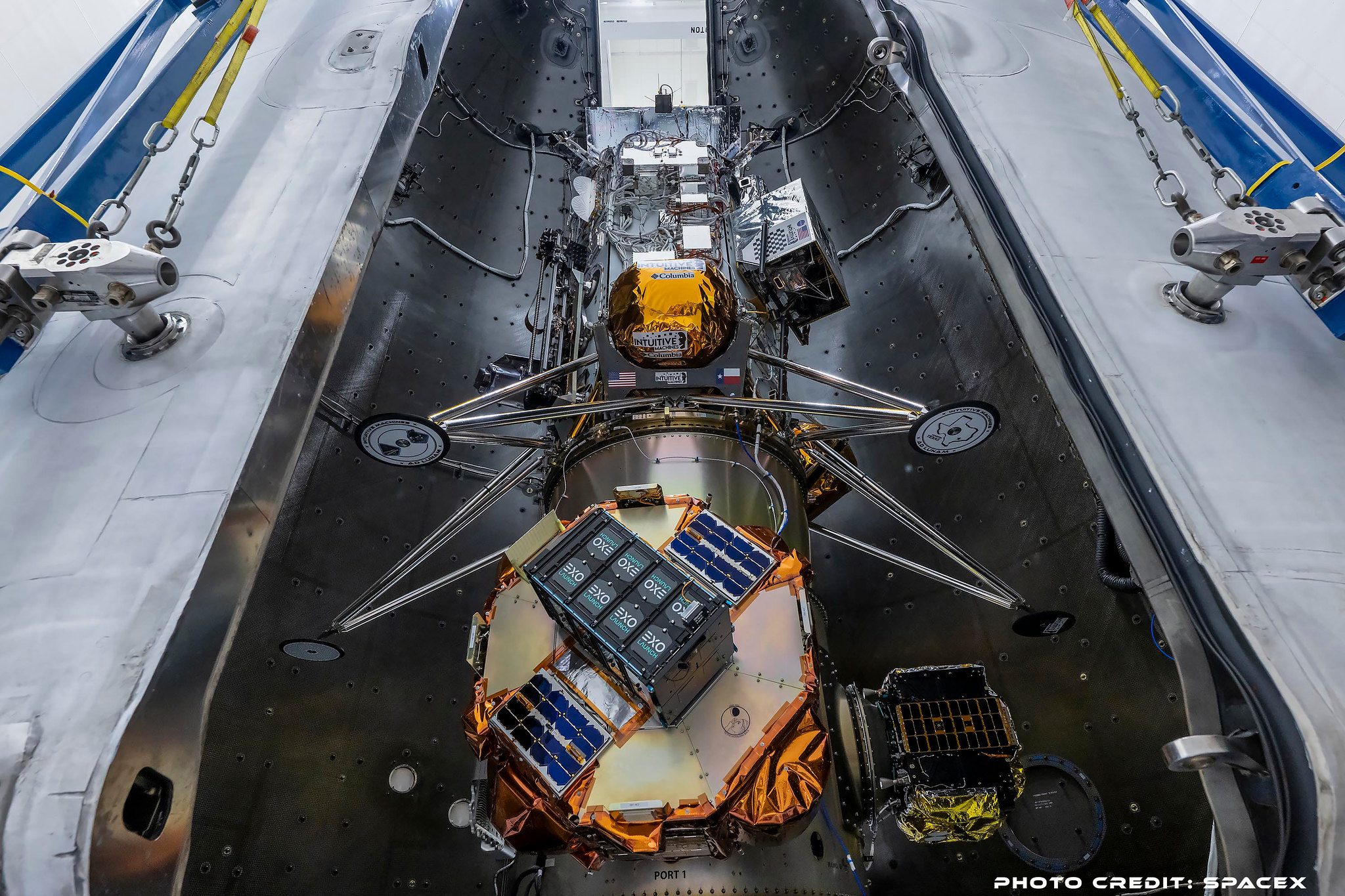
IM-1 — Odysseus (February 2024): Historic First, Imperfect Landing
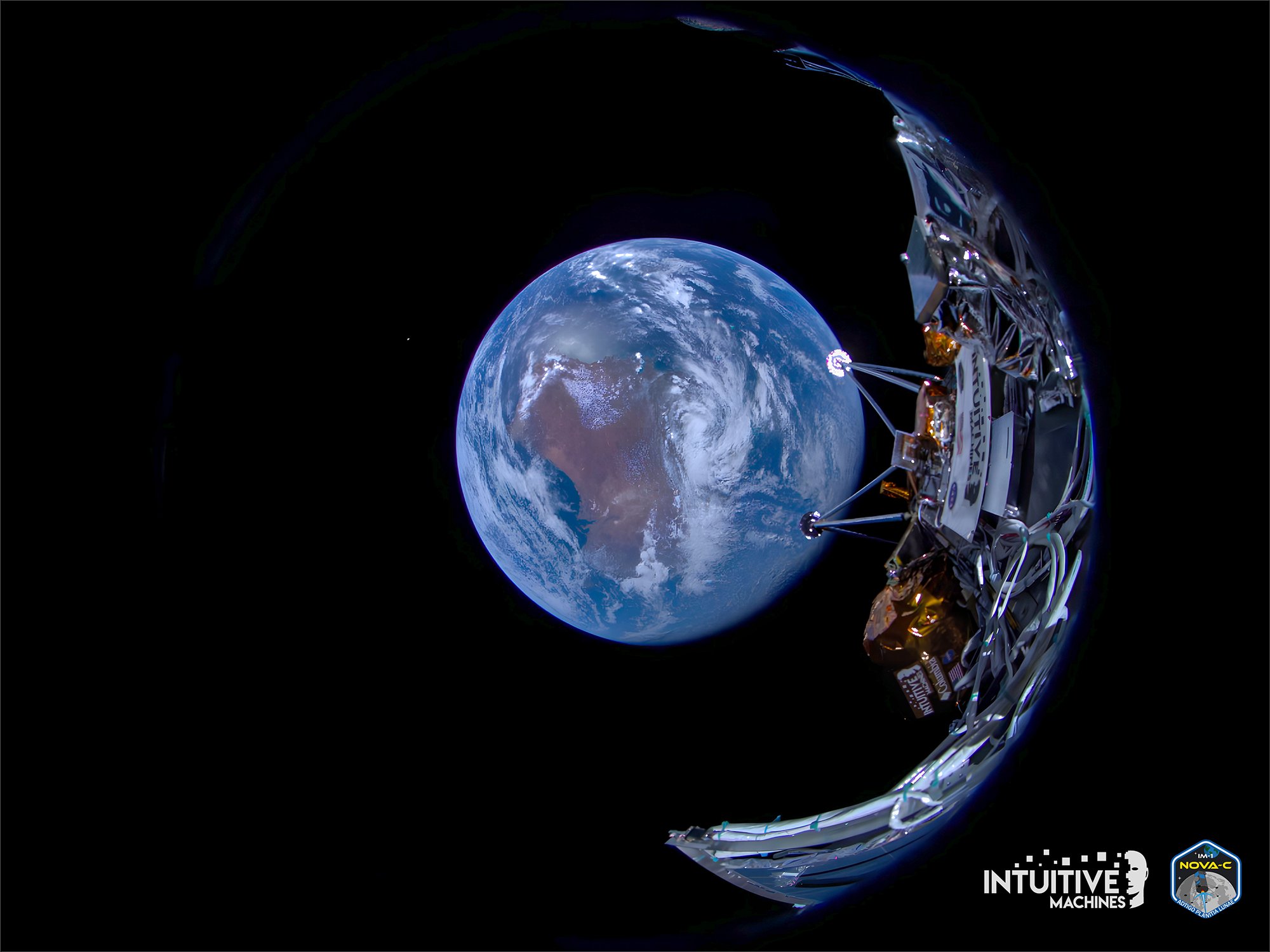
Odysseus launched February 15, 2024 on a SpaceX Falcon 9 from Kennedy Space Center. Six days later, on February 22, 2024, it became the first U.S. spacecraft to soft-land on the Moon since Apollo 17 in December 1972 — and the first commercial vehicle ever to achieve a lunar soft landing.
The mission had a near-disaster en route. Engineers discovered that laser rangefinder safety switches had not been removed before launch, disabling the primary landing sensors. With hours remaining before powered descent, a software patch was improvised to route navigation data through an experimental NASA payload (the NDL) that was not designed for primary guidance. The fix worked — Odysseus reached the surface — but it landed on a slope of approximately 12 degrees, breaking a landing leg and tipping to a 30-degree angle.
Despite lying on its side, the lander transmitted over 350 megabytes of science and engineering data. All six NASA payloads returned data including the Laser Retroreflector Array (LRA), the Lunar Node-1 navigation demonstrator, and the Radio wave Observation at the Lunar Surface of the photoElectron Sheath (ROLSES). Odysseus entered standby on February 29 as lunar night arrived, and subsequently lost power.
The mission is classified as a success by both NASA and Intuitive Machines — the first commercial lunar landing, with all scientific objectives at least partially met.
IM-2 — Athena (February–March 2025): South Pole Attempt
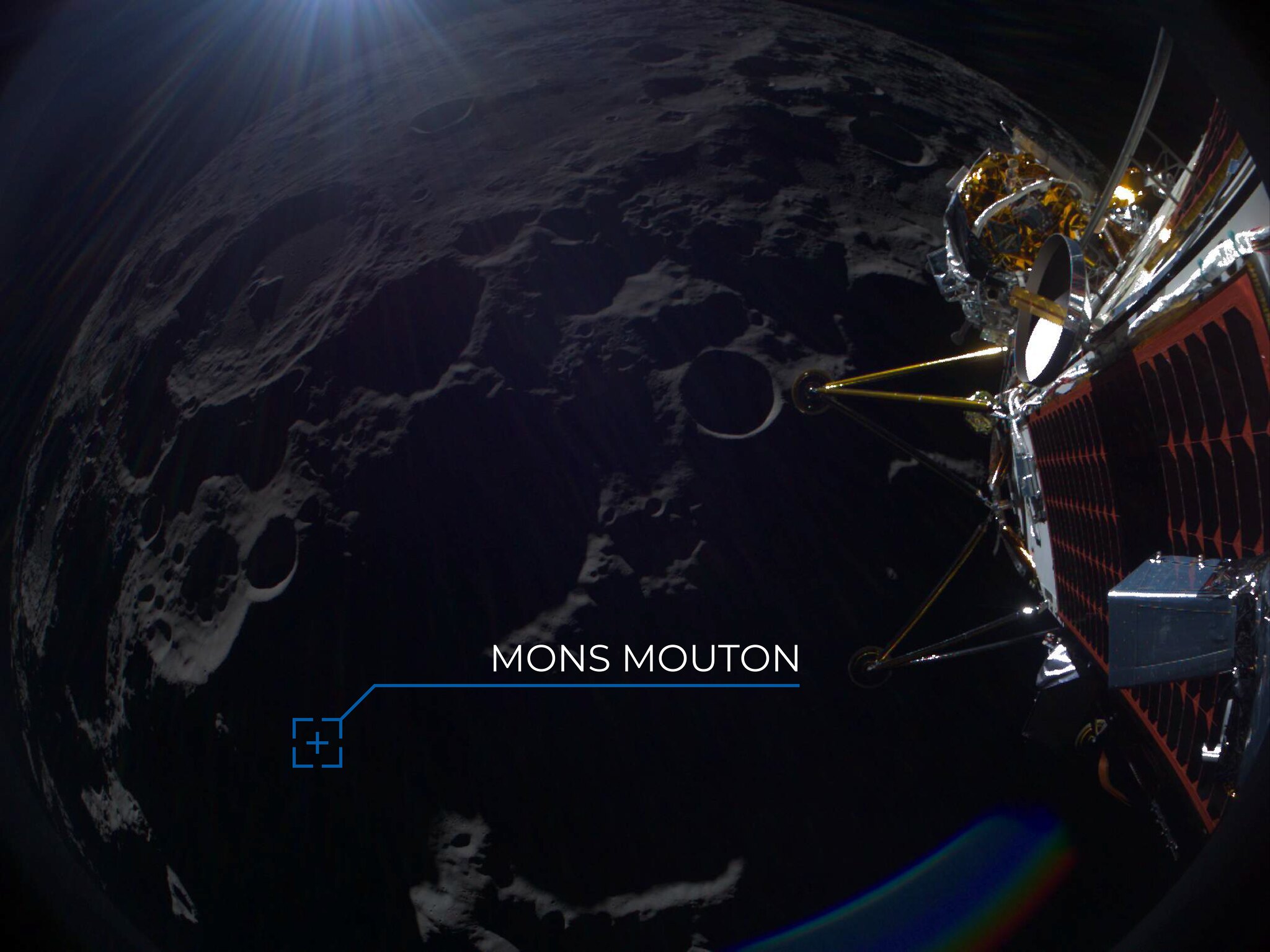
Athena launched February 27, 2025, targeting a landing site approximately 100 miles from the lunar south pole — the most demanding and scientifically valuable real estate on the Moon.
On March 6, 2025, during final powered descent, three compounding failures caused a second tip-over:
- Laser altimeter signal distortion: Unusual noise in the altimeter readings during the final descent phase caused loss of accurate altitude data.
- Extreme south pole lighting conditions: The low-angle sunlight, deep shadows, and unique terrain near the south pole degraded precision sensor performance in ways ground testing had not fully modeled.
- Terrain impact: The lander struck a plateau, tipped, skidded, and rolled 1–2 times, coming to rest inside a crater with solar panels coated in regolith dust.
Power was exhausted within approximately 12 hours. Some payloads briefly transmitted data — including Nokia Bell Labs' 4G LTE network demonstrator.
CEO Stephen Altemus publicly disclosed the root causes in detail on the May 14, 2025 earnings call. Intuitive Machines' response to the IM-2 failure is where the company's engineering culture is most visible: they published root causes, identified specific sensor and operations changes, and are implementing all of them for IM-3.
IM-3 — Trinity (Planned H2 2026): Lessons Applied
For the Reiner Gamma mission, Intuitive Machines has implemented concrete improvements:
- Redundant and dissimilar altimeters (two different technologies — one failure cannot disable both)
- A lighting-independent surface velocity sensor (optical flow navigation)
- An expanded crater terrain database for improved autonomous hazard avoidance
- 12 lunar orbits before descent (vs. 3 on IM-2) for better laser altimeter calibration
- IM-3 will also deploy the first cislunar relay satellite as a secondary payload
NASA Scope and the Broader Government Market
Intuitive Machines sits at the intersection of three U.S. government space priorities:
1. Artemis Program (Return to the Moon) NASA's Artemis campaign aims to return humans to the lunar surface, establish a sustainable presence at the south pole, and build toward a cislunar economy. Intuitive Machines' CLPS missions are explicitly part of Artemis — they scout landing sites, demonstrate navigation technology, and test surface systems before astronauts arrive. The IM-4 and IM-5 missions (south pole targeting) feed directly into crewed surface operation planning.
2. Near Space Network The $4.82 billion NSN contract makes Intuitive Machines the primary commercial communications backbone for NASA's cislunar operations through 2034. This is not a competitive award that could be lost at re-compete — it is a sole-source contract awarded because no other company had proposed a viable cislunar relay architecture.
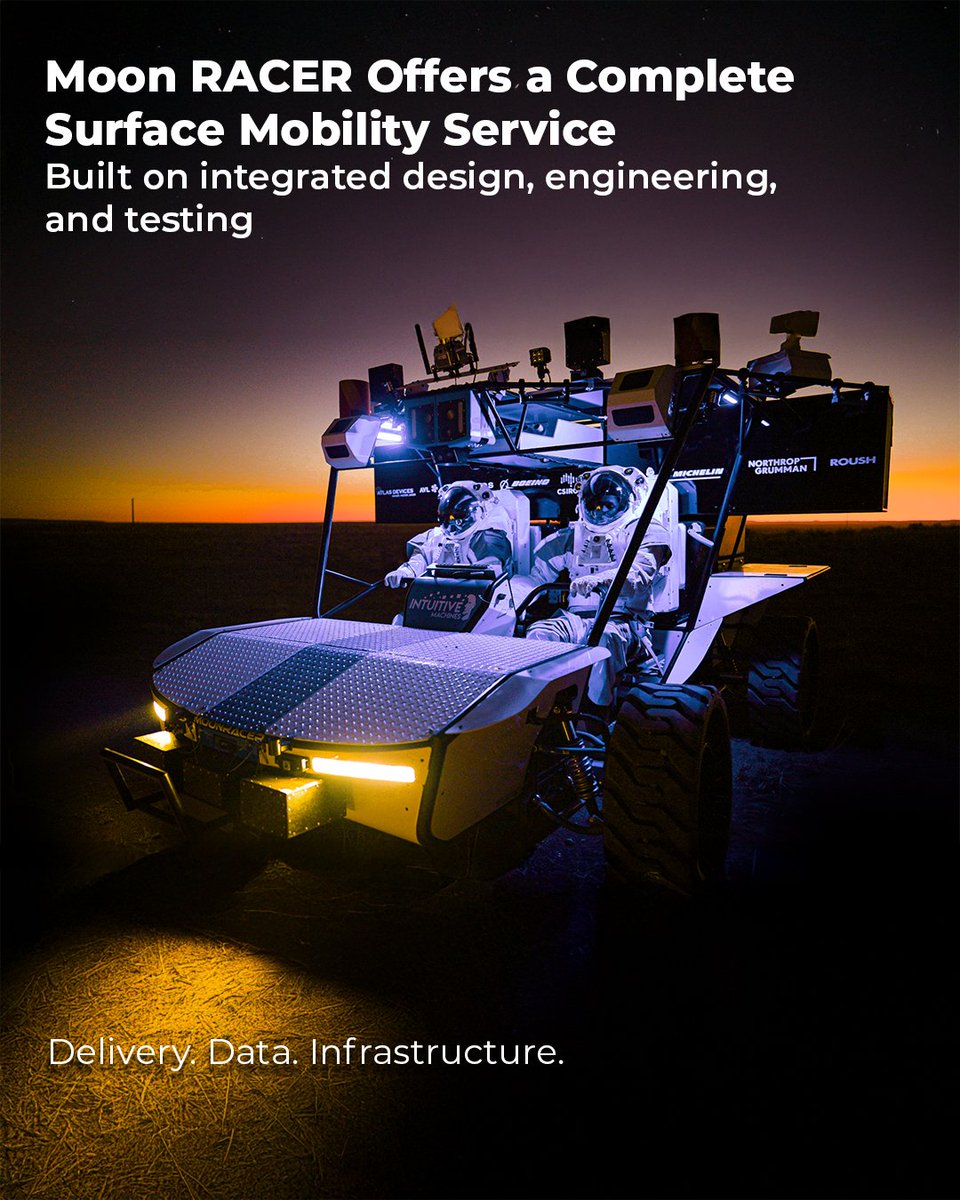
3. Lunar Terrain Vehicle Intuitive Machines also holds an LTV contract to support crewed Artemis astronaut mobility on the lunar surface. This positions the company as a systems integrator for the future crewed outpost.
Beyond NASA The KinetX acquisition brought DoD navigation customers including programs tied to the Space Development Agency's layered satellite architecture. The Lanteris acquisition brings existing commercial satellite manufacturing customers. And the Italian partnerships with Leonardo and Telespazio represent the beginning of an international customer pipeline under the Artemis Accords framework, where ESA, JAXA, KASA, and CSA are all partnered with NASA on lunar exploration.
Competitive Moat: What Makes Intuitive Machines Defensible
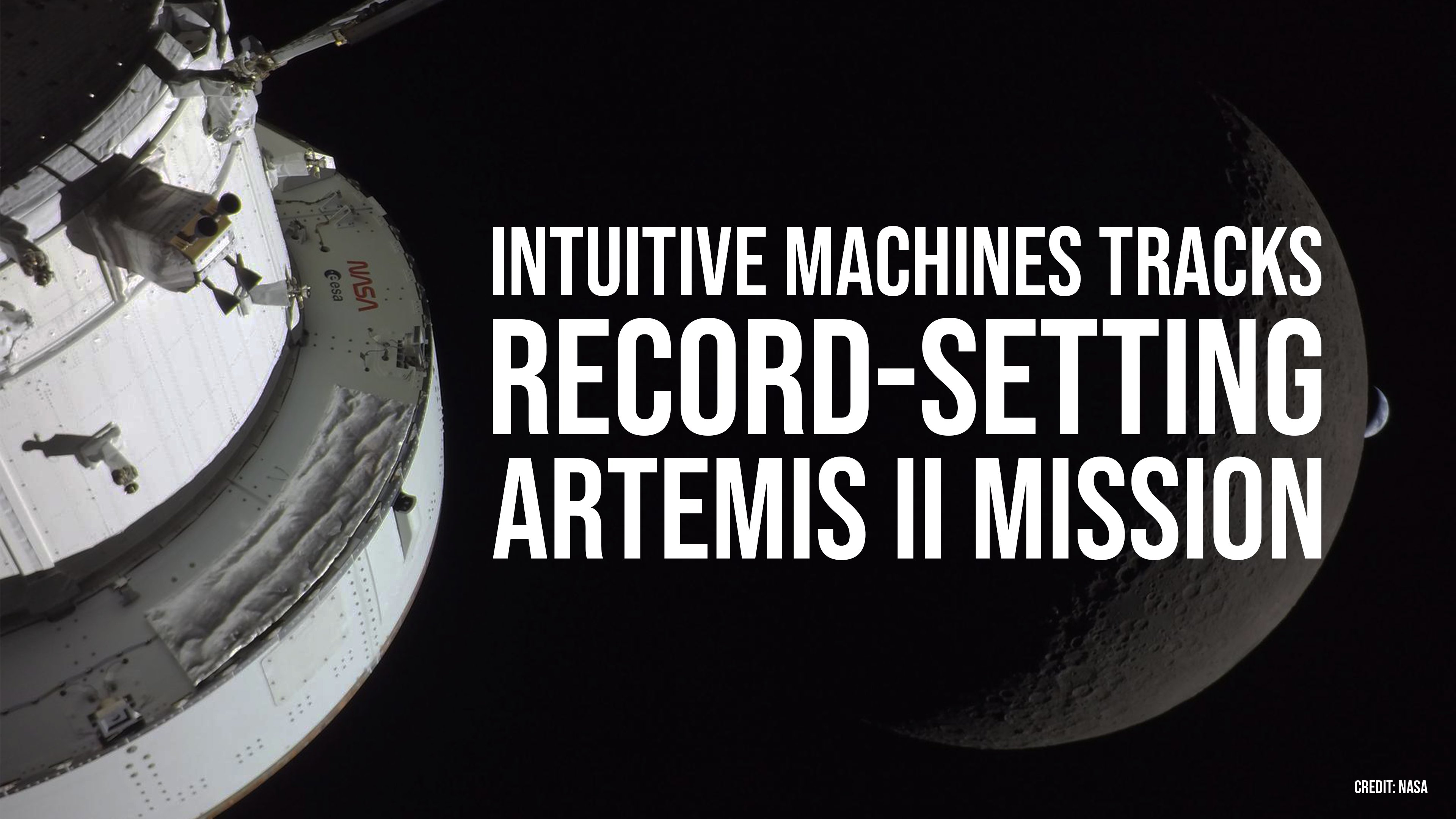
Intuitive Machines' competitive position rests on three structural advantages:
Flight Heritage No Competitor Has Only two companies have attempted to land on the Moon commercially: Intuitive Machines (two attempts, both reached the surface) and Astrobotic (Peregrine Mission One, 2024, failed due to a propellant leak and never reached the Moon). Firefly Aerospace achieved a successful lunar landing with Blue Ghost in March 2025 — giving them the beginning of flight heritage — but Intuitive Machines has two missions worth of operational data that cannot be manufactured or accelerated. ispace (Japan) crashed on Mission 1 in April 2023. This heritage matters enormously for winning future CLPS task orders.
The NSN Contract as a Structural Moat The $4.82 billion sole-source contract is not subject to competitive re-award in the near term. Building the cislunar relay constellation creates network effects: once the infrastructure exists, every lunar operator — commercial or government — needs to use it, creating a recurring revenue stream that looks far more like telecommunications infrastructure than aerospace manufacturing.
Vertical Integration No lunar company can match Intuitive Machines' stack: landing services + cislunar communications + deep space navigation + spacecraft manufacturing. The Lanteris acquisition means they can now build, launch, operate, and relay data for the entire lunar ecosystem — internally. Each acquisition reinforces the others: Lanteris builds the relay satellites, KinetX navigates them, Nova-C delivers the ground assets that use them.
The Bull and Bear Case: Honest Assessment
The Bull Case
- NSN contract is the crown jewel. $4.82 billion over 10 years, sole-source, with no near-term competitor for the cislunar relay infrastructure. If built and operated successfully, this alone justifies the current market cap.
- Lanteris transforms the company. Adding $601M in FY2025 revenue from flight-proven spacecraft manufacturing — with 50% government / 50% commercial split — substantially de-risks the financial profile.
- First-mover advantage in cislunar infrastructure. Every other space company competing for the Moon will eventually need Intuitive Machines' relay network. The more lunar activity there is, the more revenue Intuitive Machines earns from communications.
- Revenue inflection is real. From ~$76M in 2023 to $228M in 2024, guiding to up to $1B in 2026 — the trajectory is steep.
- IM-3 improvements are credible. Unlike companies that downplay failures, Altemus disclosed root causes in detail and made concrete engineering changes. This indicates a serious technical culture.
The Bear Case
- Two consecutive failed landings. IM-1 tipped over. IM-2 rolled into a crater. If IM-3 fails upright landing again, confidence in the Nova-C platform erodes — and CLPS task orders could migrate to Firefly (which landed Blue Ghost successfully in March 2025).
- Massive net losses persist. FY2024 net loss was $346.9 million. The company burns cash rapidly and has relied on equity issuances — share count has increased approximately 327% since the SPAC IPO, representing substantial ongoing dilution.
- Customer concentration. NASA represents the overwhelming majority of revenue. Any change in the Artemis program's budget, scope, or political priority ripples directly through Intuitive Machines' financials. The Trump administration's space policy priorities and recurring Congressional pressure on NASA's budget create material uncertainty.
- Lanteris integration risk. The $800M acquisition ($450M cash + $350M stock) is transformative but also complex. Integrating a former Maxar division while simultaneously building a cislunar relay constellation and preparing IM-3 is an enormous operational challenge for a ~525-person company.
- Dilution is ongoing. A $175 million share offering in February 2026 caused a 16% single-session stock decline. Further dilution to fund the Lanteris cash component and satellite constellation build is likely.
Stock Performance: From SPAC Mania to Infrastructure Re-Rating
Intuitive Machines went public on February 13–14, 2023 through a SPAC merger with Inflection Point Acquisition Corp. (IPAX) at a $10 reference price, implying an enterprise value of approximately $817 million.
The immediate trading history was extreme. On February 22, 2023, the stock hit an intraday high of approximately $136 — a meme-stock level spike driven by retail enthusiasm on SPAC opening day. By the close of February 23, 2023, the stock had collapsed ~75% in a single session to approximately $20 as the short-term speculative frenzy unwound. The company had no near-term revenue, no completed missions, and a product years from flight.
Through 2023, the stock drifted lower as share dilution continued and CLPS missions faced delays.
The IM-1 landing in February 2024 was the first genuine re-rating catalyst — the stock surged on confirmation of the first U.S. commercial lunar landing.
The NSN contract award in September 2024 ($4.82B, sole-source) was transformative for investor understanding of the company's long-term revenue model. This changed the fundamental narrative from "CLPS lander company" to "cislunar infrastructure company."
The IM-2 landing failure in March 2025 caused a decline of approximately 16% on the news of the second tip-over.
The Lanteris acquisition (January 2026) combined with the $175 million share offering (February 2026) created volatility — the offering caused a 16% single-session drop on dilution concerns, but the strategic rationale was broadly understood.
As of April 24, 2026, LUNR trades at approximately $28.58–$28.99, with a market capitalization of approximately $4–5 billion. The stock has delivered approximately 270–280% total return over the trailing twelve months, making it one of the strongest-performing space stocks in the period. However, this must be viewed in the context of the starting base following earlier drawdowns and the transformative impact of the Lanteris acquisition on the revenue profile.
Future Revenue Streams and the 2026–2030 Outlook
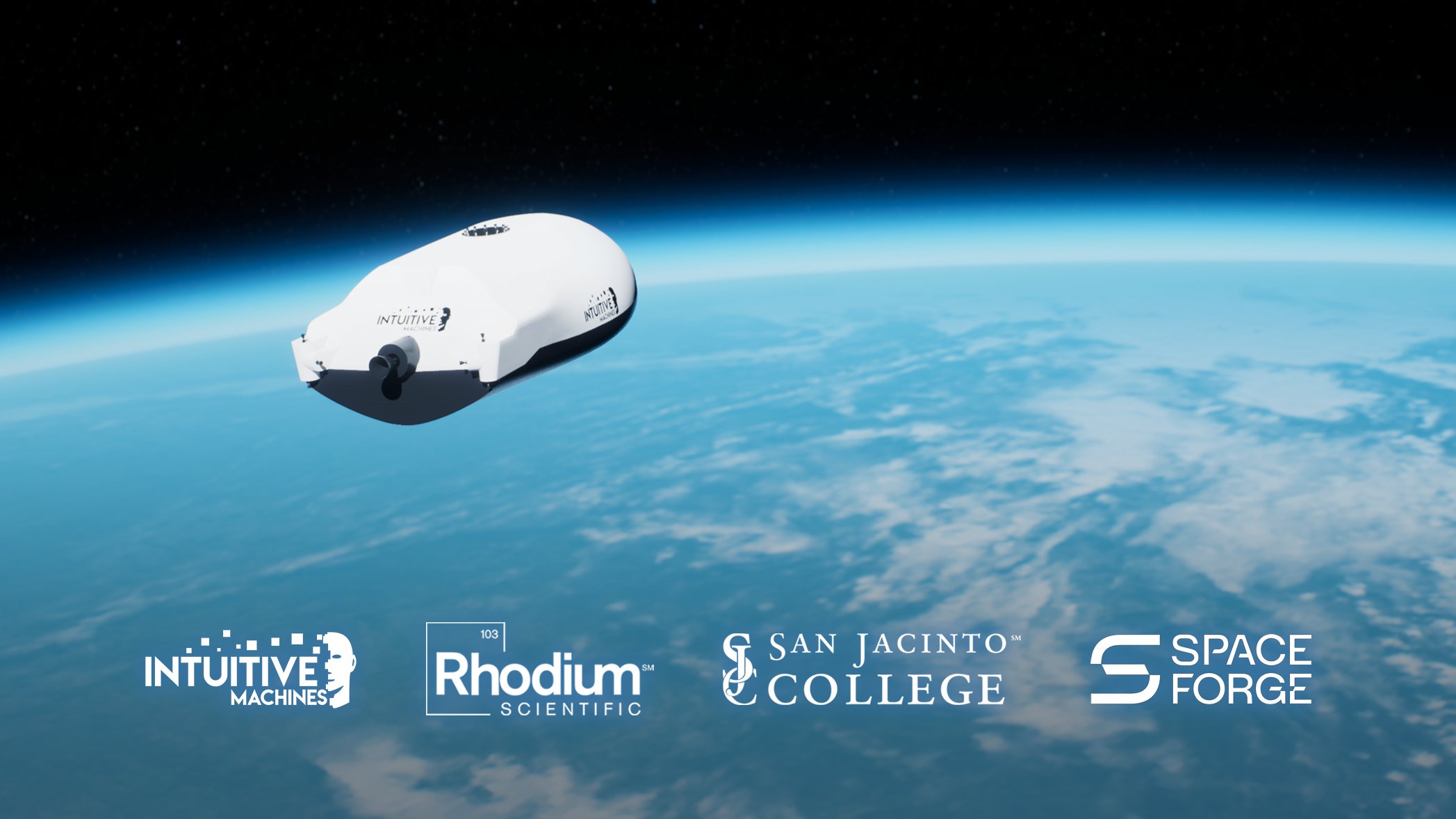
The company's revenue model becomes increasingly layered through the decade:
2026: Lanteris drives the first $1B revenue year The combined company guides to up to $1 billion in 2026 revenue, with Lanteris contributing the bulk. IM-3 (Trinity) is targeted for the second half of 2026, carrying the first cislunar relay satellite.
2027–2028: Relay constellation operationalizes All five relay satellites launching across IM-3 through IM-5 would create a persistent cislunar communications service. NASA's NSN payments begin flowing meaningfully as the constellation reaches operational capability. IM-4 and IM-5 missions add CLPS revenue.
2028+: Nova-D opens heavy cargo market IM-5's Nova-D mission, targeting Mons Malapert near the lunar south pole, demonstrates the heavy-cargo lander for the first time. Success opens a new price tier for large infrastructure delivery — fission surface power systems, habitat components — at substantially higher per-mission values than Nova-C.
Ongoing: DoD navigation and constellation management KinetX's existing DoD relationships provide a non-NASA revenue floor. As the Space Development Agency's satellite constellations grow, constellation management becomes a recurring, multi-year revenue stream.
International customers The Leonardo/Telespazio partnership is the beginning of European customer relationships under the Artemis Accords framework. As ESA, JAXA, and KASA invest in lunar programs, they will need relay services and navigation support — natural customers for Intuitive Machines' expanding portfolio.
The Verdict
Intuitive Machines is not a typical space startup. It has real flight heritage (two missions flown), a transformative government contract ($4.82B NSN), a newly acquired $600M-revenue spacecraft manufacturer, and a genuine thesis for being the foundational infrastructure layer of the cislunar economy. The management team are former NASA career professionals who know the agency's culture, procurement patterns, and long-term roadmap better than almost anyone.
The weaknesses are also real: two imperfect landings in a row, a business still losing hundreds of millions annually, significant dilution history, and nearly total dependence on NASA's continued commitment to the Artemis architecture. If Artemis faces meaningful cuts or restructuring under budget pressure, Intuitive Machines' near-term financial profile changes dramatically.
For investors, this is a high-risk, high-conviction thesis. The NSN contract alone — if executed — provides a 10-year revenue runway that dwarfs the market cap. The Lanteris acquisition dramatically de-risks near-term revenue. But the company needs IM-3 to achieve a clean upright landing to validate the Nova-C platform, and needs to demonstrate it can integrate two major acquisitions while executing technically demanding missions.
For space enthusiasts, Intuitive Machines is simply one of the most consequential companies of this era: the organization that put the United States back on the Moon, and the one most likely to build the communications backbone that all future lunar explorers — human and robotic — will depend on. Whatever the stock does, that story is already written.
Sources: NASA CLPS program records, NASA Near Space Network contract announcement (September 2024), Intuitive Machines investor relations (FY2024 earnings, Q4 2024 results), SEC EDGAR filings, SpaceNews, Ars Technica, Space.com, Spaceflight Now, Wikipedia (IM-1, IM-2 mission pages), Motley Fool LUNR analysis, company press releases via intuitivemachines.com. All financial figures are sourced from company disclosures or credible financial reporting. Stock price data reflects April 2026 market data.