The Space SPAC Crash: What Really Killed the 2021 Space Stock Boom
Somewhere between mid-2021 and the end of 2023, roughly $50 billion in paper wealth evaporated from a handful of space stocks that had briefly made retail investors believe they were early backers of the next great industrial revolution. Virgin Galactic peaked near $62 a share. Astra traded above $17. Momentus was valued at $1.2 billion before it had generated meaningful revenue. Planet Labs debuted at $11. Spire Global opened near $10.
By mid-2024, most of those numbers had collapsed by 85 to 97 percent. Astra went private at a $30 million valuation — down from a peak market cap above $2 billion. Virgin Galactic's stock fell to approximately $0.74 before the company executed a 1-for-20 reverse stock split in June 2024 to avoid NYSE delisting. A $10,000 investment in SPCE at its 2021 peak was worth roughly $217 by the time the curtain came down.
This is the post-mortem. Not just on the companies, but on the investment thesis, the deal structure, and the collective psychology that made it all possible. Understanding what went wrong is essential reading before the next wave of space listings — led by what may be the largest IPO in U.S. market history.
The 2020–2021 Space SPAC Gold Rush

The SPAC — Special Purpose Acquisition Company — is a shell company that raises money in a public offering with the stated purpose of merging with a private company within a defined window, typically 18 to 24 months. For investors, it offers a way to bet on promising private companies before a traditional IPO. For companies, it offers speed, a locked-in valuation, and the ability to make financial projections that SEC rules would prohibit in a standard IPO registration.
That last point would prove fateful for space companies.
The conditions for the boom were near-perfect. Interest rates were at historic lows following pandemic-era Federal Reserve policy, pushing investors toward riskier assets. Retail participation in markets surged through platforms like Robinhood. The meme stock phenomenon had demonstrated that retail traders could move prices dramatically. Meanwhile, SpaceX's Starlink was capturing headlines and proving that commercial space was no longer science fiction. And in the background, 2020 alone saw 247 SPAC IPOs raise $80 billion — the highest in history at the time — which was then dwarfed by 2021, when 613 SPACs collectively raised $145 billion.
Space companies, with their compelling narratives, long time horizons, and association with visionary founders, were an almost perfect fit for the SPAC structure. The merger window could be stretched. The projections could be aspirational. And the story could be told in investor presentations rather than proven in audited financials.
Between 2019 and 2022, six major space operators went public via SPAC: Virgin Galactic (2019, via Social Capital Hedosophia), Momentus (2021), Astra Space (2021), Rocket Lab (2021), Planet Labs (2021), and Spire Global (2021). Intuitive Machines followed a slightly different but still SPAC-adjacent path in early 2023.
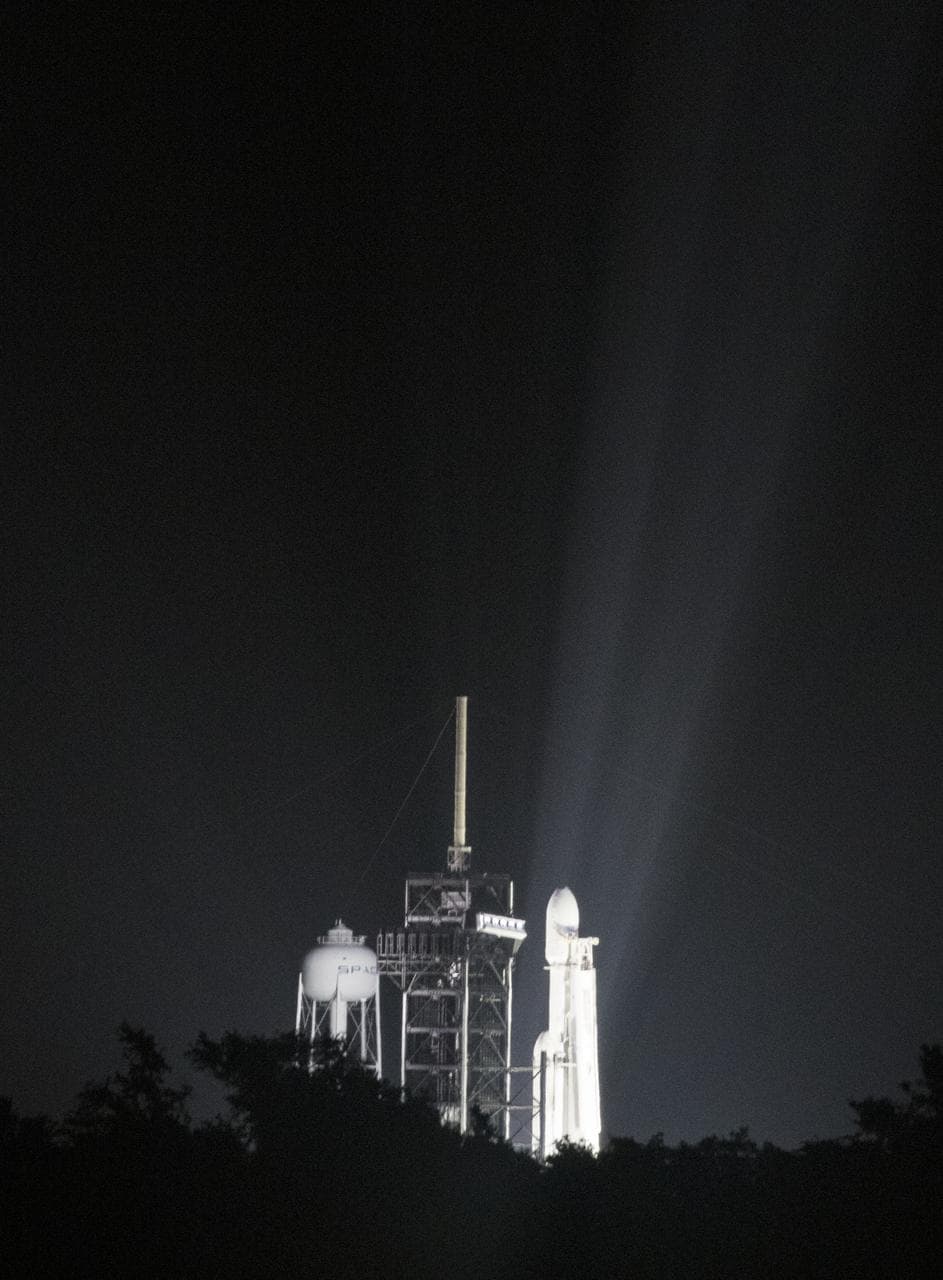
 Rocket Lab's Electron rocket — one of the few SPAC-listed space companies to survive and eventually thrive. Source: Rocket Lab / NASA
The Companies and What They Promised
Each SPAC prospectus was, in retrospect, a study in projection over reality.
Virgin Galactic (SPCE) was the OG space SPAC, having merged with Chamath Palihapitiya's Social Capital Hedosophia in 2019. It peaked at roughly $62.80 per share in February 2021, giving it a market cap north of $14 billion — this for a company that had completed exactly zero commercial spaceflights. The SPAC investor presentation promised thousands of flights, hundreds of millions in ticket revenue, and a path to profitability by 2023. Virgin Galactic did not actually begin commercial operations until June 2023, over four years after going public. By that point, the stock had already lost more than 90 percent of its peak value, crushed by endless delays, engineering setbacks, a grounding after a test flight anomaly, and the market's dawning realization that the company was burning cash at a prodigious rate with no near-term path to scale.
Astra Space (ASTR) went public in 2021 at a valuation approaching $2.1 billion, promising to be the first truly mass-produced small launch vehicle company — low cost, high cadence, a new rocket every few weeks from an automated factory. The reality was a launch vehicle that failed repeatedly. Astra suffered three consecutive launch failures in 2021 and early 2022, including one memorable incident on live video where the rocket slid sideways off the pad before staggering into the sky. The company pivoted away from orbital launch entirely in 2022, attempting to redirect toward spacecraft propulsion. By mid-2023, founders Chris Kemp and Adam London were considering Chapter 11 bankruptcy. They ultimately took the company private at $30 million — a 98 percent reduction from peak valuation.
Momentus (MNTS) presented one of the most extreme cases of projection versus reality. The company promised to be a "last mile" in-space transportation provider, using a proprietary water plasma propulsion system to ferry satellites from standard launch orbits to their final destinations. The SPAC merger with Stable Road Acquisition valued Momentus at $1.2 billion. Their investor presentation projected $1.2 billion in annual revenue by 2024. Actual trailing twelve-month revenue as of late 2025 was approximately $1 million. The company also faced SEC enforcement action related to misrepresentations made to investors during the SPAC process, resulting in a $7 million settlement. In March 2023, both Momentus and Spire Global received Nasdaq and NYSE delisting warnings after their shares fell below $1.
Planet Labs (PL) was perhaps the most legitimate of the SPAC cohort in terms of underlying technology. The company operates the world's largest fleet of Earth-imaging satellites — a genuine technical achievement — and generates real, recurring revenue from government and commercial imagery subscriptions. But the SPAC price embedded enormous growth expectations. Shares debuted near $11 in late 2021; by early 2023, they had fallen below $2. The company's actual revenue growth, while real, was nowhere near the hyperbolic projections baked into the deal price.
Spire Global (SPIR) operates a constellation of small satellites providing weather data, maritime tracking, and aviation monitoring. Like Planet Labs, it has genuine technology and paying customers. Also like Planet Labs, its SPAC valuation priced in years of accelerated growth that the company could not immediately deliver. From a post-merger peak near $10, shares slid below $1 by early 2023, triggering the delisting notice.
Rocket Lab (RKLB) also went public via SPAC — merging with Vector Acquisition in August 2021 at a $4.8 billion equity valuation, with $777 million in gross cash proceeds added to the balance sheet. We will return to Rocket Lab later, because its story diverged sharply from the rest.
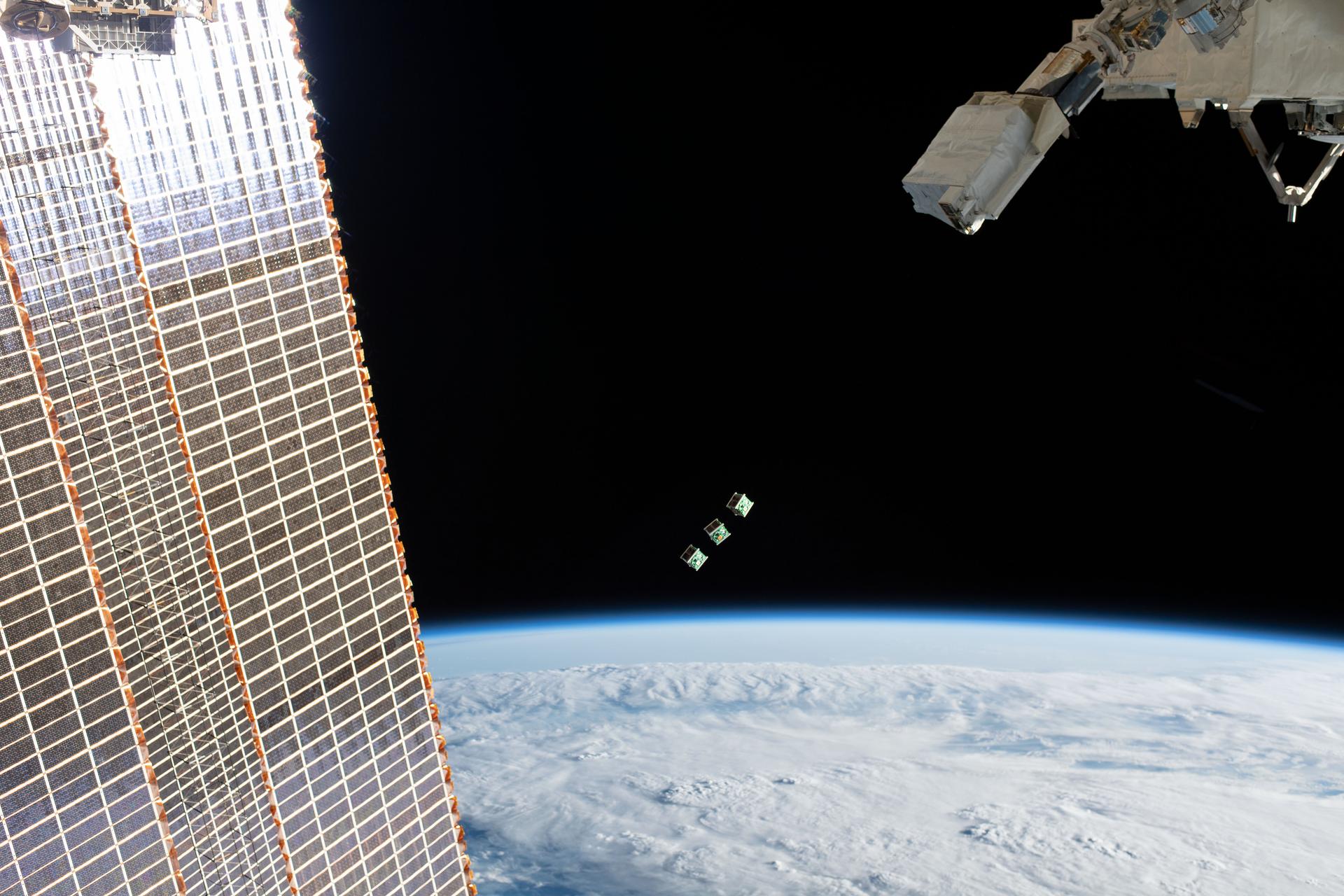 CubeSat deployment from the ISS. The small satellite market was real — but SPAC valuations assumed growth rates that took much longer to materialize. Source: NASA
The Collapse: A Timeline
The unraveling followed a predictable sequence, accelerated by the Federal Reserve's pivot to interest rate hikes beginning in March 2022.
Q1 2022: The Fed signals aggressive tightening. High-multiple growth stocks across every sector begin selling off. Space SPACs, which had been trading on narrative rather than fundamentals, are among the most exposed. Virgin Galactic falls 73 percent over the course of the year alone. Astra's repeated launch failures destroy investor confidence.
2022 (full year): Spire and Momentus reverse-split their shares to maintain listing compliance. Astra announces the suspension of its launch vehicle program entirely. Planet Labs reports fiscal year revenue of $131 million — real money, but well below SPAC-era projections.
Early 2023: Momentus and Spire receive formal delisting notices. Astra is effectively dormant as a launch company, pivoting to spacecraft propulsion while desperately seeking new financing. Virgin Galactic's stock, despite finally beginning commercial operations, cannot arrest its slide.
Mid-2024: Virgin Galactic suspends flight operations and retires its only spaceplane, executing a 1-for-20 reverse stock split in June 2024 to avoid NYSE delisting. Astra founders complete a go-private transaction, with the final per-share price of $0.50 implying a market cap of approximately $12 million. The SPAC era for space stocks is, for most practical purposes, over.
The casualties were not limited to shareholders. Several of these companies had genuinely innovative technology and talented teams. The SPAC structure itself accelerated their demise by putting them into public markets with sky-high expectations and insufficient capital to weather the inevitable difficulties of early-stage aerospace development.
The Red Flags Investors Ignored
In hindsight, the warning signs were present in every prospectus. In the moment, they were drowned out by enthusiasm.
Projections disconnected from reality. The SPAC structure's most dangerous feature is that it permits forward-looking financial projections that standard IPO S-1 filings would not allow. Astra projected $2.3 billion in revenue by 2025. Momentus projected $1.2 billion by 2024. These numbers were not grounded in demonstrated sales pipelines, signed contracts, or realistic ramp rates for the technologies involved. They were, in the most charitable interpretation, aspirational models built on assumptions that would require everything to go right. In aerospace, almost nothing goes right on schedule.
Warrants and sponsor dilution. SPAC structures come with a structural headwind that most retail investors did not fully understand. The SPAC sponsor typically receives a 20 percent "promote" — free shares — for arranging the deal. Additionally, warrants issued to early SPAC investors gave them the right to buy additional shares at $11.50, creating a persistent dilution overhang that weighed on stock prices even when business execution improved. A 2022 academic study found that the median non-redeeming SPAC investor saw their initial $10 per share diluted to $5.70 before the de-SPAC merger even closed — a 43 percent haircut from structural mechanics alone.
No revenue, no problem — until it was a problem. In a zero-interest-rate environment, investors were willing to value companies on potential rather than performance. When the Fed raised rates, the discount rate applied to those distant future cash flows increased sharply, mathematically crushing present valuations. Companies with negative operating cash flow and no near-term profitability path were the most exposed. Most space SPACs fit that description precisely.
Retail FOMO and meme-stock dynamics. Virgin Galactic in particular developed a retail investor following that resembled a meme stock community more than a traditional investment base. Forums on Reddit's WallStreetBets celebrated SPCE as a generational opportunity. This retail enthusiasm created price levels entirely divorced from business fundamentals, which only made the eventual reversion more violent.
Aerospace timelines are always longer than planned. This is perhaps the most fundamental issue, and the one most systematically ignored. Building rockets, propulsion systems, and satellite constellations at scale is extraordinarily hard. SpaceX spent years and billions of dollars working through failures before achieving operational consistency. The SPAC investor presentations assumed that newly formed companies would compress those development timelines dramatically. They did not.
 A commercial rocket launch. The market was genuine; the pace was not. Source: NASA
Why Rocket Lab Survived When Others Didn't
Rocket Lab's journey through the same SPAC boom-and-bust cycle is instructive precisely because the outcome was so different.
The company entered the public markets in August 2021 through a SPAC merger with Vector Acquisition, at a $4.8 billion valuation. The stock subsequently fell from its debut price, reaching an all-time low of $3.47 in April 2024. At that point, an outside observer might have placed Rocket Lab in the same category as its peers. They would have been wrong.
The difference came down to execution. Rocket Lab's Electron rocket had already flown successfully before the SPAC merger was even announced. By January 2026, Electron had completed over 75 orbital missions, making it the most prolific small-lift launch vehicle in operation globally — a distinction it holds over any competitor, including U.S. government systems. Real launches. Real revenue. Real customers.
The company also had a diversified business model that its SPAC peers lacked. In addition to launch services, Rocket Lab operates a spacecraft components division — reaction wheels, solar panels, flight software — that generates consistent revenue from satellite manufacturers regardless of launch market fluctuations. When launch cadence slowed, components revenue provided a buffer.
Then there was the Neutron program. Rocket Lab CEO Peter Beck announced a medium-lift reusable rocket to compete with Falcon 9 on certain payload classes, expanding the company's addressable market well beyond small satellites. While Neutron remains in development, it signals a credible long-term growth pathway that SPAC investor presentations typically fabricated rather than demonstrated.
The financial results bear out the story. In 2025, Rocket Lab reported revenue of $601.8 million — a 38 percent year-over-year increase. Government contracts totaling $515 million anchor the backlog. The stock reached an all-time closing high of $96.30 in January 2026, representing a recovery of over 2,600 percent from its 2024 low. At time of writing (April 2026), RKLB has gained over 111 percent year-to-date, driven in part by the anticipated SpaceX IPO and its implications for the broader sector.
The lesson is not that SPACs are inherently toxic for space companies. The lesson is that SPAC valuations only work when the underlying business has demonstrated technology, real revenue, and a defensible competitive position. Rocket Lab had all three. Most of its SPAC-era peers had none.
What the Next Space IPO Wave Looks Like
The carnage of 2021–2024 did not kill investor appetite for space stocks. If anything, it clarified what the market will and will not reward. And the next wave is coming — led by a name that makes all previous space listings look like warm-up acts.
SpaceX has filed a confidential draft registration statement with the SEC as of April 1, 2026, with a public S-1 expected in late April or May. A roadshow is confirmed for the week of June 8. Analyst estimates place SpaceX's valuation between $1.75 trillion and $2 trillion, which would make it the largest IPO in U.S. history. The company is estimated to generate $15 billion in annual revenue from Starlink, with growth rates of 50 percent or more. This is not a company projecting revenue it has not yet earned. This is a company with real subscribers, real cash flow, and a demonstrated launch cadence that no competitor can match. The SpaceX IPO will be a fundamentally different animal from the 2021 space SPAC wave.
Intuitive Machines (LUNR) offers another instructive comparison. The company went public through a SPAC merger in February 2023 and has experienced extreme volatility — reaching $136 on the excitement of its IM-1 lunar landing and then falling to $2.09 before recovering. But unlike the 2021 wave, Intuitive Machines has genuine NASA contracts: a $4.82 billion award for near-space communication services, and a $180 million CLPS contract for lunar south pole payloads. The company guides to nearly 5x revenue growth in 2026 with a $943 million backlog. Volatility aside, this is a company with funded missions and government backing — a qualitatively different investment than an aspirational PowerPoint deck.
Axiom Space and other commercial space station companies remain private but are potential listing candidates. The lesson from 2021 is that investors should look for companies that have moved beyond concept: signed customer contracts, functional hardware that has flown, and revenue that does not depend entirely on a single government program.
ispace, the Japanese lunar lander company, is publicly traded on the Tokyo Stock Exchange (ticker: 9348) following a 2022 IPO. After its first lunar mission failed in April 2023 due to a landing miscalculation, shares cratered. The second mission achieved lunar orbit in 2024. ispace illustrates both the difficulty and the resilience required in this sector — failure is part of the development cycle, but the market punishes it severely when valuations already price in success.
For retail investors watching the SpaceX IPO frenzy develop, the 2021 SPAC crash offers a useful corrective. The space economy is real. The long-term market opportunity — launch, satellite services, orbital manufacturing, lunar resource extraction, deep space exploration infrastructure — is genuinely massive. But the timeline to monetization in aerospace is measured in decades, not quarters. Companies that cannot survive the interval between promise and profitability will not be around to collect the returns.
 The commercial space industry attracted exceptional talent and genuine innovation. The SPAC structure, however, was a poor match for aerospace development timelines. Source: NASA / Public Domain
How to Think Differently About Space Stocks
The SPAC crash taught several durable lessons that apply to any future space investment, regardless of listing structure.
Demonstrated technology beats projected technology, every time. If a company's entire investment thesis rests on a propulsion system, a manufacturing process, or a launch vehicle that has not yet been tested successfully in flight, the valuation should reflect that risk — and SPAC valuations rarely did. Ask how many times the core hardware has actually worked.
Check the revenue composition. Government contracts from NASA, the Department of Defense, or allied space agencies are qualitatively different from projected commercial revenue. They are funded, they are often multi-year, and they validate the technology through the most demanding customer in the world. Commercial projections are useful; government contracts in backlog are real.
Understand the capital structure. SPAC warrants, sponsor promotes, and convertible debt all create dilution that erodes per-share returns even when the underlying business improves. Before investing in any newly public space company, read the capitalization table carefully. The dilution math matters.
Give aerospace timelines their due respect. SpaceX took over a decade of failures and near-bankruptcies before establishing operational reliability. Blue Origin has been operating since 2000 and is still developing its New Glenn heavy-lift vehicle. The idea that a startup could achieve consistent orbital launch operations within three years of going public was always optimistic to the point of fantasy. Patience is not optional in this sector.
Size the position to the risk. Even the most legitimate space companies carry substantial execution risk. Rocket Lab is the success story of the SPAC era, but it still reached $3.47 before recovering. Position sizing that reflects the genuine probability of multi-year drawdowns is the only rational approach.
The next space investment boom will come. It will probably begin with the SpaceX IPO in mid-2026, and the enthusiasm it generates will flow into smaller companies building adjacent capabilities. Some of those companies will be extraordinary long-term investments. Others will be 2021 redux.
The difference between the two groups will be what it has always been: real hardware that actually flies, real customers who actually pay, and real revenue that closes the gap between the dream and the financial statement.
 Earth's city lights from orbit — taken by NASA astronauts aboard the ISS. The commercial space economy is vast and real, but its buildout is measured in decades. Source: NASA
SpaceOdysseyHub covers the space economy from technical operations to financial markets. For deeper analysis of individual space companies, see our deep dives on Axiom Space and Arianespace.