Image: NASA / JPL-Caltech / MSSS
Curiosity (Mars Science Laboratory)
Mission Profile
| Launch date | 2011-11-26 |
|---|---|
| Launch vehicle | Atlas V 541 |
| Spacecraft | Curiosity rover (MSL) |
| Target | Mars |
| Type | Robotic |
| Cost | $2.5B life-cycle |
| Mass | 899 kg |
| Duration | Primary 1 Mars year; now in 14th Earth year of ops |
| Partners | NASA JPL (lead), Goddard (SAM), Los Alamos (ChemCam), Roscosmos (DAN) |
| Instruments | Mastcam, MAHLI, ChemCam, APXS, SAM, CheMin, DAN, RAD, REMS, MARDI |
Prime Contractors
Companies that built, launched, or operate this mission. Tickers link to their investor profile.
- NASA JPL
- Lockheed Martin
- United Launch Alliance
- Malin Space Science Systems
- L3Harris (Aerojet Rocketdyne)
Overview
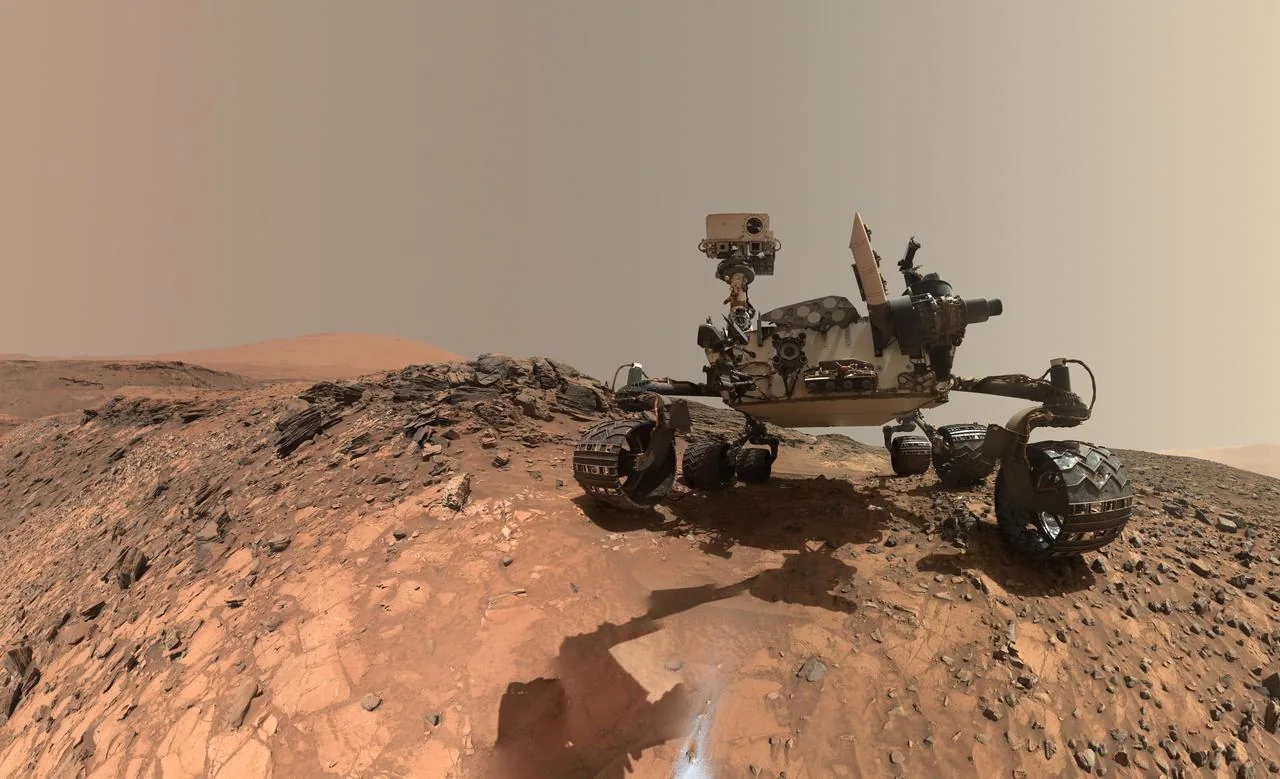
Curiosity, the rover at the heart of NASA's Mars Science Laboratory mission, has been operating in Gale Crater since the dramatic 'seven minutes of terror' sky-crane landing on 6 August 2012. The mission's central goal is to determine whether Mars ever offered conditions favorable for microbial life — a question Curiosity answered affirmatively within its first year, when analysis at Yellowknife Bay revealed a habitable ancient lake environment with neutral-pH water, key biogenic elements, and an energy gradient. In the years since, Curiosity has driven more than 32 km up the lower slopes of Mount Sharp, climbing through a stratigraphic record that spans billions of years of Martian climate evolution. The rover's instrument suite includes the SAM analytical lab (which has detected organic molecules and seasonal methane variability), the ChemCam laser spectrometer, the MAHLI hand-lens imager, and DAN — a Russian-supplied neutron detector for hydrogen mapping. Powered by a Multi-Mission Radioisotope Thermoelectric Generator, Curiosity has now operated for more than 13 Earth years, far exceeding its 23-month primary mission. As of April 2026, Curiosity is exploring the sulfate-bearing layers high on Mount Sharp that mark the transition to a drier Martian climate.
Key Milestones
2011-11-26
Launch from Cape Canaveral SLC-41
2012-08-06
Successful Gale Crater landing via sky-crane
2013-03-12
NASA confirms ancient habitable environment at Yellowknife Bay
2018-06-07
SAM detects ancient organic molecules in mudstone
2024-07-18
Curiosity drills sample 'Mammoth Lakes 2' in sulfate unit