Europa
A moon-wide ocean of liquid water beneath a cracked icy shell — possibly habitable.
Vital statistics
01
Overview
Europa is the smallest of Jupiter's four Galilean moons and arguably the most exciting place in the solar system to search for life beyond Earth. Beneath its smooth, cracked ice shell lies a global ocean of liquid water — twice the volume of all of Earth's oceans combined. Tidal flexing from Jupiter keeps the water liquid, while chemical reactions at the rocky seafloor could supply the energy life would need.
04
Surface
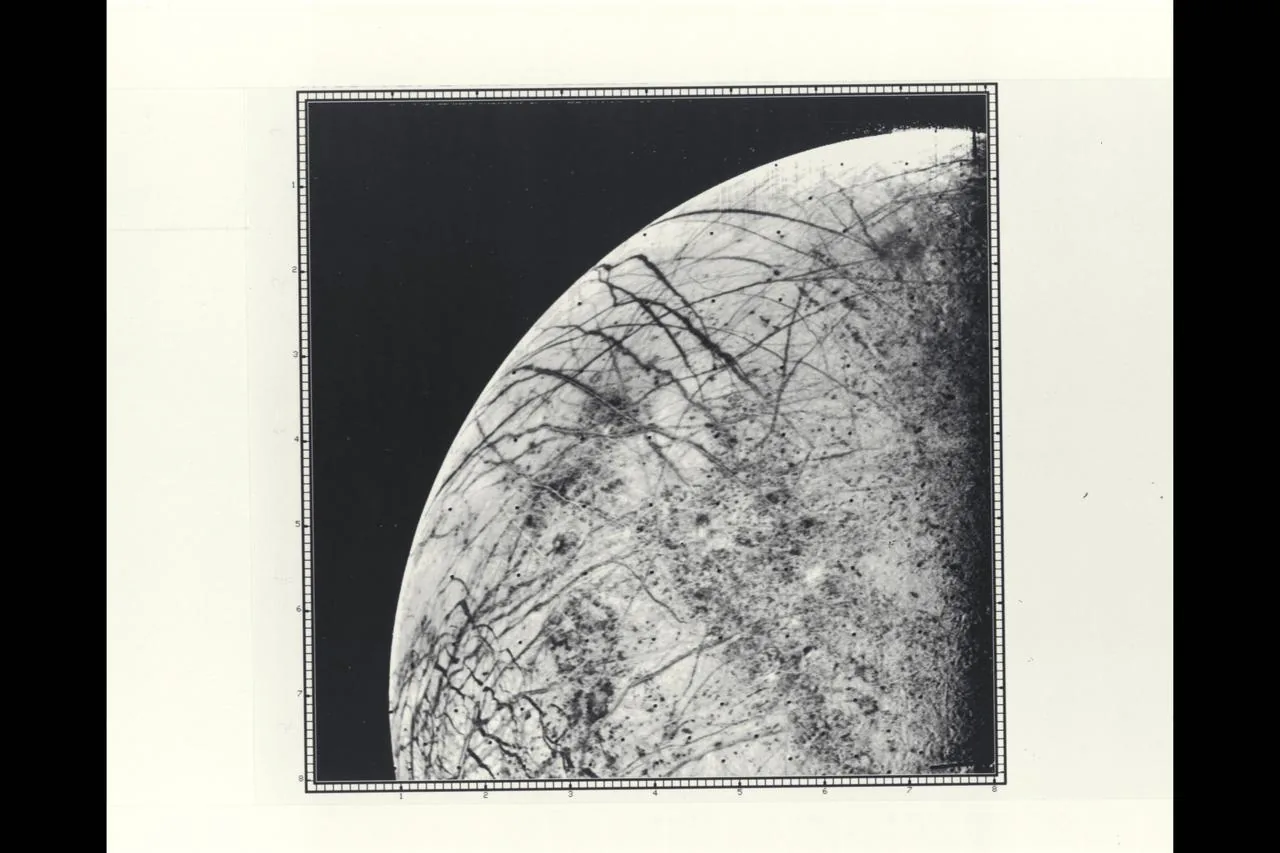
The smoothest surface in the solar system — almost no impact craters, indicating active resurfacing on geological timescales. The icy crust is criss-crossed by long red-brown lineae that may be salt or organic deposits welled up from below. Plumes of water vapour up to 200 km tall have been detected erupting from the south polar region.
05
Exploration
NASA's Europa Clipper launched in October 2024 and arrives at Jupiter in 2030, planning 49 close flybys to assess habitability. ESA's JUICE (Jupiter Icy Moons Explorer), launched 2023, will also study Europa, Ganymede, and Callisto. Galileo (1995-2003) provided the magnetic-field measurements that confirmed the subsurface ocean.
Did you know?
Europa's ocean has more liquid water than every body of water on Earth combined.
Plumes of water vapour 200 km tall have been spotted erupting from the south polar region.
Galileo confirmed the subsurface ocean by measuring the moon's induced magnetic field.
The ice shell may rotate independently of the rocky interior beneath.
Europa's surface is the youngest in the outer solar system — under 100 million years old.
If Europa hosts hydrothermal vents like Earth's ocean floor, it's the strongest astrobiology candidate in the solar system.
Timeline
- 16101610
Galileo Galilei discovers Europa among Jupiter's four largest moons.
- 19791979
Voyager 1/2 flybys reveal the smooth icy surface.
- 19951995
Galileo orbiter begins close passes; magnetic data hints at subsurface ocean.
- 20132013
Hubble detects water vapour plumes near the south pole.
- 20242024
NASA's Europa Clipper launches.
- 2030 (planned)2030 (planned)
Europa Clipper begins flybys.