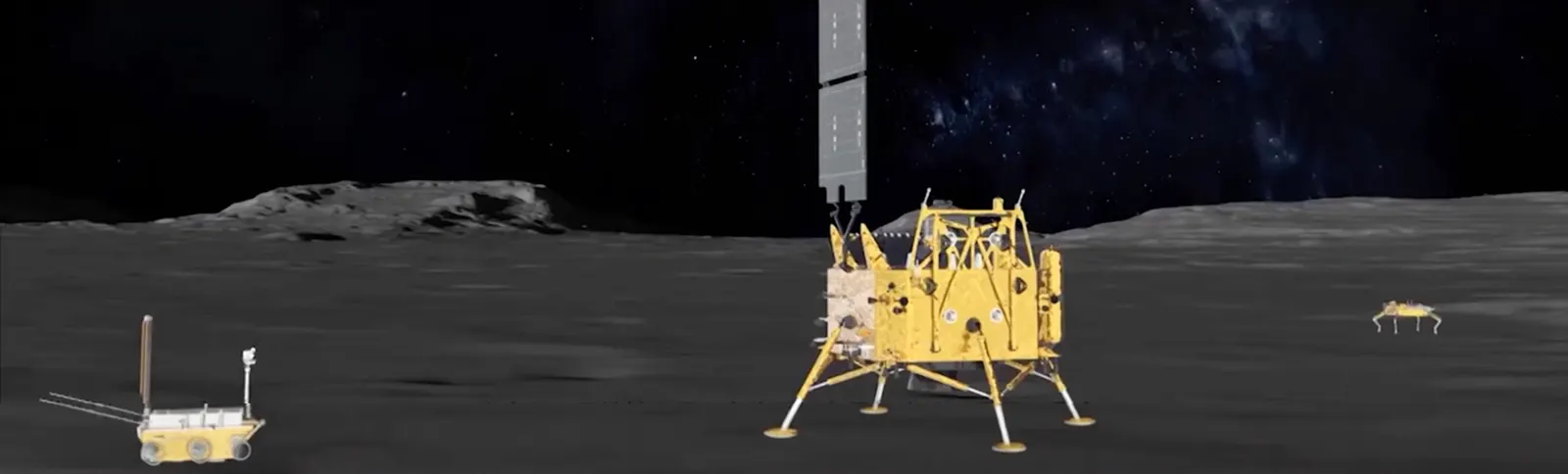
Chang'e 7
Chang'e 7 is CNSA's flagship 2026 lunar south-pole reconnaissance mission, a four-vehicle stack — relay orbiter, main orbiter, lander, rover and the world-first 'mini flying detector' hop probe — designed to survey permanently-shadowed crater interiors for water ice and define the landing-site envelope for the crewed China Manned Lunar Program targeting 2030 [1][2][3]. It is the critical scientific precursor to Chang'e 8 (2028 resource-utilisation demo) and the International Lunar Research Station (ILRS) operational by ~2035, and it carries the first international payloads from Egypt, Pakistan, Bahrain, Italy, Switzerland, Russia and Thailand under the CNSA-led ILRS partnership [4][5].
Funding & Contract Structure
Total committed: CNSA does not publish itemised programme budgets; sector analyst Andrew Jones at SpaceNews estimates Chang'e 7 development cost at ~¥6-8B (~$840M-$1.1B) including the relay orbiter and flying-detector technology demonstrations [2][8]
Annual run-rate: Chinese national civil-space spending estimated by Euroconsult at approximately $14B in 2024; Chang'e + ILRS precursor missions are funded under the 14th and 15th Five-Year Plan science envelopes [8]
Per launch: Single Long March 5 (Y8 or Y9) launch from Wenchang Space Launch Site; Long March 5 unit cost reported by SpaceNews at ~$180M reference range although CNSA does not break out launch from spacecraft cost [2][7]
Procurement vehicle: COST-PLUS — Government pays incurred costs plus a fee — contractor bears low risk; cost overruns common.
Congressional status: Chang'e 7 is a State Council-approved flagship of the 14th Five-Year Plan (2021-2025) and continues into the 15th Five-Year Plan, with explicit Politburo Standing Committee endorsement as part of the strategic lunar programme [8]
GAO / CRS findings
| Date | Finding |
|---|---|
| CNSA Deputy Administrator Bian Zhigang at IAC 2024 confirmed Chang'e 7 launch readiness for 2026 and disclosed international payload selections from Egypt, Pakistan, Bahrain, Italy, Switzerland, Russia and Thailand under the ILRS framework[5] | |
| Queqiao-2 relay satellite launched March 20, 2024 establishes the lunar communications backbone for Chang'e 7 (south-pole and far-side coverage), de-risking the Chang'e 7 telecommunications architecture[7] |
Beneficiary Breakdown
| Contractor | Role | Share | Ticker |
|---|---|---|---|
| China Aerospace Science and Technology Corporation (CASC) | prime | State-owned parent of all flight-hardware subsidiaries; CAST builds the lander and rover, CALT delivers the Long March 5 launch vehicle, SAST contributes power-system and thermal hardware[6] | private |
| China Academy of Space Technology (CAST, 5th Academy) | prime | Spacecraft system prime for the lander, rover, main orbiter, relay orbiter, and the world-first lunar flying detector; integration and test responsibility for the full five-vehicle stack[1] | private |
| China Academy of Launch Vehicle Technology (CALT, 1st Academy) | prime | Long March 5 launch vehicle prime for the Chang'e 7 trans-lunar injection; CALT also leads the Long March 10 development that supports the 2030 crewed landing[7] | private |
| National Astronomical Observatories of China (NAOC) | sub | Science leadership for Chang'e 7 instrument suite and lunar-data archive; coordination with international ILRS partners on payload integration[2] | private |
| Egypt Space Agency (EgSA) | supplier | International payload contribution — hyperspectral imager developed in partnership with the National Authority for Remote Sensing and Space Sciences (NARSS) of Egypt, first Egyptian instrument on a lunar mission[4] | private |
| Institute of Space Technology, Pakistan (IST) | supplier | ICUBE-Q CubeSat secondary payload — Pakistan's first lunar mission, deployed on the Chang'e 7 relay orbiter for lunar-orbit science[5] | private |
Key Milestones
Chang'e 7 mission concept formally established under the 13th Five-Year Plan as the lunar south-pole science precursor
Chang'e 7 included in 14th Five-Year Plan with 21-instrument payload manifest and ILRS-alignment commitment
Queqiao-2 relay satellite launched March 20 2024 to establish lunar far-side and polar communications backbone supporting Chang'e 6, 7, 8
Chang'e 6 lunar far-side sample return completes successfully (June 25 2024) — Chang'e 7 inherits CAST descent-stage heritage
CNSA confirms international ILRS payload allocations for Chang'e 7 — Egypt, Pakistan, Bahrain, Italy, Switzerland, Russia, Thailand
Chang'e 7 mission stack arrives at Wenchang Space Launch Site for pre-launch integration; ~August 2026 launch window, Shackleton rim landing zone
Planned Chang'e 7 launch on Long March 5 from Wenchang Space Launch Site (~Aug 2026)
Planned south-polar soft landing and rover / mini flying detector deployment
Chang'e 8 launch — ISRU and 3D-printing technology demo co-located with Chang'e 7 site; ILRS basic configuration construction begins
China Manned Lunar Program (CMLP) targets first crewed landing using Long March 10 and Lanyue lander
Catalysts
| Date | Event | Sentiment |
|---|---|---|
| Chang'e 7 mission stack arrives at Wenchang spaceport for integration and testing — launch on track for ~August 2026, targeting the Shackleton crater rim region at the lunar south pole[17] | bullish | |
| Chang'e 7 launch on Long March 5 from Wenchang Space Launch Site (~Aug 2026) — full five-vehicle stack (relay orbiter + main orbiter + lander + rover + flying detector)[17] | bullish | |
| Chang'e 7 lander touchdown near the lunar south pole — fourth Chinese soft lunar landing after Chang'e 3, 4, 5, 6[2] | bullish | |
| First flying-detector descent into a permanently shadowed crater — world-first in-situ confirmation of polar water-ice signatures by an active mobile lunar surface vehicle[3] | bullish | |
| Chang'e 8 launch — ISRU and 3D-printing technology demonstration co-located with Chang'e 7 site; basic ILRS configuration construction begins[10] | bullish | |
| China Manned Lunar Program targets first crewed landing using Long March 10 and Lanyue lunar lander; Chang'e 7 reconnaissance defines the landing-site envelope[9] | bullish |
Risk Register
Competitive Landscape
Investability Map
| Ticker | Exposure | Note |
|---|---|---|
| 600118.SS | low | China Spacesat (Shanghai-listed CAST subsidiary) is a publicly-traded proxy for CAST small-satellite engineering; Chang'e 7 prime contracts flow through state-owned CASC rather than the listed subsidiary so equity exposure is indirect. |
| 600879.SS | low | Aerospace Long-March Launch Vehicle Technology (CALT-listed subsidiary) provides launch-vehicle revenue exposure including the Long March 5 family that launches Chang'e 7. |
| 002179.SZ | low | AVIC Jonhon Optronic Technology — Shenzhen-listed connector and optoelectronic supplier to Chinese aerospace primes; small-cap proxy for the broader Chang'e supplier base. |
Not investment advice. Figures as-quoted from cited sources.
Sources
- [1] CNSA — Chang'e 7 mission overview (English release; five-vehicle architecture including flying detector) (Agency budget doc, accessed )
- [2] SpaceNews — China prepares Chang'e 7 for 2026 lunar south-pole launch (Andrew Jones) (Industry trade press, accessed )
- [3] Planetary Society — Chang'e 7 mission profile and the flying-detector (mini hop probe) concept (Industry trade press, accessed )
- [4] CNSA — ILRS cooperation: Egypt Space Agency hyperspectral imager joins Chang'e 7 payload manifest (Agency budget doc, accessed )
- [5] SpaceNews — Andrew Jones on Chang'e 7 international payload selection and ILRS partnerships (Pakistan, Bahrain, Italy, Switzerland, Russia, Thailand) (Industry trade press, accessed )
- [6] Chinese Lunar Exploration Program (CLEP) — programme home and Chang'e series overview (Agency budget doc, accessed )
- [7] SpaceNews — Queqiao-2 relay satellite launches to support Chang'e 6, 7, 8 (March 2024) (Industry trade press, accessed )
- [8] China State Council — 14th Five-Year Plan for the National Economy and Society (space and lunar exploration envelope) (Agency budget doc, accessed )
- [9] CMSA / SpaceNews — China Manned Lunar Program targets 2030 crewed landing using Long March 10 and Lanyue lander (Industry trade press, accessed )
- [10] Planetary Society — Chang'e 8 ISRU and 3D-printing demonstration and ILRS basic configuration (~2035) (Industry trade press, accessed )
- [11] Egyptian Space Agency — official Chang'e 7 partnership announcement (hyperspectral imager) (Agency budget doc, accessed )
- [12] Institute of Space Technology Pakistan — ICUBE-Q lunar CubeSat partnership with CNSA (Agency budget doc, accessed )
- [13] Nature — Editorial on Chang'e programme cadence and ILRS roadmap (2024) (Agency budget doc, accessed )
- [14] Xinhua — official CNSA confirmation of Chang'e 7 instrument manifest (21 instruments) (Agency press / Congressional record, accessed )
- [15] GAO Watch / Brookings — comparative analysis: U.S. Artemis vs. China ILRS / Chang'e 7 lunar exploration cadence (Industry trade press, accessed )
- [16] Andrew Jones / SpaceNews — Chang'e 7 mini flying detector technical brief (Industry trade press, accessed )
- [17] SpaceNews — China's Chang'e-7 arrives at spaceport for lunar south pole exploration mission (Apr 2026; ~Aug 2026 launch, Shackleton rim) (Industry trade press, accessed )