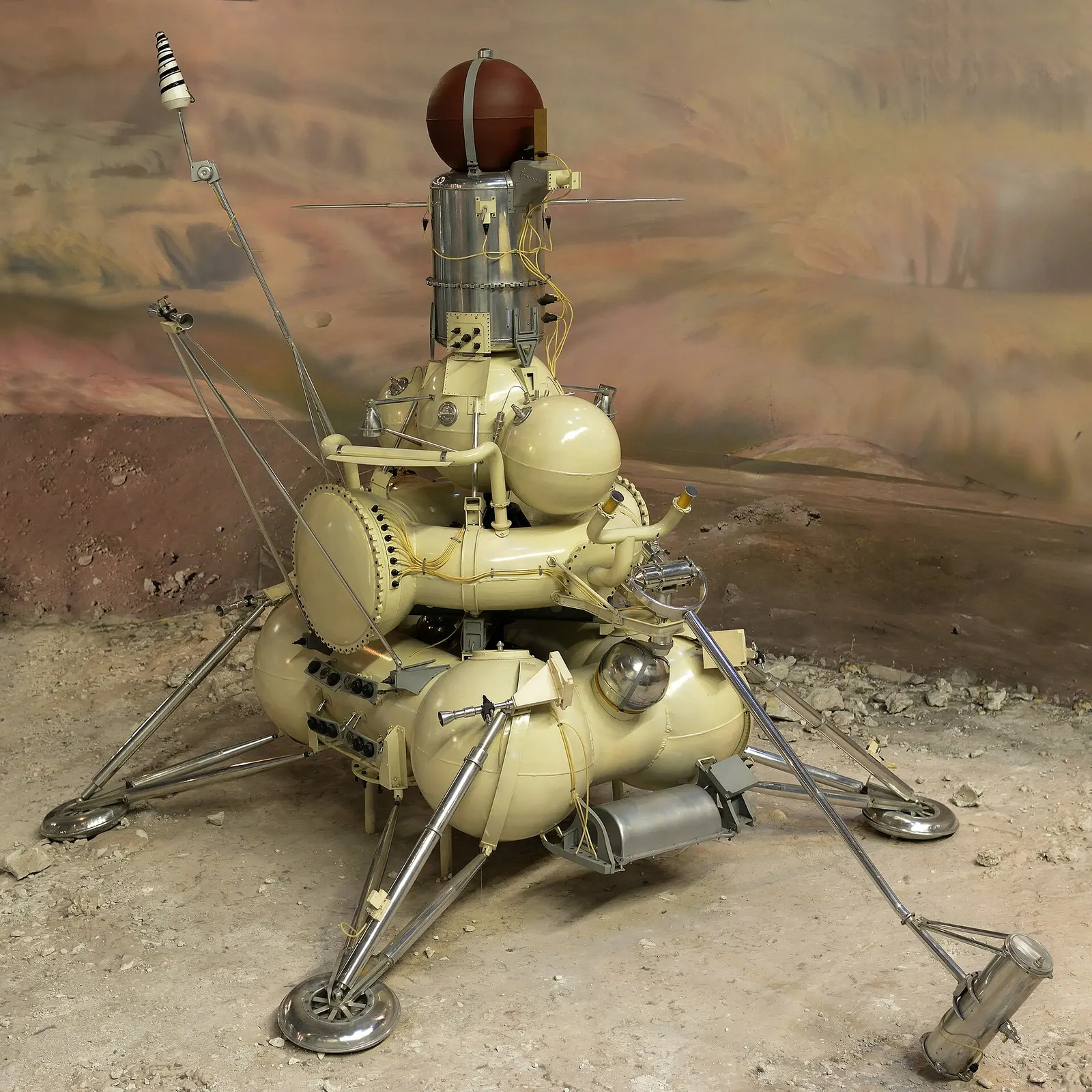
Luna Programme (Russia)
The modern Luna programme is Roscosmos's attempt to revive Soviet-era lunar exploration after a 47-year operational gap. Luna-25 — the first Russian lunar mission since Luna-24 in 1976 — launched on Soyuz-2.1b on August 10, 2023 but crashed into the lunar surface on August 19, 2023 after an impulse from its propulsion system became uncontrolled during pre-landing orbital correction [1][2]. Roscosmos's recovery roadmap targets Luna-26 (polar orbiter) no earlier than 2027, Luna-27 (south-polar lander) no earlier than 2028 and Luna-28 (sample return) no earlier than 2030, all amid materially constrained post-2022 budgets and a deepened cooperation framework with China's International Lunar Research Station (ILRS) [3][4].
Funding & Contract Structure
Total committed: Total Luna-25 mission cost reported at approximately ₽12.6B (~$133M, FY2023 exchange) from cumulative federal space programme allocations dating back to the 2010 lunar exploration concept [8]. Forward Luna-26 / -27 / -28 budgets are subject to the constrained Roscosmos Federal Space Programme 2025-2035 currently in revision [6]
Annual run-rate: Roscosmos Director Yury Borisov publicly acknowledged in 2024 that the Roscosmos consolidated annual budget approximates ₽300B (~$3.5B) — materially below 2010s peaks and constrained by post-2022 economic conditions [7]
Per launch: Soyuz-2.1b / Fregat per-launch reference cost ~$48-65M; Luna-class mission all-in cost (spacecraft + launcher + ground segment) approximately $130-150M per mission based on Luna-25 disclosed figures [8]
Procurement vehicle: COST-PLUS — Government pays incurred costs plus a fee — contractor bears low risk; cost overruns common.
Congressional status: Federal Space Programme 2016-2025 expired end-2025; the Federal Space Programme 2025-2035 has been under revision since 2024 with Duma approval timeline subject to recurring slippage [6]
GAO / CRS findings
| Date | Finding |
|---|---|
| Roscosmos interdepartmental commission attributed the Luna-25 failure to an uncontrolled impulse from the propulsion system during the pre-landing corrective burn; spacecraft transitioned to an unintended orbit and impacted the surface[5] | |
| Roscosmos Director Yury Borisov publicly confirmed Luna-26 launch slipped from 2027 target window, citing knock-on effects of Luna-25 failure investigation and Federal Space Programme revision delays[6] |
Beneficiary Breakdown
| Contractor | Role | Share | Ticker |
|---|---|---|---|
| NPO Lavochkin | prime | Spacecraft bus prime for Luna-25, Luna-26, Luna-27 and Luna-28; Soviet-era specialist for robotic deep-space platforms; state-owned, non-listed[2] | private |
| TsSKB Progress | prime | Soyuz-2.1b launcher prime contractor for Luna-25; Russian state-owned launcher manufacturer; non-listed[1] | private |
| NPO Energomash | sub | RD-107A and RD-108A booster engines for Soyuz-2.1b; long-standing Russian liquid rocket engine producer; non-listed[9] | private |
| Russian Academy of Sciences (IKI) | prime | Space Research Institute (IKI) — payload science lead for Luna-25 instruments and Luna-26/-27/-28 instrument suites; federally funded research institute[10] | private |
| China National Space Administration | prime | ILRS programme co-lead; cooperation framework with Russia signed March 2021 covers shared infrastructure, crewed phase planning by ~2035[4] | private |
Key Milestones
Luna-24 — final Soviet-era lunar mission; sample-return spacecraft returned 170g of lunar regolith from Mare Crisium
Roscosmos lunar exploration concept (Luna-Glob series) formally established under the Federal Space Programme
Russia-China ILRS Memorandum of Understanding signed by Roscosmos and CNSA
ESA disengages from PILOT-D precision-landing cooperation with Roscosmos following Russia's invasion of Ukraine
Luna-25 launches on Soyuz-2.1b / Fregat from Vostochny Cosmodrome on August 10/11, 2023 — first Russian lunar mission since 1976
Luna-25 crashes on August 19, 2023 after uncontrolled corrective burn impulse; loss of mission confirmed by Roscosmos on August 20
Roscosmos interdepartmental commission completes Luna-25 failure investigation; on-board autonomy and propulsion-system redesign recommended
Luna-26 — polar lunar orbiter target launch window (originally 2024, slipped multiple times)
Luna-27 — south-polar lander target launch window with indigenous precision-landing technology
Luna-28 — south-polar cryogenic sample-return mission target launch window
Catalysts
| Date | Event | Sentiment |
|---|---|---|
| Luna-26 — polar lunar orbiter target launch window on Soyuz-2.1b / Fregat; carries multispectral imaging and gamma-spectrometer payloads[3] | neutral | |
| Luna-27 — south-polar lander target launch window with indigenous precision-landing technology (post-ESA PILOT-D disengagement)[3] | neutral | |
| Luna-28 — south-polar cryogenic sample-return mission target launch window; Roscosmos's first sample-return since Luna-24 (1976)[3] | neutral | |
| ILRS notional crewed phase target — Russia-China joint crewed lunar operations; subject to substantial schedule and funding risk[4] | neutral |
Risk Register
Competitive Landscape
Investability Map
| Ticker | Exposure | Note |
|---|---|---|
| N/A | low | Luna programme contractors (NPO Lavochkin, TsSKB Progress, NPO Energomash) are state-owned Russian entities with no listed equity exposure. Western sanctions and post-2022 capital-market access constraints preclude meaningful institutional investability. |
| 601989.SS | low | China State Shipbuilding Corporation and CASIC / CASC subsidiaries listed on Shanghai/Shenzhen exchanges are ILRS-bloc adjacent but have no direct Luna programme content. Investor access varies by jurisdiction. |
| 601811.SS | low | Sino-Russian aerospace cross-shareholdings are limited; investors seeking ILRS-bloc lunar exposure typically gain it via Chinese CASC-affiliated listed entities rather than any Russian or joint Russo-Chinese vehicle. |
Not investment advice. Figures as-quoted from cited sources.
Sources
- [1] Roscosmos — Luna-25 mission overview (launch August 10/11, 2023 from Vostochny Cosmodrome) (Agency budget doc, accessed )
- [2] NPO Lavochkin — Luna-25 spacecraft project page (1,750 kg landing platform, 8 instruments, Boguslavsky crater target) (Agency budget doc, accessed )
- [3] Roscosmos — Luna-Glob programme overview (Luna-26 / -27 / -28 mission roadmap) (Agency budget doc, accessed )
- [4] CNSA / Roscosmos — International Lunar Research Station (ILRS) joint statement (signed March 9, 2021) (Agency budget doc, accessed )
- [5] Roscosmos — Luna-25 failure interdepartmental commission communique (August 20, 2023) (Agency budget doc, accessed )
- [6] SpaceNews — Roscosmos Director Borisov confirms Luna-26 launch slippage and Federal Space Programme 2025-2035 delays (GAO / CRS report, accessed )
- [7] Reuters — Russia's Roscosmos faces budget constraints; Borisov interview on space-sector funding (GAO / CRS report, accessed )
- [8] Russian Federation — Federal Space Programme 2016-2025 budget filings (Luna-25 ₽12.6B disclosure) (Agency budget doc, accessed )
- [9] NPO Energomash — RD-107A / RD-108A booster engine product portfolio (Official company site, accessed )
- [10] Russian Academy of Sciences IKI — Luna-25 payload suite and forward Luna instruments (Agency budget doc, accessed )
- [11] ESA — ExoMars Russia cooperation suspension following Russia-Ukraine war (2022 announcements) (Agency budget doc, accessed )
- [12] NASA NSSDCA — Luna-24 (1976 Soviet sample return) historical mission archive (Agency budget doc, accessed )
- [13] SpaceNews — Luna-25 crash analysis and comparison with India's Chandrayaan-3 successful soft landing (GAO / CRS report, accessed )
- [14] TASS — Roscosmos confirms Luna-26 polar orbiter remains in Federal Space Programme draft despite delays (GAO / CRS report, accessed )
- [15] Reuters — ILRS membership expansion (Belarus, Pakistan, Venezuela join Russia-China lunar framework) (GAO / CRS report, accessed )