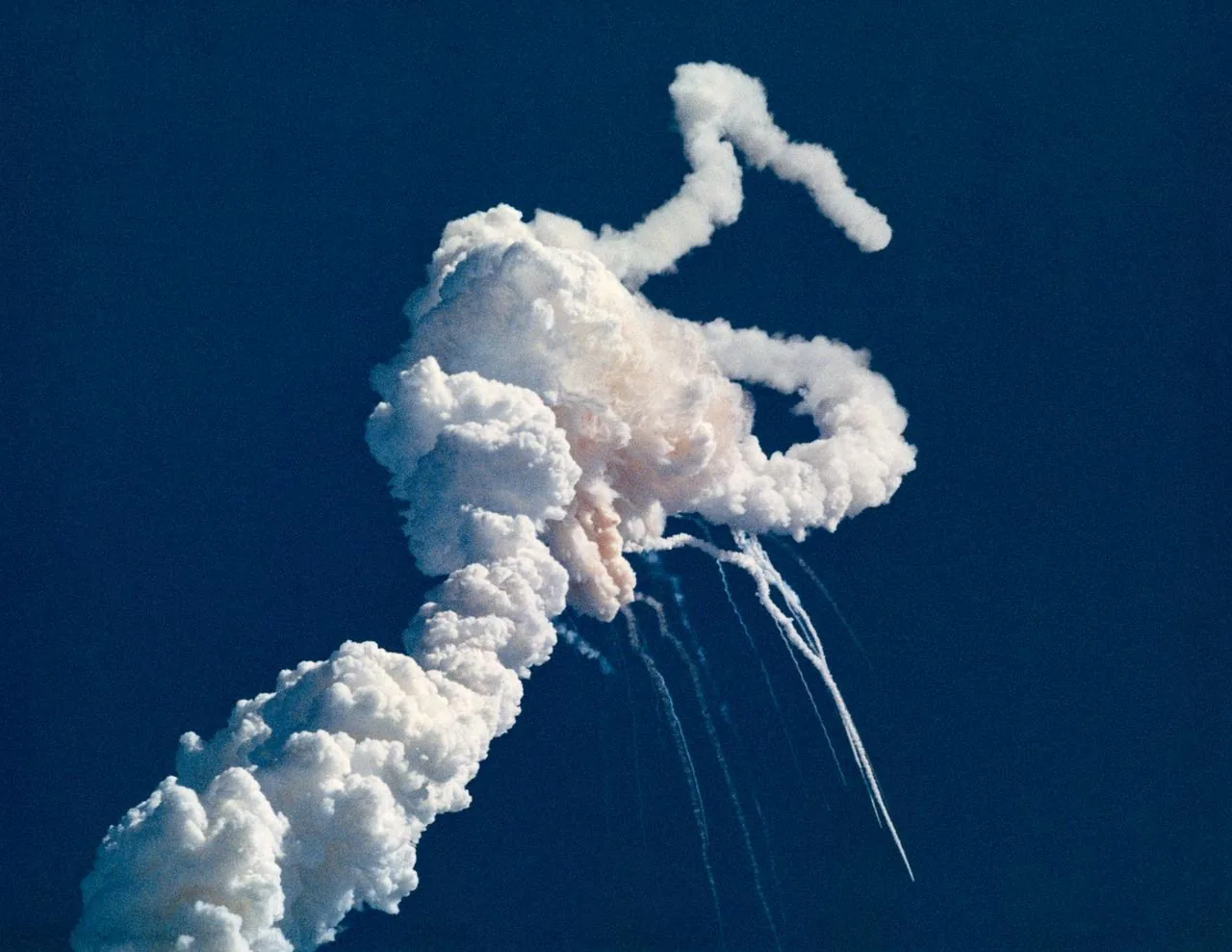
On 28 January 1986, Space Shuttle Challenger launched from Kennedy Space Center at 11:38 EST on mission STS-51-L. The overnight temperature had dropped to -6 °C — the coldest launch morning in Shuttle history. Engineers at Morton Thiokol had argued the night before that cold temperatures made the O-ring seals on the solid rocket boosters dangerously likely to fail. Their concerns were overruled by managers who felt the engineers hadn't proved failure was certain.
02 / 04
Seventy-three seconds after launch, at an altitude of roughly 14 km, a hot gas plume from a failed O-ring joint ignited the external tank's liquid hydrogen. The orbiter was torn apart by aerodynamic forces as it travelled near Mach 1.9. The solid rocket boosters, suddenly freed, flew in opposing arcs before range safety officers sent destruct commands. All seven crew members perished.
03 / 04
The crew compartment continued on a ballistic trajectory and impacted the Atlantic Ocean nearly three minutes later at around 330 km/h. Physical evidence suggests at least three crew members survived the initial breakup and were alive — though likely unconscious from depressurisation — until ocean impact.
04 / 04
President Reagan addressed the nation that evening, closing with words from the poem 'High Flight'. The Shuttle fleet was grounded for nearly three years. The Rogers Commission identified a systemic breakdown in NASA's safety culture: engineers had flagged O-ring anomalies on previous flights, but the concern never reached anyone with authority to stop the launch.
“
The future doesn't belong to the fainthearted; it belongs to the brave. The Challenger crew was pulling us into the future, and we'll continue to follow them.
President Ronald Reagan · Address to the Nation, 28 January 1986
By the numbers
Launch date
28 Jan 1986
Failure at
T + 73 seconds
Altitude at breakup
~14 km
Cause
O-ring failure (SRB field joint)
Temperature at launch
−6 °C (coldest ever)
Fleet grounded
2 yr 8 months
Why it mattered
Challenger ended the era of 'routine' spaceflight and forced NASA to confront how institutional pressure silences safety concerns. The investigation and resulting cultural changes reshaped risk management across aviation, nuclear power, and engineering worldwide.
▸O-ring failure was caused by overnight temperatures of −6 °C — the seals had never been tested below 12 °C, and engineers warned management the night before
▸The solid rocket booster joint had shown O-ring erosion on 13 of 24 previous flights — but NASA managers reclassified this as 'acceptable risk'
▸Physical evidence suggests some crew members survived the initial breakup and were conscious briefly — the crew cabin sank to 100m depth after a 3-minute free fall
▸President Reagan's evening address used lines from the poem 'High Flight' — one of the most memorable speeches in spaceflight history
▸The Rogers Commission found the O-ring concern had been documented since 1977 — nine years before the disaster