Time Machine
You have arrived · The Shuttle Era
Galileo launches to Jupiter
October 18, 1989NASA/JPL
NASA / Johnson Space Center
The world that day
4.5 billion
People on Earth
2
Nations to launch a human
12
Humans to walk on the Moon
0
Known worlds beyond the Sun
On the afternoon of 18 October 1989, Space Shuttle Atlantis climbed away from Kennedy Space Center with a Jupiter spacecraft folded in its payload bay. Galileo had waited years for this ride. Conceived in the 1970s and repeatedly delayed, it lost its powerful Centaur upper stage to post-Challenger safety rules, leaving a booster too weak to fly direct. So navigators plotted a six-year detour, one swing past Venus and two past Earth, stealing speed from each planet. Hours after launch the astronauts released Galileo, and its solid-fuel stage fired it out of Earth orbit for good.
The cruise became a saga in itself. In April 1991 the umbrella-like high-gain antenna jammed partly open, threatening the entire mission, until engineers reinvented it in flight, using data compression and upgraded ground stations to recover most of the planned science through a small low-gain antenna. Along the way Galileo made the first close flyby of an asteroid, Gaspra, in October 1991, discovered the first known asteroid moon, Dactyl, orbiting Ida in 1993, and in July 1994 held the only direct view of comet Shoemaker-Levy 9's fragments slamming into Jupiter.
On 7 December 1995 it all converged. The 339-kilogram probe Galileo had released months earlier hit Jupiter's atmosphere at roughly 47.6 kilometres per second, the fastest atmospheric entry ever flown, survived deceleration approaching 230 times Earth's gravity, and transmitted for about 58 minutes as it sank into the clouds. That same day the orbiter braked into orbit, becoming the first spacecraft ever to orbit an outer planet. Across 34 orbits it built the case for a saltwater ocean beneath Europa's ice, found hints of hidden water inside Ganymede and Callisto, and discovered that Ganymede generates its own magnetic field.
Galileo flew almost eight years at Jupiter, far past its design life, its instruments slowly battered by radiation. By 2003 the fuel was nearly gone, and NASA faced a question Galileo's own discoveries had created: an abandoned spacecraft might one day crash into Europa and contaminate a possibly habitable ocean. So on 21 September 2003 controllers deliberately flew Galileo into Jupiter at about 48 kilometres per second, destroying the spacecraft to protect the worlds it had revealed.
By the numbers
- Launch
- 18 Oct 1989 (STS-34 Atlantis + IUS)
- Orbiter mass
- 2,223 kg (plus 339 kg probe)
- Route
- Venus + 2 Earth gravity assists, 6-year cruise
- Jupiter arrival
- 7 Dec 1995
- Jupiter orbits
- 34
- Mission end
- 21 Sep 2003 (deliberate Jupiter impact)
Why it mattered
Galileo rewrote the map of where life might exist. Its evidence for a liquid ocean beneath Europa's ice transformed icy moons from frozen curiosities into prime astrobiology targets, a thread that leads directly to Europa Clipper and ESA's JUICE missions. It pioneered orbital exploration of the outer solar system and asteroid science, and its deliberate destruction set the planetary-protection precedent Cassini later followed at Saturn. The improvised rescue of its crippled antenna remains a textbook case of engineering a mission back from the brink.
- First spacecraft to orbit an outer planet, and its probe's 47.6 km/s plunge remains the fastest atmospheric entry ever flown.
- Made the first close asteroid flyby (Gaspra, 1991) and discovered the first asteroid moon, Dactyl, orbiting Ida.
- During its 1990 Earth flyby, Carl Sagan's team used Galileo's instruments to 'detect' life on Earth, a control experiment for recognizing living worlds elsewhere.
- Its main antenna never fully opened, yet compression software and ground-station upgrades recovered the bulk of the planned science through a low-gain antenna.
- Held the only direct view of comet Shoemaker-Levy 9 striking Jupiter in July 1994, on the side of the planet hidden from Earth.
Keep travelling
People also explored

From the same era
Moment
Mir core module launched
From the same era

From the same era
Moment
Buran — first fully autonomous spaceplane orbital flight
From the same era
From the same era
Moment
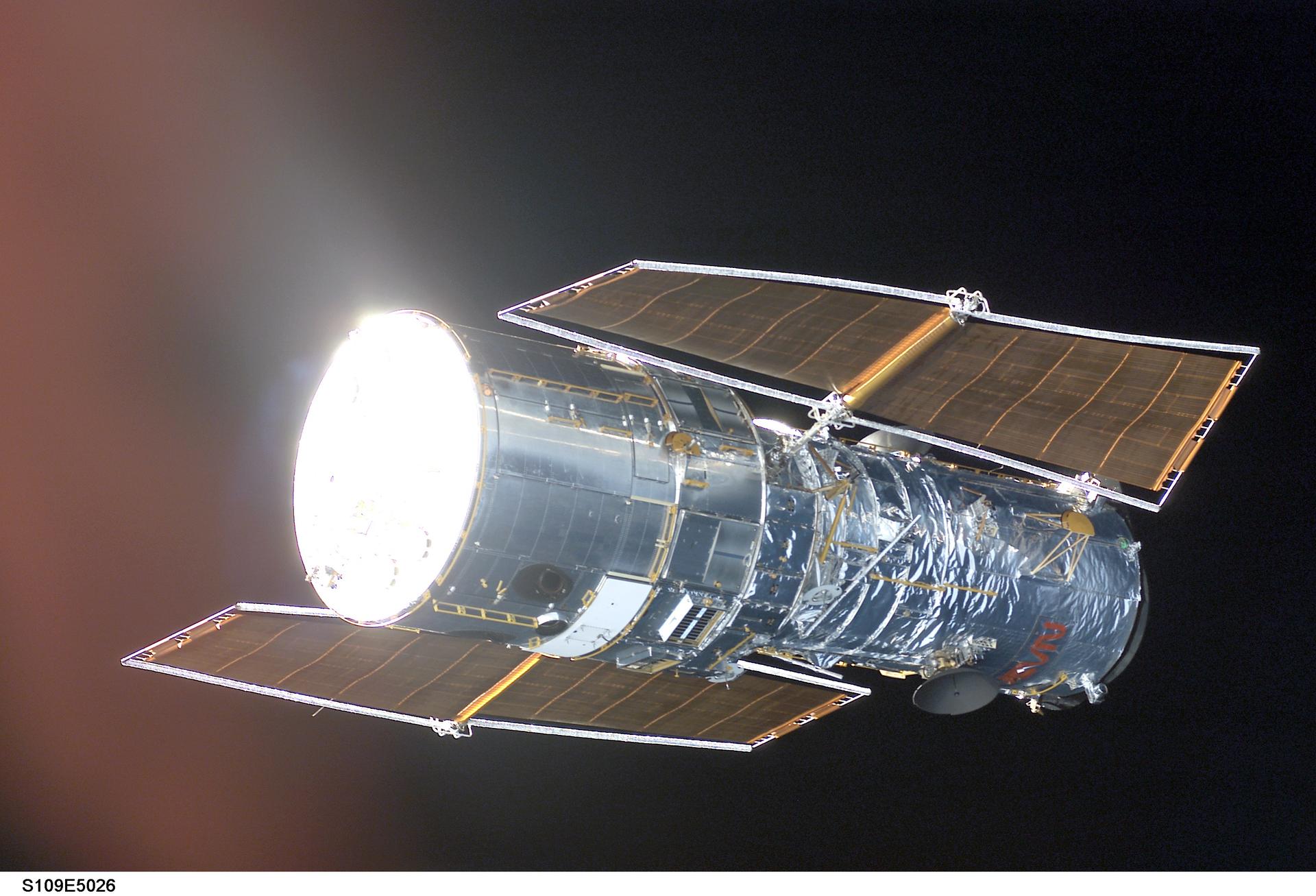
Hubble Space Telescope launched
From the same era

From the same era
Moment
Valeri Polyakov returns after 437-day Mir stay
From the same era