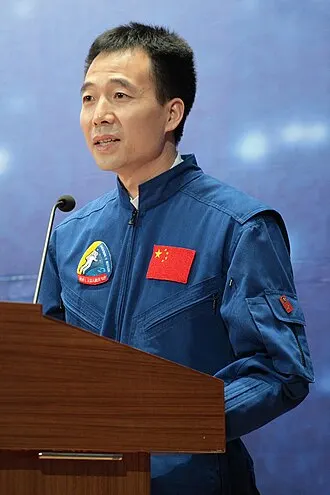
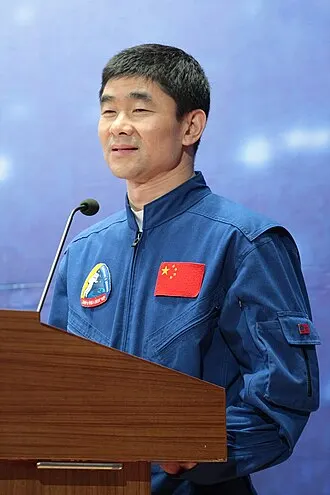
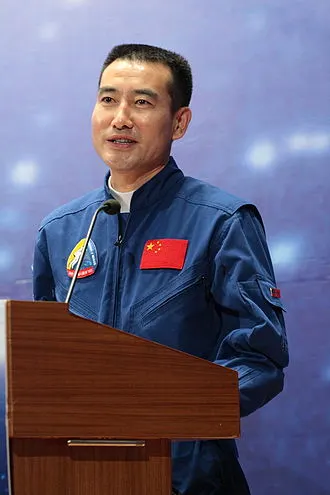
On the evening of 27 September 2008, during the spacecraft's 29th orbit, China stopped to watch live television. Inside Shenzhou 7's orbital module, Zhai Zhigang, sealed in the Chinese-built Feitian spacesuit, gripped the handle of a hatch that did not want to open. He heaved at it repeatedly; crewmate Liu Boming passed him a metal pry bar. When the hatch finally swung wide, the Earth was rolling past below, and for the first time in history a Chinese astronaut floated out into open space.
02 / 04
The choreography carried symbolism in every detail. Zhai wore Feitian, China's first homemade EVA suit; Liu Boming, standing by half-out of the hatch as his backup, wore a Russian-made Orlan, two nations' spacesuit engineering working side by side. Liu handed out a small Chinese flag, and Zhai waved it at the camera while greeting the country in words broadcast live to the nation. The walk lasted about 22 minutes, with the third crew member, Jing Haipeng, monitoring systems from the re-entry module.
03 / 04
What viewers did not fully grasp at the time was the nerve involved. Just as the spacewalk began, a fire alarm sounded in the orbital module, terrifying for any crew even though fire is essentially impossible in vacuum, and ground control soon confirmed it was false. The crew pressed on without breaking stride; Liu Boming said afterwards that they were determined to complete the spacewalk and fly the flag regardless. After the EVA, the mission released a small companion satellite, BX-1, which photographed Shenzhou 7 sailing over the blue Earth.
04 / 04
The re-entry module landed on the Inner Mongolian grasslands on 28 September after 68 hours and 27 minutes of flight, ending China's first three-person mission. With one short walk, China had become the third country to master extravehicular activity, using its own suit and its own airlock. The techniques proven that day, depressurisation, hatch operations, tether work, became the foundation for building and maintaining the Tiangong space station a decade later.
“
I'm feeling quite well. Greetings to all the people of the nation and all the people of the world.
Zhai Zhigang · Shenzhou 7 commander, speaking live during China's first EVA
By the numbers
Launch
25 Sep 2008, 21:10 Beijing time, Jiuquan
EVA
27 Sep 2008, about 22 min
EVA suit
Feitian, first Chinese-built EVA suit
Crew size
3, first Chinese three-person flight
Flight duration
68 h 27 min
Landing
28 Sep 2008, Inner Mongolia
Why it mattered
Shenzhou 7 gave China the third pillar of human spaceflight: the ability to work outside a spacecraft in an independently developed suit, through an indigenous airlock. The 22-minute walk validated the Feitian suit and the EVA procedures without which no space station can be assembled or maintained, and it confirmed the program's deliberate cadence, each flight adding exactly one major capability. The skills first demonstrated in those few minutes outside the hatch were used routinely a decade later to build Tiangong, where Chinese crews now spacewalk as a matter of course.
▸The hatch jammed as the world watched live; Zhai only got it open after repeated heaves and a metal pry bar handed over by Liu Boming.
▸A fire alarm sounded just as the EVA began; it proved false, and the crew pressed on, with Liu Boming later saying they were resolved to fly the flag no matter what.
▸Two suits, two nations: Zhai walked in the Chinese Feitian suit while his backup Liu Boming wore a Russian Orlan in the open hatch beside him.
▸After the spacewalk the mission released a small companion satellite, BX-1, which photographed Shenzhou 7 in orbit.
▸China became the third country with independent spacewalk capability, 43 years after Alexei Leonov's first EVA.