Time Machine
You have arrived · The New Space Age
Blue Ghost Mission 1 and IM-2 launch together
January 15, 2025Firefly / Intuitive Machines / SpaceX
NASA/Kim Shiflett
The world that day
8.1 billion
People on Earth
3
Nations to launch a human
12
Humans to walk on the Moon
5,500
Known worlds beyond the Sun
At 1:11 a.m. Eastern on 15 January 2025, a Falcon 9 climbed away from Pad 39A carrying something no rocket had ever lofted: two Moon landers at once. Inside the fairing rode Firefly Aerospace's Blue Ghost, bound for Mare Crisium, and below it ispace's Resilience lander from Japan, beginning a slow scenic route to the northern plains. One detail of the record deserves correction: Intuitive Machines' IM-2 Athena, often paired with this launch in memory, actually flew on its own Falcon 9 six weeks later, on 26 February 2025. The January night launch nonetheless opened the most crowded season of commercial lunar exploration ever attempted.
Blue Ghost, named 'Ghost Riders in the Sky', carried ten NASA science and technology payloads under the agency's Commercial Lunar Payload Services program, from a regolith-sampling vacuum to a radiation-tolerant computer and a dust-repelling electrodynamic shield. Firefly, a company that had never flown beyond Earth orbit, chose patience over haste: roughly 25 days circling Earth for checkouts, a translunar cruise, then 16 days in lunar orbit before committing to descent. Along the way, its LuGRE payload acquired GPS and Galileo signals farther from Earth than ever before, proving satellite navigation works at lunar distances.
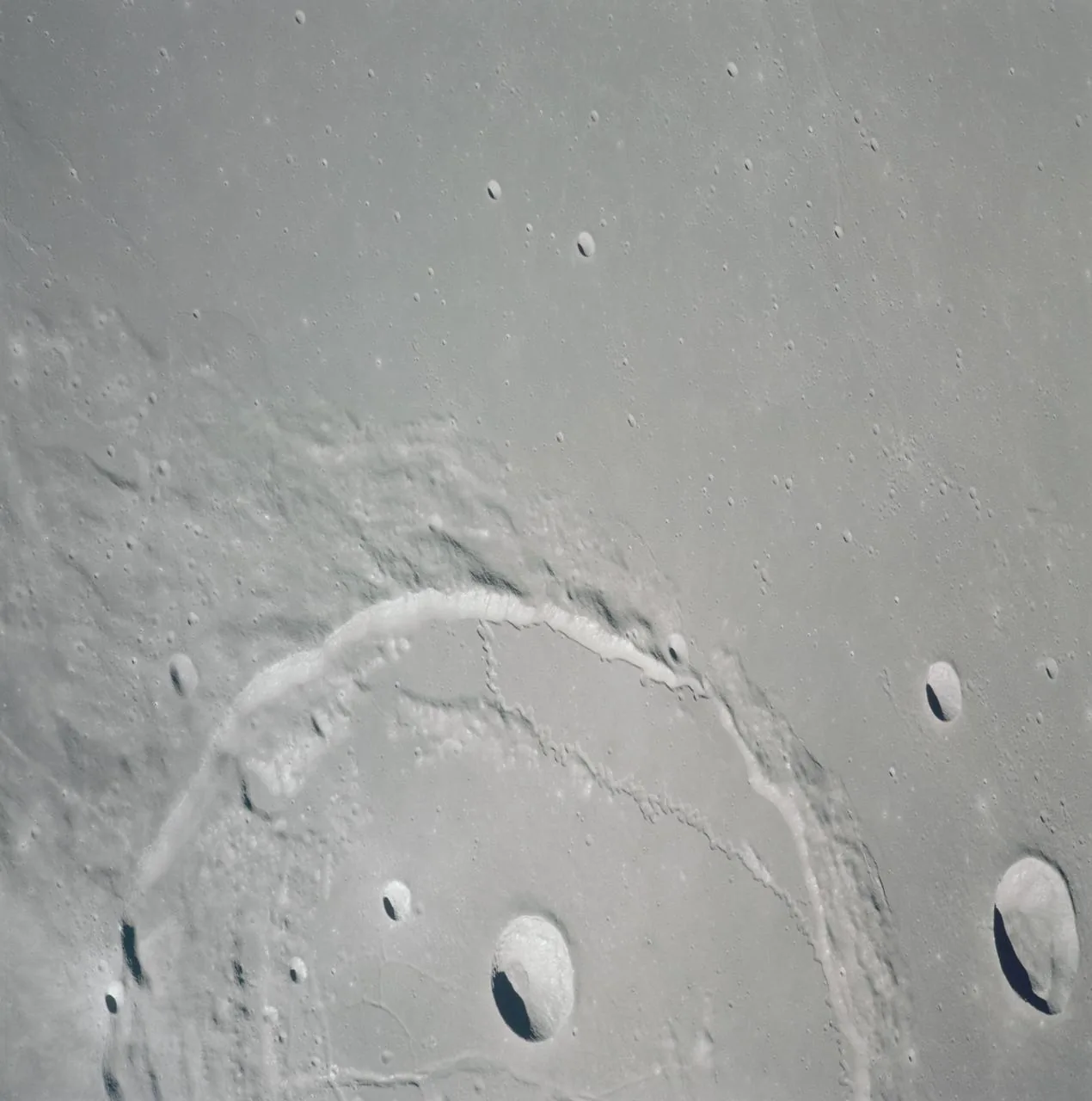
On 2 March 2025, Blue Ghost settled upright beside the ancient volcanic dome Mons Latreille in Mare Crisium, becoming the first commercial spacecraft to achieve a fully successful soft landing on the Moon. It worked through a complete 14-day lunar day, drilling, sampling and imaging, and on 14 March it photographed the Earth eclipsing the Sun, a total solar eclipse seen from the lunar surface. Its fellow travelers fared differently. Athena reached the Moon on 6 March and made the southernmost lunar landing in history near Mons Mouton, but tipped onto its side in a crater and fell silent the next day. Resilience, after its long spiral, crashed during its final descent into Mare Frigoris on 5 June 2025.
Taken together, the missions that began or were echoed in that January launch wrote the real lesson of the commercial lunar era: getting to the Moon cheaply is now routine; landing on it gently is still hard, and one company had just proven it could be done perfectly. NASA's bet, paying private firms fixed prices to deliver its instruments, had produced its first complete vindication.
By the numbers
- Launched
- 15 Jan 2025, 06:11 UTC, Falcon 9, Kennedy LC-39A
- Co-passenger
- ispace Resilience (Hakuto-R Mission 2)
- NASA payloads
- 10 CLPS science and tech instruments
- Transit
- ≈45 days to Mare Crisium
- Landing
- 2 Mar 2025, near Mons Latreille, Mare Crisium
- Surface operations
- ≈14 days, one full lunar day
Why it mattered
This launch opened the busiest year the Moon had ever seen and delivered the commercial lunar industry's first unqualified triumph. After Beresheet crashed, ispace's first lander crashed, and IM-1 tipped over, Blue Ghost's flawless touchdown proved NASA's Commercial Lunar Payload Services gamble could work as designed: a fixed-price contract, a private lander, and ten government payloads operating exactly as planned. The dual-manifest Falcon 9 also showed how rideshare economics could halve the cost of reaching the Moon. The contrasting fates of Blue Ghost, Athena and Resilience over the following months defined both the promise and the brutal difficulty of the new lunar economy on which NASA's Artemis logistics now depend.
- It was the first time two lunar landers shared a single rocket, though the record needs a correction: Blue Ghost's co-passenger was ispace's Resilience, while IM-2 Athena launched separately on 26 February 2025.
- Blue Ghost became the first commercial lander to pull off a fully successful Moon landing, touching down upright on 2 March 2025 with all ten NASA payloads working.
- On 14 March 2025, Blue Ghost photographed a total solar eclipse from the Moon, watching Earth slide across the Sun, then captured the long lunar sunset before the two-week night fell.
- The LuGRE payload acquired GPS and Galileo navigation signals at record distance and on the lunar surface, evidence that future Moon missions can navigate with the same satellites as your phone.
- The three landers' fates mapped the state of the art: Blue Ghost succeeded completely, Athena made the southernmost lunar landing ever but tipped over and died within a day, and Resilience crashed during descent in June.
Keep travelling
People also explored
The mission behind this moment
Mission
Blue Ghost Mission 1
The mission behind this moment

From the same era
Moment
Starship Flight 6 — propulsive soft splashdown
From the same era

From the same era
Moment
Parker Solar Probe makes closest-ever approach to the Sun
From the same era

From the same era
Moment
New Glenn — Blue Origin's first orbital launch
From the same era

From the same era
Moment
Starship Flight 7 — second successful booster catch
From the same era