Arrokoth
The most distant world ever explored — a primordial contact binary from the early solar system.
- Type
- Kuiper Belt object (contact binary)
- Diameter
- ≈36 km long
- Rotation
- ≈15.9 h
- Orbit
- 44.6 AU from the Sun
- Discovered
- 2014
- Visited by
- New Horizons (2019)
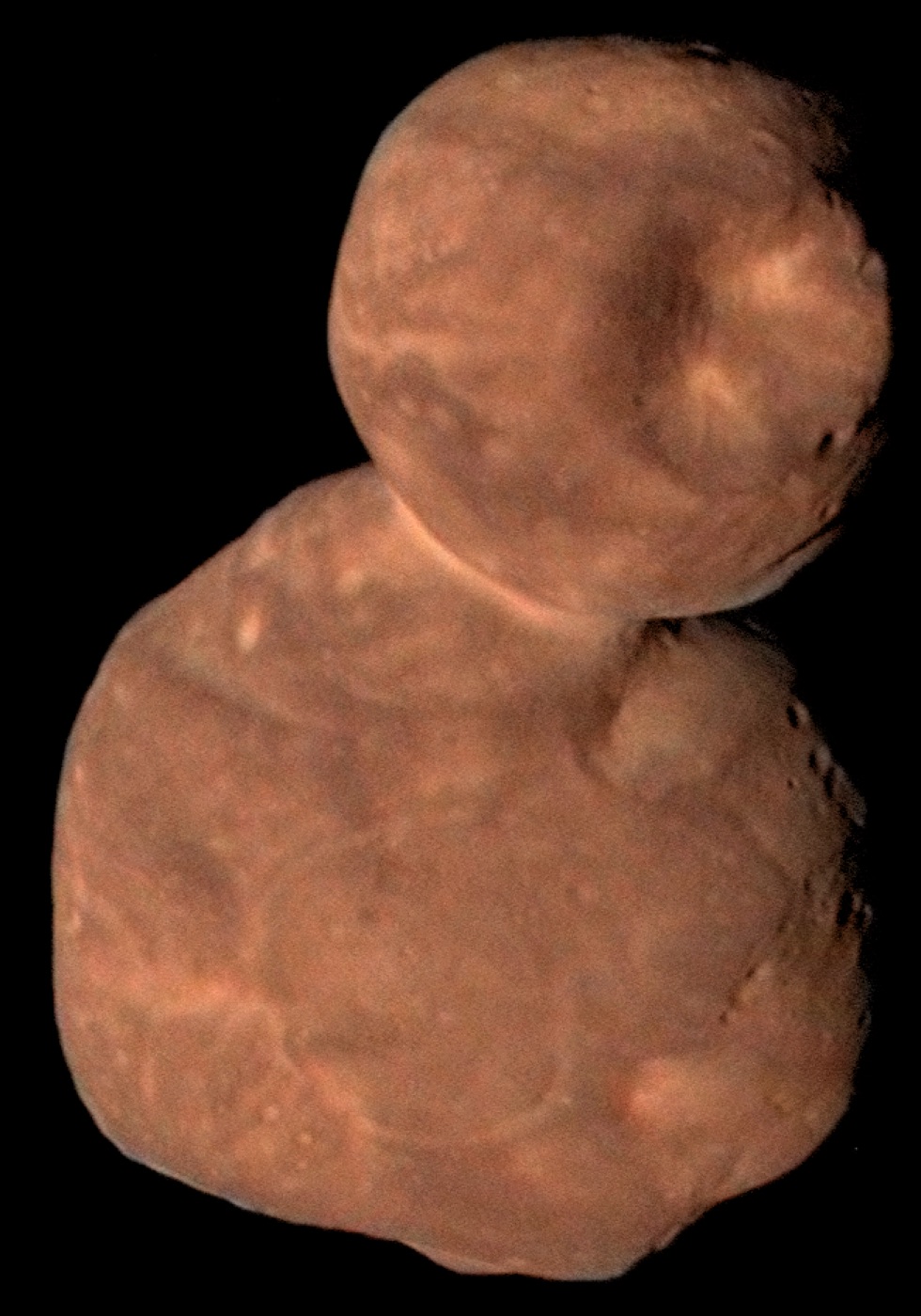
The most distant and most primitive world ever explored — two lobes gently merged in the early solar system.
Can you see it?
Spacecraft onlyThe most distant world ever explored — a 36 km icy body 44 AU away, far beyond the reach of any amateur (and only a faint dot even to Hubble). New Horizons is our only close look.
- What you need
- No backyard instrument can detect it.
Up close
Arrokoth is a flattened contact binary: a larger lobe (Wenu) and a smaller one (Weeyo) joined at a bright neck. Its two pancake-like lobes formed nearby and merged gently — a pristine snapshot of how planetesimals were built.
Its surface is 'ultra-red,' coloured by irradiated organic ices and almost unchanged for 4.5 billion years — a deep-frozen relic of the solar system's birth.
Discovery & exploration
Discovered on 26 June 2014 with the Hubble Space Telescope during a hunt for a target beyond Pluto, and later named Arrokoth — 'sky' in the Powhatan language. Its pre-naming nickname was 'Ultima Thule.'
NASA's New Horizons flew within ~3,500 km of Arrokoth on 1 January 2019, while it was 6.6 billion km from the Sun — the most distant flyby in history.
Did you know?
- It is the most distant — and most primitive — world ever explored.
- Its two lobes merged at walking pace (~2 m/s), supporting the gentle 'pebble-cloud' theory of how worlds form.
- Its ultra-red colour comes from tholins — organic ices baked by 4.5 billion years of cosmic radiation.
Sources: NASA — Arrokoth facts · Wikipedia — 486958 Arrokoth