Ceres
The largest world in the Main Belt and the first dwarf planet ever visited by a spacecraft.
- Type
- Dwarf planet (Main Belt)
- Diameter
- ≈940 km
- Rotation
- 9 h 4 min
- Orbit
- 2.77 AU from the Sun
- Discovered
- 1801 · Giuseppe Piazzi
- Visited by
- Dawn (2015–2018)
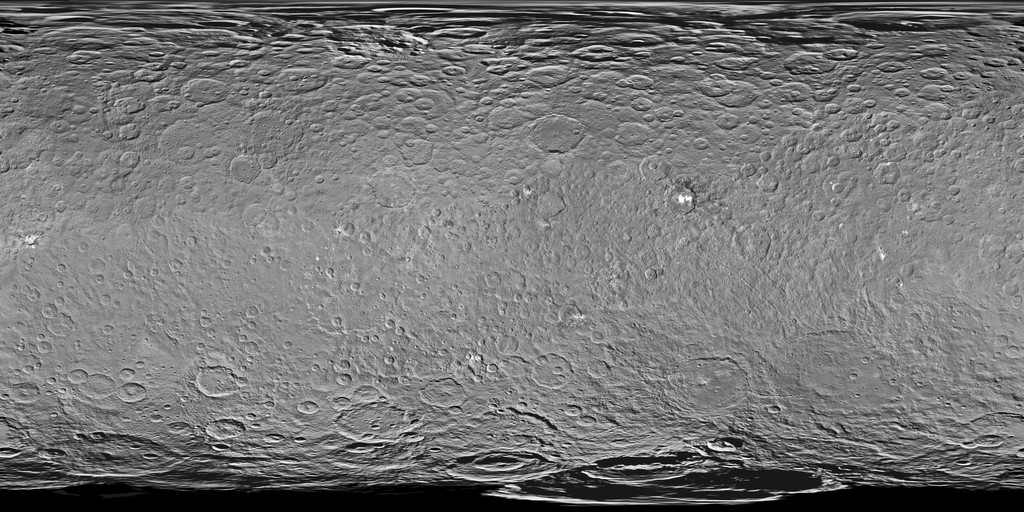
The first dwarf planet orbited — its Occator crater holds bright carbonate salt deposits from a subsurface brine.
Can you see it?
BinocularsA binocular target at its best — never quite naked-eye, and 2026 is an off year: Ceres has no opposition until 7 January 2027.
- No 2026 opposition. Ceres slowly brightens through the year toward its next opposition on 7 January 2027 (magnitude ~6.8, in Gemini).
- What you need
- Under a dark sky, 7×50 binoculars show it as a faint star-like point. No amateur telescope resolves its ~0.8-arcsecond disk.
- How to find it
- Use a dated finder chart and the two-night trick — the 'star' that has shifted position between nights is Ceres.
Up close
At 940 km across, Ceres is the largest object in the asteroid belt and the only dwarf planet in the inner solar system — round, carbonaceous and surprisingly water-rich.
Beneath a ~40-km crust lies a muddy, briny layer, possibly the remnant of a subsurface ocean. Its 80-km Occator crater holds the famous bright 'faculae' — salt deposits left by brine that reached the surface in the geologically recent past.
Discovery & exploration
Discovered on 1 January 1801 by Giuseppe Piazzi — the very first asteroid ever found — and named for Ceres, the Roman goddess of agriculture (the root of the word 'cereal').
NASA's Dawn orbited Ceres from March 2015 to October 2018, descending to ~35 km. It revealed the Occator bright spots as surfaced brine and found hydrohalite, a salt never before seen off Earth. Dawn still circles Ceres today as a silent derelict.
Did you know?
- Ceres holds more water than any inner-solar-system body except Earth — locked in ice and deep brine.
- Dawn was the first spacecraft ever to orbit two different worlds: Vesta, then Ceres.
- When found in 1801 it was hailed as a new planet — and counted as one for half a century before being reclassified.
Sources: NASA — Dawn · in-the-sky.org — Ceres 2027