Vesta
The second-largest body in the Main Belt and the only protoplanet whose surface rocks have fallen to Earth as HED meteorites.
- Type
- Protoplanet (Main Belt)
- Diameter
- ≈525 km
- Rotation
- 5 h 21 min
- Orbit
- 2.36 AU from the Sun
- Discovered
- 1807 · Heinrich Olbers
- Visited by
- Dawn (2011–2012)
Its Rheasilvia impact basin holds one of the tallest mountains in the solar system (~22 km).
Can you see it?
Naked eyeThe brightest asteroid in the sky — at its best it skirts naked-eye visibility from a dark rural site, and is an easy binocular target anywhere.
- 2 May 2026 — opposition at magnitude 5.7, in Libra. The standout asteroid event of the year.
- 13 Oct 2026 — a second, fainter opposition at magnitude 6.5, in Cetus (binoculars needed).
- What you need
- Binoculars show it easily as a star-like point. Even a large telescope shows no disk — its angular size is only ~0.6 arcseconds, so it always looks like a star.
- How to find it
- In early May, anchor on Zubeneschamali (β Librae, magnitude 2.6); Vesta sits about 10° to its upper-right and drifts ~0.5° westward each night. Sketch or photograph it two nights running — the "star" that moved is Vesta.
Up close
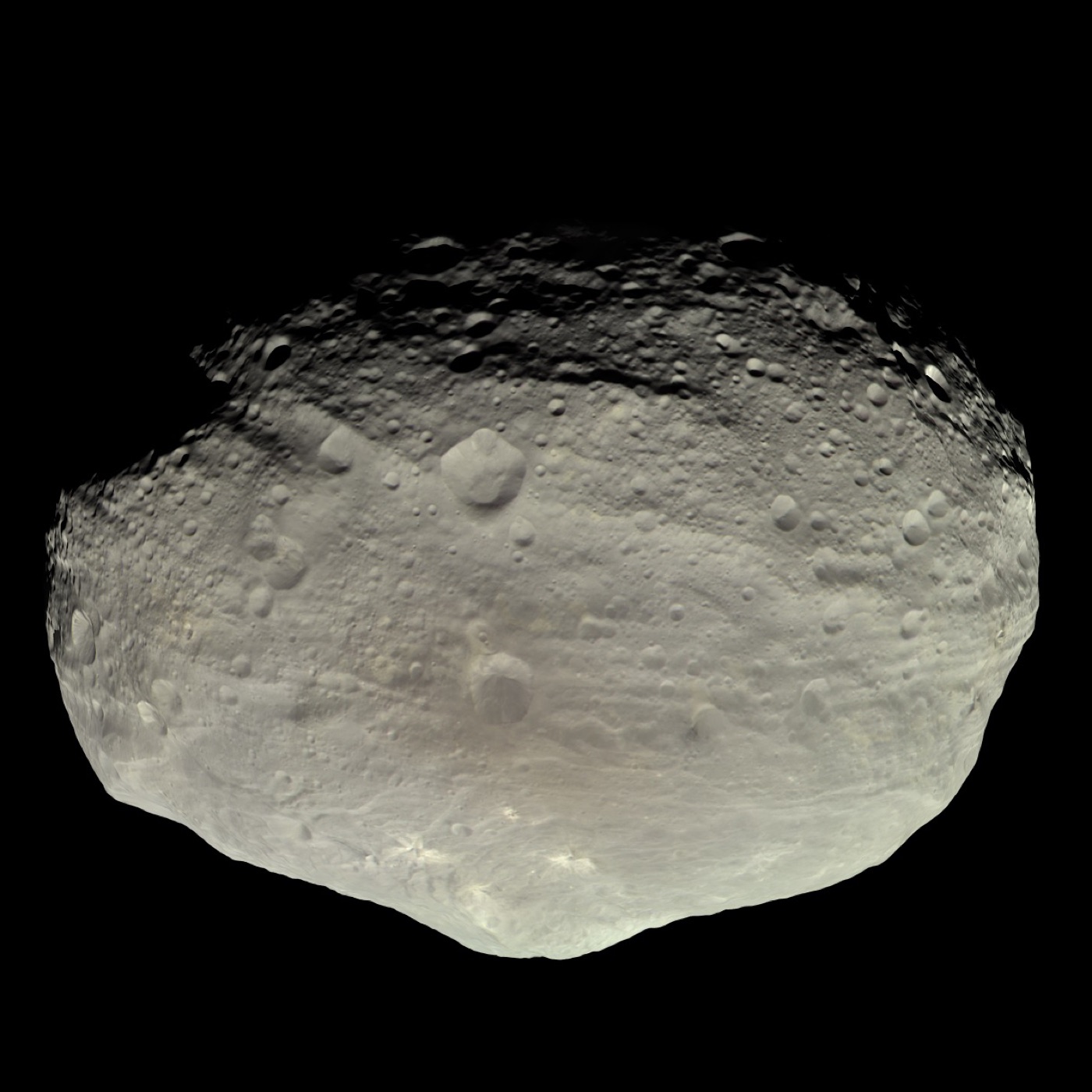
Vesta is a 525-km differentiated protoplanet — a survivor from the first few million years of the solar system, with an iron–nickel core, a rocky mantle and a basaltic crust. It is less a typical asteroid than a tiny planet that never finished forming.
Its south pole is dominated by Rheasilvia, a ~500-km impact basin whose central peak rises ~20–22 km — among the tallest mountains in the solar system. The giant impact that carved it flung out the 'Vestoid' family of fragments.
Discovery & exploration
Discovered on 29 March 1807 by Heinrich Olbers — the fourth asteroid ever found — and named by Carl Friedrich Gauss for Vesta, the Roman goddess of the hearth.
NASA's Dawn orbited Vesta from July 2011 to September 2012, mapping it from as close as 210 km and confirming it as a differentiated protoplanet and the parent body of the HED meteorites.
Did you know?
- You can legally own a piece of Vesta: HED meteorites (eucrites, diogenites, howardites) are blasted-off Vestan crust — eucrites sell for roughly $4–10 a gram.
- It is the only asteroid that can ever be glimpsed with the unaided eye.
- Roughly 1 in 20 meteorites that fall to Earth trace back to Vesta.
Sources: NASA — Dawn at Vesta · in-the-sky.org — Vesta 2026