The energy transition is the defining challenge of the 21st century. Wind turbines fall still when the air is calm. Solar panels go dark at night and underperform under clouds. Battery storage is improving but remains expensive and resource-intensive. Meanwhile, the sun blazes in orbit 24 hours a day, 365 days a year, with an intensity roughly eight times greater than what reaches Earth's surface through the atmosphere.
Space-based solar power (SBSP) is not a new idea — Peter Glaser proposed it in a 1968 Science paper — but it is an idea whose time may finally be approaching. A convergence of dramatically lower launch costs, advances in wireless power transmission, and climate urgency is bringing SBSP from science fiction to serious engineering consideration. This piece makes the affirmative case.
What Space Solar Power Actually Is
The concept is elegant in its logic. A large satellite in geostationary orbit (roughly 36,000 km above Earth) collects sunlight continuously with photovoltaic panels. It converts that electricity into microwaves or a laser beam and transmits it to a receiving antenna — called a rectenna — on the ground. The rectenna converts the microwave energy back into usable electricity and feeds it into the grid.
The key advantages over terrestrial solar are stark. A geostationary SBSP satellite receives sunlight for more than 99% of the year. It faces no weather, no night cycle, and no atmospheric scattering. The power delivered per unit of collector area is dramatically higher than any Earth-based installation. And because microwave transmission passes through clouds and rain with minimal loss, the receiving station can be located anywhere — deserts, coastlines, or densely populated regions.
The Numbers That Make It Compelling
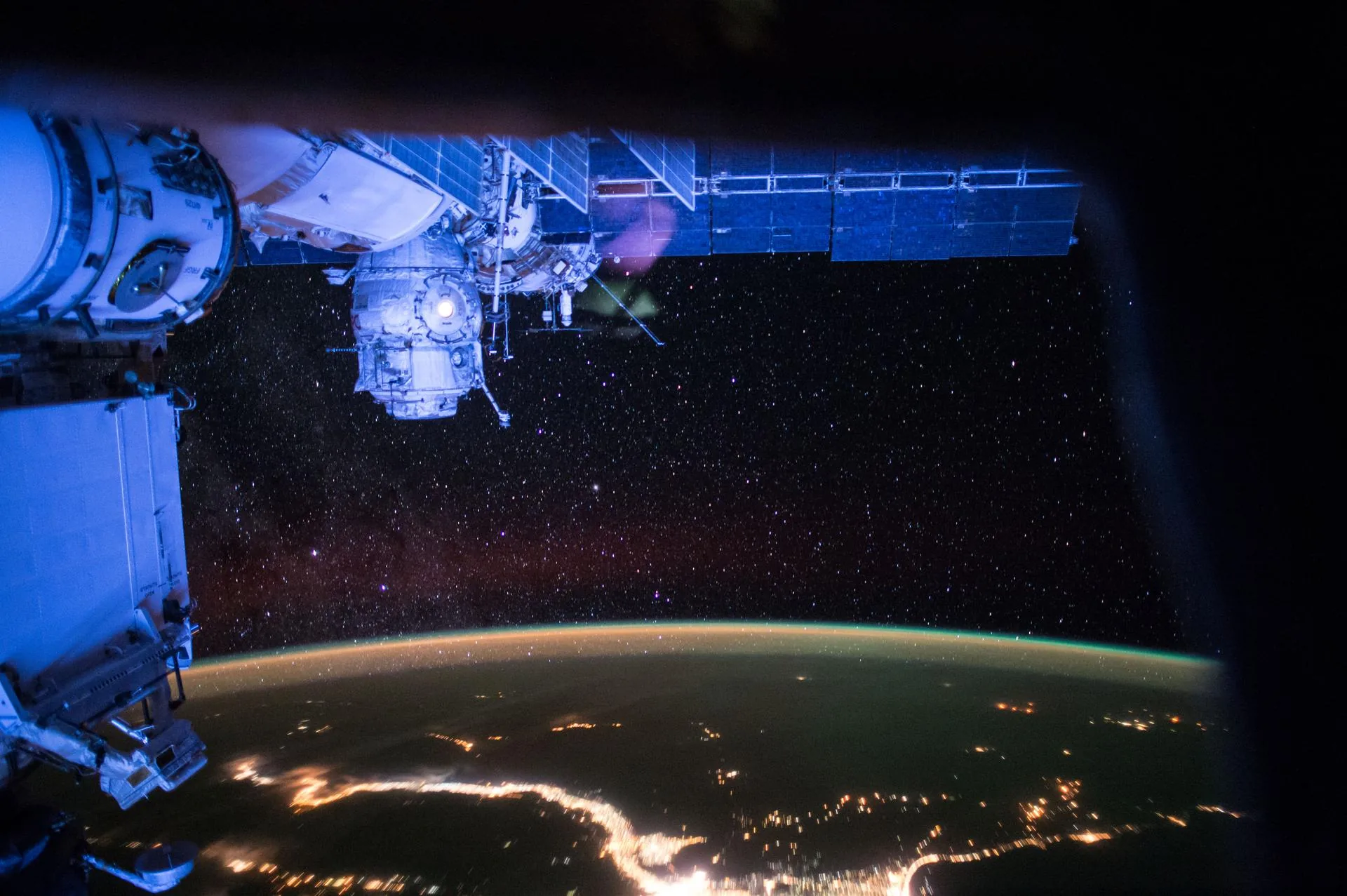
Energy density is the core argument. In low Earth orbit, solar irradiance averages about 1,361 watts per square meter. On the ground, after atmospheric losses and accounting for day-night cycles, effective solar irradiance in a good location averages perhaps 170–250 watts per square meter across the full year. An SBSP system in geostationary orbit, beaming power continuously, could deliver roughly five to ten times more energy per unit of solar panel area than the same panel on the ground.
The International Energy Agency projects that global electricity demand will nearly double by 2050. Meeting that demand with zero-carbon sources while managing grid intermittency is the central challenge of energy policy. SBSP offers something that wind and ground solar cannot: firm, dispatchable, baseload renewable power — energy that flows constantly regardless of season or time of day, adjustable by pointing the beam.
The European Space Agency estimated in a 2022 study that a single mature SBSP system could deliver 2 gigawatts of continuous power — roughly the output of two large nuclear plants — to the European grid. ESA's SOLARIS initiative, formally proposed to member states, calls for a demonstrator satellite in the early 2030s and commercial deployment thereafter.
Current Projects and Serious Players
The field has moved beyond white papers. Several concrete programs are now underway:
ESA SOLARIS: The European Space Agency's SOLARIS concept received conceptual funding approval in 2022. ESA has conducted extensive system architecture studies and is lobbying member governments for a full development budget targeting a 2035–2040 operational timeline.
Caltech SSPP: The California Institute of Technology launched the Space Solar Power Demonstrator (SSPD-1) aboard a Momentus Vigoride spacecraft in January 2023. The MAPLE (Microwave Array for Power-transfer Low-orbit Experiment) payload successfully transmitted power wirelessly in space — the first in-orbit demonstration of targeted wireless power transfer from a spacecraft.
UK Space Energy Initiative: The UK government funded a £3 million feasibility study, with aerospace company Frazer-Nash concluding in 2021 that SBSP is technically viable and could be competitive with other low-carbon power sources by 2050 if developed now.
China's SBSP program: China's Chongqing University and state aerospace entities have been testing microwave power transmission at ground stations and have published roadmaps targeting a 1-megawatt test satellite by 2030 and a gigawatt-scale commercial system by 2050.
JAXA: Japan's space agency has been working on SBSP concepts since the 1980s and continues R&D into lightweight photovoltaic arrays and phased-array transmitters.
Addressing the Objections Directly
Critics raise legitimate concerns. Let's take them seriously.
"Launch costs make it prohibitively expensive"
This was true in 2000 when launching a kilogram to geostationary transfer orbit cost $30,000–$50,000. Today, SpaceX Falcon Heavy brings that to roughly $5,000–$7,000/kg to GTO. Starship, designed for full reusability, targets below $100/kg to low Earth orbit and potentially $1,000/kg to GTO at scale. SBSP becomes economically viable at roughly $500/kg to GTO — a threshold that in-space assembly, on-orbit manufacturing, or lunar material sourcing could eventually enable.
"Microwave beams are dangerous"
The power density at the rectenna is designed to be lower than current safety standards for microwave exposure — roughly one-fifth of the intensity of sunlight. The beam is non-ionizing radiation. Birds flying through would experience no harm. The receiving antenna can be fenced as an exclusion zone, similar to a power plant substation. If the satellite loses lock on the ground station, phased-array systems automatically defocus and the beam disperses harmlessly.
"It's just too far away to be practical"
This objection confuses difficulty with impossibility. Yes, SBSP requires in-orbit assembly of multi-kilometer structures, precision pointing from geostationary orbit, and a new generation of lightweight photovoltaic materials. These are hard engineering problems. But they are qualitatively different from, say, controlled nuclear fusion — they require no new physics, only sustained engineering development.
"Why not just build more terrestrial solar and storage?"
Ground solar is critical and should continue scaling. But SBSP serves a fundamentally different role: firm baseload power independent of geography and weather. The world will likely need both — and SBSP may be particularly valuable for densely populated regions with limited land for solar farms, or for nations with poor solar resources.
The Economic Case in 2026
The economics are not yet favorable at scale — but the trajectory matters. The Caltech SSPD-1 demonstration and continued launch cost reduction are moving the cost curves. A McKinsey analysis suggested that if launch costs fall to $200/kg to orbit, SBSP could reach grid parity with offshore wind by the late 2040s.
There is also a strategic economic angle. Nations that develop SBSP infrastructure first will hold enormous geopolitical leverage — the ability to beam clean energy to energy-insecure allies. The UK Frazer-Nash study estimated a mature UK SBSP industry could be worth £300 billion by 2050 in export revenues alone.
The comparison to the early nuclear industry is instructive. Fission power also required decades of investment before achieving commercial viability, and governments bore most of that cost. The social return on that investment — reliable, low-carbon baseload power — was enormous. SBSP deserves the same long-term commitment.
What Needs to Happen
Three things must converge for SBSP to become a reality within our lifetimes:
- Launch cost reduction to below $500/kg to GTO, most likely through Starship and successor vehicles. This is largely on track.
- Demonstration of gigawatt-scale wireless power transmission with conversion efficiency above 50% end-to-end. Current experiments achieve 20–30%; physics allows 70%+.
- Government commitment to bridge the valley of death between demonstrator and commercial-scale deployment — the same gap that stalled SBSP in the 1980s when NASA killed its study program.
The Caltech MAPLE experiment proved the physics works in space. ESA's SOLARIS initiative shows serious institutional commitment. What is missing is a Apollo-program-level decision to treat SBSP as a priority rather than a curiosity.
Bottom Line
Space-based solar power is not a fantasy. It is a hard engineering challenge with a realistic pathway to becoming one of humanity's most important energy technologies. The physics is sound. The cost barriers are falling. Multiple serious programs — in Europe, the United States, Japan, and China — are generating real data.
The objections are real but answerable. The opportunity — firm, global, zero-carbon baseload power beamed from orbit — is worth the investment. A civilization that can put rovers on Mars and telescopes at the L2 Lagrange point can surely build a power satellite. The question is whether we have the will to fund it before climate deadlines close the window.
The sun never sets in geostationary orbit. We should be harvesting it.