
Choosing a rocket propellant is not about picking the most energetic chemical. It's about making the right set of compromises across energy density, handling complexity, storage stability, engine design implications, cost, and increasingly, reusability considerations. The "best" propellant depends entirely on the mission — which is why today's rockets use five distinct major propellant combinations, and why researchers are investigating dozens more.
This guide covers every significant propellant combination in use or serious development, with the technical details that matter and the practical trade-offs that determine which rockets use what.
The Fundamental Metrics
Before comparing specific propellants, you need to understand what we're measuring.
Specific Impulse (Isp): The most important efficiency metric. Measured in seconds, Isp expresses how much thrust an engine produces per unit of propellant mass consumed per unit time. Higher Isp means more efficient use of propellant. A high-Isp engine extracts more velocity change (delta-v) from the same propellant mass.
Thrust-to-weight ratio (TWR): How much thrust the engine produces relative to its own mass. Engines must produce enough thrust to lift the rocket off the ground (TWR > 1 at liftoff), but higher TWR generally means a lighter, more compact engine.
Energy density: How much chemical energy per kilogram of propellant. This feeds directly into achievable performance, though propellant density also matters — a dense propellant means smaller, lighter tanks.
Storability: Cryogenic propellants (liquid oxygen, liquid hydrogen, liquid methane) must be stored at extremely low temperatures and are constantly evaporating, requiring active cooling or venting. "Storable" propellants (nitrogen tetroxide, UDMH, hydrogen peroxide) can be stored at room temperature indefinitely, making them preferred for applications requiring months of standby time (spacecraft attitude thrusters, military missiles).
Liquid Propellant Combinations
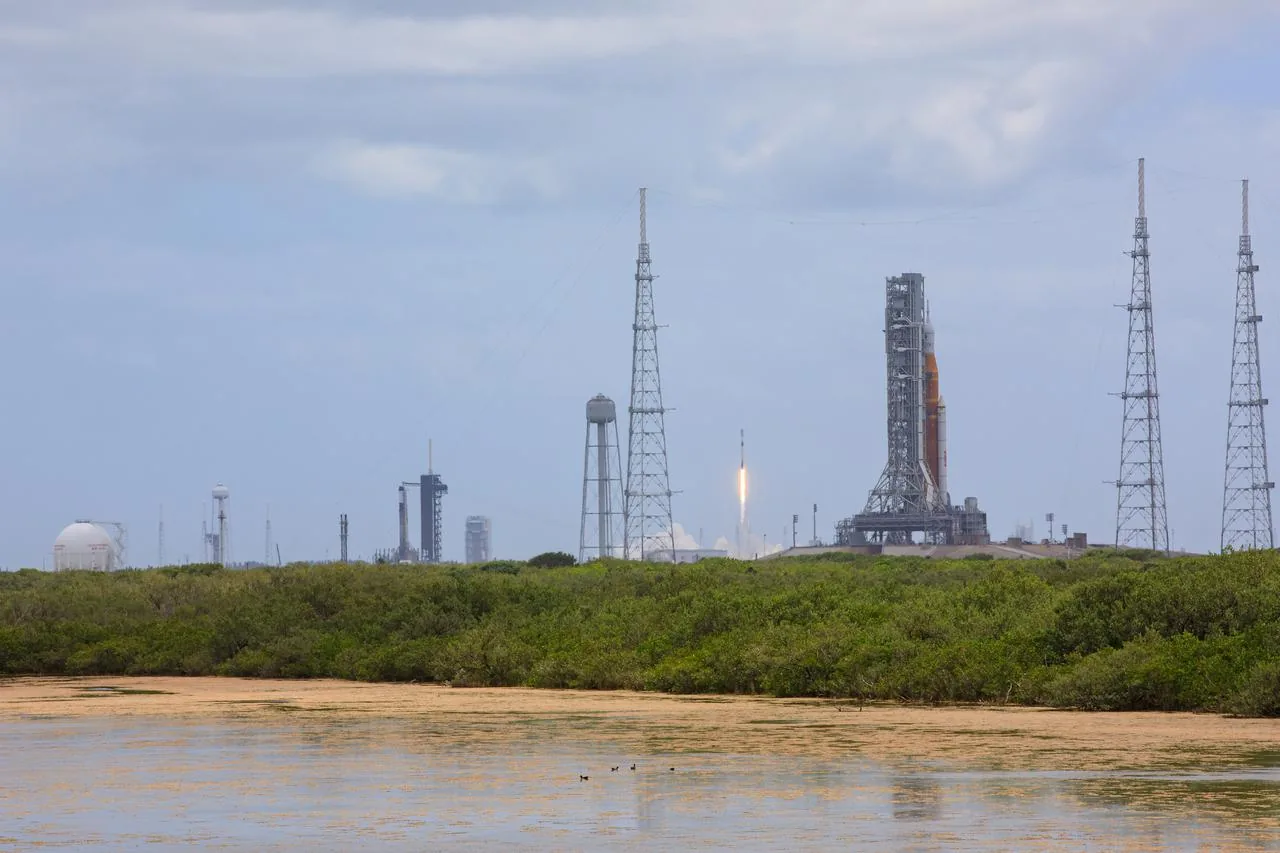
RP-1 / LOX (Refined Petroleum / Liquid Oxygen)
Used by: SpaceX Falcon 9 (Merlin engines), Atlas V (RD-180), Antares (NK-33/RD-181), various others
Isp: ~311s (sea level) / ~340s (vacuum)
Storage temperatures: LOX at –183°C; RP-1 ambient
RP-1 is highly refined kerosene — essentially jet fuel with tighter specifications. It is dense (814 kg/m³), cheap, widely available, and easy to handle. It's liquid at room temperature, so tanks don't require cryogenic insulation (only the LOX tanks do).
LOX is the standard oxidizer for virtually all high-performance liquid rockets. It's abundant (produced by fractional distillation of air), cheap, non-toxic, and extremely energetic as an oxidizer. The only significant handling challenge is its cryogenic temperature and the fire hazard of concentrating oxidizer at engine start.
The RP-1/LOX combination produces the characteristic dark, smoky exhaust plume seen on Falcon 9 launches — the black smoke is carbon soot from incomplete combustion of the hydrocarbon fuel. Despite this, the combination is among the most practical for first stages: the high density means compact tanks and a compact rocket, and the propellants are not especially difficult to load.
Key advantages: Dense propellants → smaller tanks, well-proven technology, cheap, simpler handling than LH2 Key disadvantages: Lower Isp than LH2 or methane, carbon coking in engine plumbing (makes reuse harder), soot production
SpaceX's Merlin engine was designed for reusability — a Falcon 9 first stage has flown 23 times. But RP-1's carbon coking (a buildup of carbon deposits in fuel passages and on turbopump components) makes the cleaning and inspection between flights more complex than SpaceX would like. This is one reason SpaceX chose methane for Starship.
Liquid Hydrogen / LOX (LH2/LOX)
Used by: NASA Space Launch System (RS-25 engines), European Ariane 5/6 (Vulcain 2), JAXA H-IIA/H-3, Space Shuttle Main Engines
Isp: ~366s (sea level) / ~453s (vacuum)
Storage temperatures: LH2 at –253°C (just 20°C above absolute zero); LOX at –183°C
LH2/LOX produces the highest Isp of any operational propellant combination — roughly 30% better efficiency than RP-1/LOX. This translates directly into the ability to carry a larger payload fraction or achieve more delta-v with the same vehicle mass. For upper stages and orbital maneuver engines where efficiency dominates over compact packaging, LH2/LOX is the gold standard.
The catch is hydrogen itself. Liquid hydrogen is the least dense substance that can be stored in liquid form at 70 kg/m³ — about one-tenth the density of water and one-eleventh the density of RP-1. Enormous tanks are required to store meaningful masses of hydrogen. The Space Shuttle's large orange external tank was 97% volume LH2 and LOX, with the LH2 tank larger despite containing less mass.
Hydrogen also leaks through most materials at a molecular level (hydrogen embrittlement), requires extreme insulation to maintain at –253°C, and forms explosive mixtures with air at concentrations as low as 4%. Ground operations for hydrogen-fueled rockets are significantly more complex and hazardous than for RP-1 or methane systems.
Key advantages: Highest Isp of any chemical propellant, clean combustion (water is the only byproduct) Key disadvantages: Extremely low density (large tanks), complex and expensive storage/handling, difficult to reuse (hydrogen embrittlement, complex infrastructure), most expensive of the major propellants
LH2/LOX is increasingly being questioned for next-generation rockets. The complexity and cost of hydrogen handling, combined with the difficulty of rapid reusability, has pushed the industry toward methane. The RS-25 engines on NASA's SLS — originally designed for the Space Shuttle — are being expended (not recovered) on each SLS flight despite being the most expensive rocket engines ever produced (approximately $146 million each). This economic absurdity is a direct consequence of LH2's reuse complexity.
Liquid Methane / LOX (CH₄/LOX)
Used by: SpaceX Starship (Raptor engines), Rocket Lab Neutron (Archimedes engines), ULA Vulcan (BE-4 engines, methane/LOX), Relativity Space Terran-1
Isp: ~330s (sea level) / ~380s (vacuum)
Storage temperature: LCH₄ at –162°C; LOX at –183°C
Methane is the newest major propellant combination to achieve operational status. It sits neatly between RP-1 and LH2 in the key trade-offs:
- Better Isp than RP-1 (more efficient)
- Much higher density than LH2 (smaller tanks)
- Cleaner combustion than RP-1 (less carbon coking, simpler reuse)
- More manageable storage temperature than LH2 (similar to LOX)
The game-changing advantage for methane is in-situ resource utilization (ISRU) on Mars. The Martian atmosphere is 96% CO₂, and the poles contain water ice. The Sabatier reaction (CO₂ + 4H₂ → CH₄ + 2H₂O) produces methane from these feedstocks using renewable energy. A Starship landing on Mars could theoretically manufacture its own return propellant from local resources — this is why SpaceX chose methane specifically.
SpaceX's Raptor engine is the highest chamber pressure production rocket engine ever built (exceeding 300 bar in Raptor 3), enabling exceptional performance from a relatively small engine.
Key advantages: Better reusability than RP-1, better density than LH2, manufactureable from Mars atmosphere/water, growing engine ecosystem Key disadvantages: Less mature technology than RP-1/LOX or LH2/LOX, slightly lower density than RP-1 (somewhat larger tanks)
Nitrogen Tetroxide / UDMH (N₂O₄ / Unsymmetrical Dimethylhydrazine)
Used by: Russian Proton rocket, Chinese Long March 2/3/4, European Ariane 4 historically, most spacecraft attitude thrusters
Isp: ~285s (vacuum)
Storage: Room temperature, indefinitely stable
This is a "storable" bipropellant combination — both components remain liquid at room temperature and don't evaporate. N₂O₄ and UDMH are hypergolic, meaning they ignite spontaneously on contact with each other, requiring no ignition system. This makes them extremely reliable for attitude control thrusters on spacecraft that must fire reliably after months or years in storage.
The serious downside: both N₂O₄ and UDMH are highly toxic. Nitrogen tetroxide is corrosive and forms nitric acid in contact with moisture. UDMH is a known carcinogen and acutely toxic. Handling these propellants requires full protective equipment and stringent safety protocols. Spills are hazardous environmental incidents.
The Proton rocket, which uses these propellants, has had several accidents where propellant spills at Baikonur Cosmodrome caused significant environmental contamination. The Chinese Long March series using N₂O₄/UDMH has dropped stages on populated areas, releasing toxic propellant clouds. This is the primary driver of China's ongoing transition toward liquid oxygen-based propellants in newer Long March variants.
Key advantages: Room-temperature storage, hypergolic ignition (extreme reliability), decades of use in spacecraft Key disadvantages: Highly toxic, environmental hazard, lower performance than cryogenic propellants
Liquid Oxygen / Kerosene (LOX/Kerosene) — Russian Variants
Russia's most capable engines — the RD-180 (used on Atlas V) and RD-170/RD-171 (Zenit, Soyuz) — use kerosene (similar to RP-1) and LOX in a staged combustion cycle that achieves exceptional performance: the RD-180 produces 3.83 MN of thrust with an Isp of 338s at sea level. These engines were designed in the Soviet Union and represent the peak of hydrocarbon engine development — SpaceX's Merlin and Raptor engines are partially inspired by the staged combustion concepts pioneered in these Russian engines.
Solid Rocket Propellants
APCP (Ammonium Perchlorate Composite Propellant)
Used by: Space Shuttle solid rocket boosters, NASA SLS solid boosters, most military strategic missiles, many sounding rockets
Isp: ~250–270s
APCP consists of ammonium perchlorate oxidizer and aluminum powder fuel, held together in a hydroxyl-terminated polybutadiene (HTPB) binder — essentially a synthetic rubber that also acts as part of the fuel. Mixed and cast into the motor casing, it forms a solid grain that burns from the inside out at a carefully controlled rate.
Solid rockets cannot be throttled or shut down after ignition — the burn rate is determined by the grain geometry. This makes them suitable for boosters (where you want maximum thrust for a fixed burn time) but unsuitable for precise orbital maneuvering.
The smoke trail from solid rocket motors is aluminum oxide — the combustion product of the aluminum fuel. This is non-toxic but persistent and highly visible.
Key advantages: High thrust-to-weight ratio, simple (no pumps or plumbing), long storage life, reliable Key disadvantages: Cannot throttle or shut down, lower Isp than liquid propellants, single-use
Advanced and Future Propellants
Liquid Fluorine (as Oxidizer)
LF2 is a more energetic oxidizer than LOX, producing higher Isp when combined with hydrogen (up to ~480s). It was tested in the 1960s. The problem: fluorine is the most reactive element known, attacks virtually all materials, and forms hydrofluoric acid on contact with moisture — one of the most dangerous industrial chemicals. No operational rocket has used it since the 1960s experiments. It will likely remain a laboratory curiosity.
Nuclear Thermal Propulsion (NTP)
Not a chemical propellant at all — NTP uses a nuclear reactor to heat a propellant (typically hydrogen) to very high temperatures before expelling it through a nozzle. The result is Isp of 800–1000s — roughly double the best chemical rockets.
NASA and DARPA are developing the DRACO (Demonstration Rocket for Agile Cislunar Operations) nuclear thermal engine for potential deployment in the late 2020s. NTP is seen as the most practical near-term technology for faster Mars transits — cutting transit time from 6–7 months to 3–4 months, dramatically reducing crew radiation exposure.
Nuclear Pulse Propulsion
The most extreme concept: detonate nuclear bombs behind the spacecraft for thrust. Project Orion in the 1960s proposed this seriously. Isp could be millions of seconds. Practical, ethical, and treaty constraints make this essentially impossible in any near-term timeline.
Green Propellants
For spacecraft maneuvering, hydrazine (N₂H₄) has been the standard monopropellant for decades. It's highly toxic. Research programs are developing less toxic alternatives:
- LMP-103S (HPGP): Ammonium dinitramide-based green propellant, developed by ECAPS. Has flown on the PRISMA satellite. ~12% higher Isp than hydrazine, much lower toxicity
- AF-M315E: NASA's "green" propellant, demonstrated on the GPIM satellite in 2019. Similar performance improvement over hydrazine
These are becoming the standard for new smallsat designs that want to avoid hydrazine's handling complexity.
Choosing the Right Propellant: A Summary
| Mission Profile | Best Choice | Why |
|---|---|---|
| High-performance first stage | RP-1/LOX or CH₄/LOX | Dense, practical, increasingly reusable |
| Efficient upper stage / second stage | LH2/LOX | Highest Isp, efficiency matters more than density |
| Reusable launch system | CH₄/LOX (methane) | Best combination of Isp and reuse-friendliness |
| Long-duration spacecraft thrusters | Storable bipropellants (N₂O₄/UDMH) or green monopropellants | Room-temperature storage, reliable ignition |
| High-performance boosters | Solid APCP | Maximum thrust-to-weight, simplicity |
| Mars missions | CH₄/LOX | Can be synthesized on Mars |
| Future deep-space missions | Nuclear thermal (LH2 working fluid) | 2x Isp improvement over best chemical |
Key Takeaways
- Specific impulse (Isp) is the core efficiency metric — higher Isp means more delta-v from the same propellant mass
- RP-1/LOX is the workhorse — practical, dense, well-proven, but makes reuse harder due to carbon coking
- LH2/LOX offers the highest Isp but demands enormous tanks and complex, expensive handling; increasingly challenged by methane
- Methane/LOX (used by Starship and Neutron) is the emerging standard for next-generation reusable rockets — better Isp than RP-1, much better reusability, and synthesizable on Mars
- Storable propellants (N₂O₄/UDMH) dominate spacecraft attitude control despite their toxicity — reliability and storability trump performance for long-duration spacecraft
- Nuclear thermal propulsion — if developed — could cut Mars transit times in half and would represent the most important propulsion advance since the liquid rocket engine