Ranked by light-travel time (look-back time), the deepest confirmed image-and-spectrum target is JADES-GS-z14-0 (JWST, z=14.32, ~13.5 billion years look-back) — we are seeing the galaxy as it existed roughly 290 million years after the Big Bang. Second is JADES-GS-z13-0 (z=13.20), third is JADES-GS-z11-0 / GN-z11 (z≈10.6–11.0). The Hubble eXtreme Deep Field stays on this list because of its scientific weight, even though JWST has now eclipsed Hubble's redshift records. The photos below are ranked by the look-back time of the deepest confirmed object visible in each field.
Comparison Summary Table
| Rank | Image / Field | Telescope | Year | Deepest Confirmed Redshift | Look-Back Time |
|---|---|---|---|---|---|
| 1 | JADES-GS-z14-0 | JWST (NIRSpec/NIRCam) | 2024 | z = 14.32 | ~13.5 Gyr |
| 2 | JADES-GS-z13-0 | JWST (NIRSpec) | 2023 | z = 13.20 | ~13.4 Gyr |
| 3 | GN-z11 (re-confirmed by JWST) | Hubble + JWST | 2016 / 2023 | z = 10.60 | ~13.3 Gyr |
| 4 | CEERS-93316 / CEERS field | JWST (NIRCam) | 2022 | z ≈ 10.0 (photometric) | ~13.3 Gyr |
| 5 | JWST NIRCam JADES survey | JWST | 2022–2024 | dozens of z > 9 galaxies | ~13.0–13.4 Gyr |
| 6 | Hubble eXtreme Deep Field (XDF) | Hubble Space Telescope | 2012 | z ≈ 11.9 (photometric, MACS0647-JD reanalysis) | ~13.3 Gyr |
| 7 | Hubble Ultra Deep Field (HUDF) | Hubble | 2004 | z ≈ 7.0 | ~13.0 Gyr |
| 8 | JWST First Deep Field — SMACS 0723 | JWST | 2022 | z ≈ 8.5 (lensed) | ~13.1 Gyr |
| 9 | Hubble Deep Field (1995) | Hubble | 1995 | z ≈ 5–6 | ~12.8 Gyr |
| 10 | JWST Cosmic Cliffs / Pillars of Creation | JWST | 2022 | Local (~7,500 ly / ~7,000 ly) | iconic, not deep |
Look-back times use Planck 2018 cosmological parameters. Photometric redshifts (without spectroscopy) carry larger uncertainty than spectroscopically confirmed values.
1. JADES-GS-z14-0 — z = 14.32
Telescope: JWST. Look-back time: ~13.5 billion years.
In May 2024, the JWST Advanced Deep Extragalactic Survey (JADES) team announced spectroscopic confirmation of a galaxy at redshift z = 14.32 — the most distant galaxy ever spectroscopically confirmed. We are seeing JADES-GS-z14-0 as it existed approximately 290 million years after the Big Bang.
The galaxy is intrinsically luminous and surprisingly large for that epoch (roughly 1,600 light-years across), suggesting that early-universe galaxies grew faster than pre-JWST models predicted. The discovery was made using JWST's Near-Infrared Spectrograph (NIRSpec), which detected the Lyman-alpha break shifted into the mid-infrared.
This is the new gold standard for "deepest photo ever taken" — though "photo" here means a multi-band imaging detection plus spectroscopic confirmation, not a single optical exposure. (NASA / STScI JADES)
2. JADES-GS-z13-0 — z = 13.20
Telescope: JWST. Look-back time: ~13.4 billion years.
Before JADES-GS-z14-0 took the title, JADES-GS-z13-0 held the redshift record. JWST NIRSpec confirmed it at z = 13.20 in 2023. We see it at roughly 320 million years after the Big Bang.
It is fainter and somewhat less luminous than the eventual record holder, but the spectroscopic Lyman-break detection was decisive. JADES-GS-z13-0 was one of four galaxies confirmed by NIRSpec spectroscopy in the same JADES paper, all at z > 10 — an early-universe abundance that surprised the community. (NASA Webb Space Telescope)
3. GN-z11 — z = 10.60
Telescope: Hubble (originally), JWST (re-confirmed). Look-back time: ~13.3 billion years.
GN-z11 was the most distant galaxy known for several years before JWST launched. Discovered in Hubble GOODS-North data in 2016 with a photometric redshift of z ≈ 11.1, it was later confirmed spectroscopically by JWST NIRSpec in 2023 at z = 10.60. We see it about 400 million years after the Big Bang.
JWST observations also detected nitrogen and oxygen emission in its spectrum, suggesting it already contained chemically enriched stars — meaning at least one earlier generation of stars had already lived and died. (Hubble GN-z11 release)
4. CEERS Field — z ≈ 10 (photometric)
Telescope: JWST. Look-back time: ~13.3 billion years.
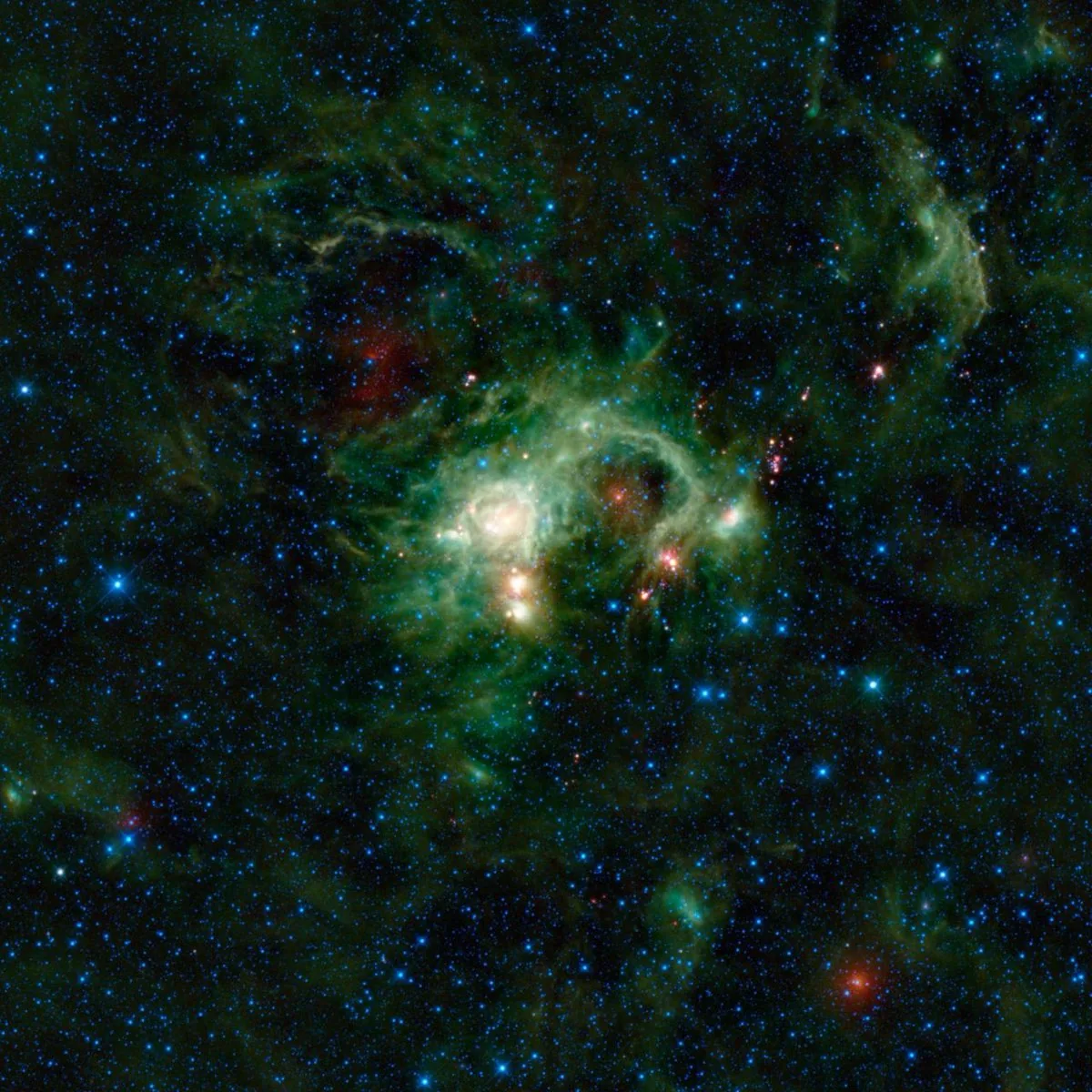
The Cosmic Evolution Early Release Science (CEERS) survey was one of JWST's first major extragalactic programs. It produced thousands of high-redshift candidate galaxies in the Extended Groth Strip, including several at photometric z > 10. Some have since been spectroscopically confirmed (with a few revised downward).
CEERS images have been widely circulated as "the new Hubble Deep Field" because they show a comparable density of galaxies at far greater distances. The blue, red, and green tracers in the CEERS color images correspond to JWST NIRCam filters at different infrared wavelengths. (JWST CEERS)
5. JADES NIRCam Survey
Telescope: JWST. Look-back time: ~13.0–13.4 billion years.
JADES is JWST's flagship deep-field program — the modern successor to the Hubble Ultra Deep Field. The survey combines NIRCam imaging across the GOODS-South and GOODS-North fields with NIRSpec follow-up of the most interesting candidates. It has so far produced dozens of confirmed z > 9 galaxies and the two record holders above.
The combined NIRCam mosaic is one of the most data-rich images ever produced of the deep universe, revealing not just point-source galaxies but resolved morphologies (disks, mergers, irregulars) at look-back times of more than 13 billion years. (NASA JADES)
6. Hubble eXtreme Deep Field (XDF) — 2012
Telescope: Hubble. Look-back time at deepest source: ~13.2 billion years.
The Hubble eXtreme Deep Field combined ten years of observations of a tiny patch within the original Ultra Deep Field — about 5,500 individual images totaling more than 22 days of exposure. The result was the deepest visible-light image of the universe at the time, reaching apparent magnitudes around 31.
The deepest confirmed objects in the XDF reach photometric redshifts around z ≈ 9–11 (later refined). Although JWST has now seen further, the XDF is still cited as a foundational image of cosmology — it was the first to reveal galaxies as they appeared less than 500 million years after the Big Bang.
The XDF image was assembled at NASA Goddard and STScI. (Hubble XDF)
7. Hubble Ultra Deep Field (HUDF) — 2004
Telescope: Hubble. Look-back time: ~13.0 billion years (deepest confirmed).
The Hubble Ultra Deep Field, observed over 11.3 days in late 2003 and early 2004, was the deepest image of the universe ever taken at the time. It revealed approximately 10,000 galaxies in a patch of sky one-tenth the apparent diameter of the full Moon.
The HUDF was the first photo to convincingly show the universe at z ≈ 7 — galaxies as they existed roughly 750 million years after the Big Bang. It transformed the public understanding of how dense the early universe was with galaxies. (NASA Hubble UDF)
8. JWST First Deep Field — SMACS 0723
Telescope: JWST. Look-back time: ~13.1 billion years (lensed).
The first full-color image released by JWST in July 2022 showed the galaxy cluster SMACS 0723 acting as a gravitational lens. The cluster's mass bent the light of background galaxies into arcs and rings, revealing some of the most distant galaxies ever observed at the time of release — out to roughly z ≈ 8.5.
It was the first public proof that JWST's optics and instruments worked as designed. The image carried enormous symbolic weight as the opening salvo of the JWST science era. (NASA JWST First Images)
9. Hubble Deep Field (1995)
Telescope: Hubble. Look-back time: ~12.8 billion years.
The original Hubble Deep Field — observed over 10 days in December 1995 by Director's Discretionary Time at the request of STScI Director Robert Williams — was the proof of concept for ultra-long exposure deep imaging. It revealed roughly 3,000 galaxies in an empty-looking patch of sky in Ursa Major and demonstrated for the first time the sheer abundance of galaxies at high redshift.
The HDF is included here because it changed how astronomy was done. Every deep field since — UDF, XDF, JADES, CEERS — owes its existence to the success of that 1995 image. The deepest confirmed objects in the HDF reach z ≈ 5–6. (Hubble Deep Field)
10. JWST Cosmic Cliffs / Pillars of Creation
Telescope: JWST. Distance: ~7,000–7,600 light-years (local universe).
The Cosmic Cliffs of the Carina Nebula and the JWST 2022 reimaging of the Pillars of Creation in M16 are not deep-field photos by redshift — they are local. We include them because they are the most-viewed JWST images, they are technically "deep" in the sense of revealing dust structure no prior telescope could resolve, and they convey what the telescope can do better than any deep-redshift number.
Cosmic Cliffs shows the edge of NGC 3324 in Carina at about 7,600 light-years. Pillars of Creation in NGC 6611 lies about 7,000 light-years away. Both are inside our own galaxy. They are iconic, but they are not what astronomers mean when they say "deep universe." (NASA JWST Carina)
Methodology / How We Ranked
We ranked by light-travel time (look-back time) to the deepest spectroscopically confirmed source in the image. Where no spectroscopic confirmation exists, we used the most reliable photometric redshift. Look-back times were computed using Planck 2018 cosmological parameters (H₀ = 67.4, Ωₘ = 0.315).
We chose look-back time over redshift directly because it is more intuitive: at z = 14, you're seeing light that left its source 13.5 billion years ago. Redshift values are noted alongside.
We excluded:
- Single-galaxy images that were not the result of a deep-field campaign.
- Press-release images where no underlying redshift was published (no scientific anchor).
- Cosmic Microwave Background images. The CMB is the deepest "photo" possible (the surface of last scattering, ~13.8 Gyr lookback) but is a thermal radiation map rather than a galactic image, and warrants its own dedicated ranking.
FAQ
What is the most distant galaxy we have ever seen? JADES-GS-z14-0, spectroscopically confirmed by JWST in May 2024 at z = 14.32. We see it as it was approximately 290 million years after the Big Bang.
Is the Hubble Deep Field still useful? Yes. The HDF and its successors (UDF, XDF) remain foundational data sets. JWST extends the redshift frontier but doesn't invalidate Hubble's optical/UV measurements — the two telescopes are complementary in wavelength coverage.
Why does redshift matter more than apparent distance? Because the universe is expanding, distance is ambiguous — different definitions (comoving, luminosity, angular-diameter) give very different numbers. Redshift is what we directly measure. Light-travel time (look-back time) is the most intuitive translation.
Can we ever see further than JADES-GS-z14-0? Yes — JWST is expected to push the record to z ≈ 16–17 within its operational lifetime. The theoretical limit before stars existed at all (the "cosmic dark ages") sits around z ≈ 20–30, and observing it would require radio facilities like the future Square Kilometre Array.
Why is JWST so much better than Hubble for deep imaging? JWST is optimized for infrared. As galaxies move further away, their light is redshifted — visible light from a z=11 galaxy arrives in the infrared. Hubble's instruments cut off in near-IR; JWST extends to mid-IR with a much larger primary mirror (6.5 m vs. 2.4 m).
Are the JADES record-holders 'firm' or could they be revised down? JADES-GS-z14-0 and -z13-0 both have NIRSpec spectroscopic confirmation, so the redshifts are firm to within standard line-fitting uncertainty. Photometric-only candidates have been revised down in the past — that's why we separate spectroscopic from photometric in the table.
Sources
- NASA JWST mission page: https://www.nasa.gov/mission/webb/
- STScI Webb releases: https://webbtelescope.org/contents/news-releases
- JADES survey: https://jades-survey.github.io/
- CEERS survey: https://ceers.github.io/
- Hubble Ultra Deep Field: https://hubblesite.org/contents/news-releases/2004/news-2004-07.html
- Hubble eXtreme Deep Field: https://hubblesite.org/contents/media/images/2012/37/3098-Image.html
- Original Hubble Deep Field: https://hubblesite.org/contents/news-releases/1996/news-1996-01.html
- Carina Cosmic Cliffs: https://www.nasa.gov/image-article/cosmic-cliffs-in-carina/
- JWST first images press release: https://www.nasa.gov/news-release/nasas-webb-delivers-deepest-infrared-image-of-universe-yet/